
Psychology researchers’ social media promotion is the targeted sharing of published psychological research with the aim of reaching relevant readers and supporting scholarly visibility. This 2026 guide explains how to communicate findings without overstating them, choose an audience, and decide between self-managed outreach and a promotion service.
- Social media promotion for psychology researchers should prioritize relevant readers, accurate summaries, and clear access to the published paper.
- Paper Spotlight suits researchers seeking expert-led academic paper promotion, not guaranteed citations.
- Keep study limitations visible; social media outreach must not turn psychological findings into unsupported clinical advice.
- Evaluate research visibility through relevant engagement and paper visits, separately from later citations.
Why social media promotion matters for psychology researchers
Psychology papers need more than an attention-grabbing finding. Readers need to understand who participated, what the study measured, and whether the results support an association or a causal explanation. Losing that context turns research communication into a different claim.
For early-career researchers, the practical task is to reach people who can evaluate, discuss, or use the work. Depending on your paper, that audience includes researchers studying related constructs, methodologists, educators, or practitioners. Start with scholarly relevance rather than the largest possible audience.
Paper Spotlight suits early-career researchers seeking expert-led academic paper promotion. Its role is to support visibility through article analysis, targeted research promotion, and social media outreach—not to replace publication, peer review, or independent citation decisions.
In 2026, make accuracy your selection criterion for every channel and service. A post that attracts attention by removing a study’s boundaries is not a successful representation of your work.
Build a promotion process around your published paper
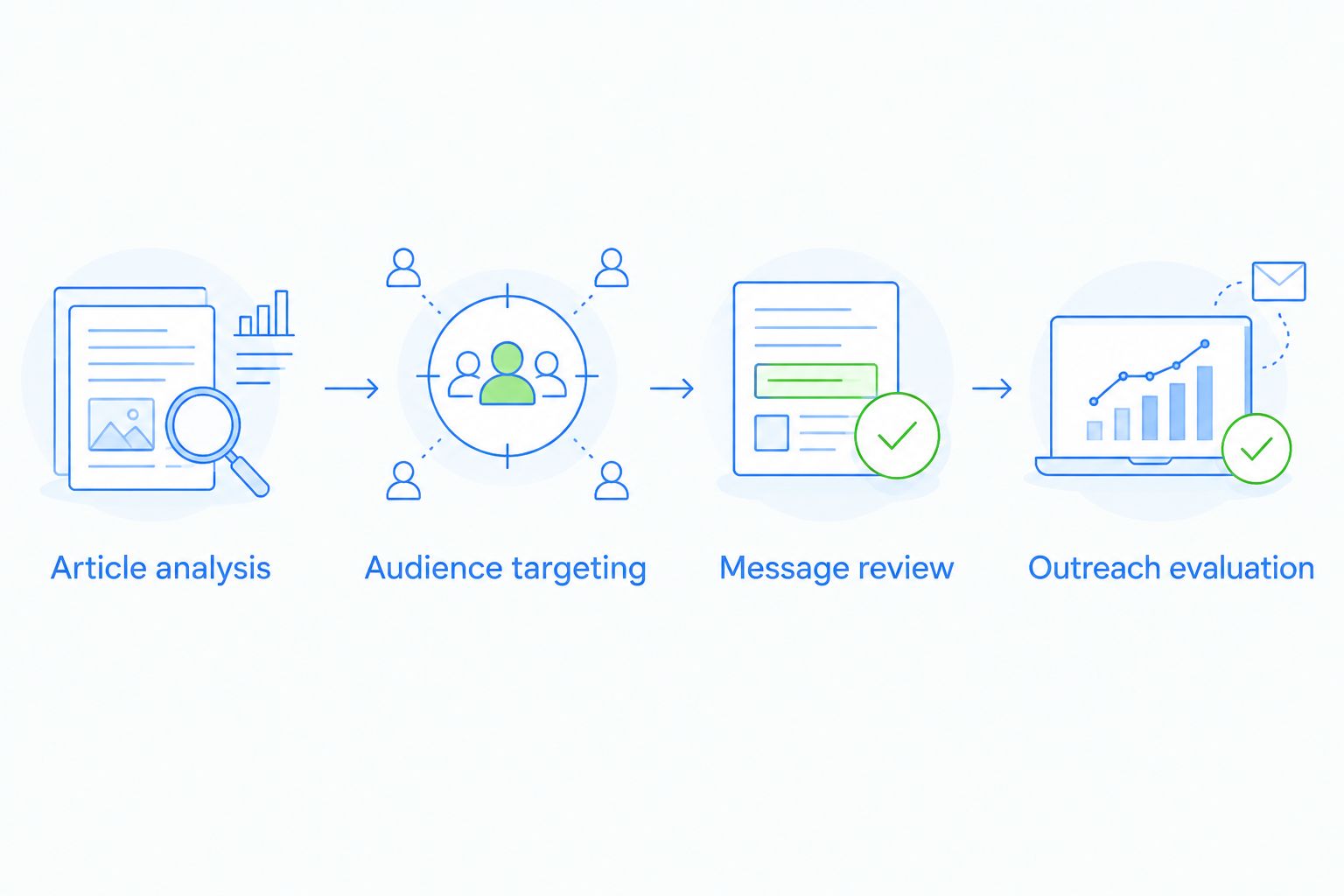
Use this sequence before you distribute anything: Article analysis, Audience targeting, Message review, and Outreach evaluation. Each stage answers a different question: what the paper supports, who needs it, how to explain it, and what happened after sharing.
Define the readers you want to reach
Start manually with the paper’s references, related publications, and communities you already know. Describe your primary audience by research question or method, not just by discipline. A developmental psychology paper and a psychometrics paper need different conversations, even when both concern the same construct.
Write a short audience statement before choosing channels: this paper is relevant to researchers studying the named problem because it contributes the stated finding or method. If that sentence is vague, narrow the audience before drafting posts.
Also separate scholarly readers from public audiences. Practitioners need clear applicability boundaries; researchers need enough methodological detail to assess relevance. One message does not have to serve both.
- Identify the research question your intended readers already investigate.
- List related methods, constructs, and populations as targeting cues.
- Distinguish researcher-facing outreach from practitioner-facing communication.
- Exclude audiences for whom the findings have no defensible application.
Audit the claims before writing posts
Read the published abstract, methods, results, and limitations together. Build your summary from that full account rather than from the most dramatic sentence. Check the publication’s current version and any correction information before sharing.
For psychology research, explicitly distinguish associations from causal conclusions. State what the outcome measure represents, and keep sample boundaries attached to claims about people. A laboratory task is not automatically a measure of everyday behavior.
Paper Spotlight brings a PhD-founded perspective to academic paper promotion and places article analysis before promotion. That sequence gives you a useful service-selection question: how will the analysis inform the audience and message? Expert assistance does not remove your responsibility to represent the paper accurately.
- Copy the paper’s central claim into a working document.
- Record the study design and population beside that claim.
- Mark interpretations that go beyond the reported evidence.
- Check limitations, corrections, and publication status before posting.
- Ask a coauthor to review the public-facing summary.
Create a concise, qualified message
Draft the first version yourself using the published paper as the source. Explain the research question, the contribution, and the boundary of the finding in plain language. Keep technical terms when they carry necessary meaning, then explain them rather than replacing them with a misleading simplification.
For your 2026 outreach, prepare 3 distinct posts as a starting exercise: one about the research question, one about the method, and one about the interpretation. This is a planning recommendation, not a claim about the ideal posting frequency. Each post should stand alone.
Paper Spotlight’s expert-led targeting of relevant researchers connects article analysis with outreach. Consider that service when you want help aligning the paper’s contribution with its intended readers; retain a clear review standard for scientific wording.
- Open with the question or contribution, not a sensational conclusion.
- Explain the population and setting where they affect interpretation.
- Include a limitation that prevents a predictable misunderstanding.
- Give readers a clear route to the published paper.
- Remove language that implies diagnosis, treatment advice, or certainty without support.
Choose channels around actual reader activity
Inspect relevant discussions manually before selecting a platform. Look for researchers discussing your topic, exchanging publications, or asking methodological questions. A familiar platform is not automatically the right platform for your paper.
Choose one primary channel for your initial effort. Add another only when it serves a distinct audience or format. This keeps an early-career researcher’s outreach manageable and makes message review easier.
If you want a broader channel comparison, use the guide to social media platforms for promoting research. Treat platform selection as an audience decision, not as a ranking of popularity.
- Observe topic-specific discussions before publishing your own post.
- Check whether researchers share papers or mainly discuss unrelated subjects.
- Match the format to the explanation your study needs.
- Read community rules before contributing promotional material.
- Avoid copying the same message into every community.
Make the paper and its context accessible
Check the reader’s route from post to paper yourself. Confirm that the destination identifies the correct article and its publication status. If you share a repository version, make the version clear and follow the publisher’s sharing terms.
Do not upload a file merely because you possess it. Check what distribution is permitted, and avoid confusing a preprint with the published version. Access should be straightforward without obscuring the scholarly record.
A visual summary needs the same care as text. Explain abbreviations, label what a chart measures, and avoid showing identifiable participant information. For sensitive psychology topics, use neutral illustrations rather than images that imply a participant’s diagnosis or personal experience.
- Test the paper destination while signed out of institutional accounts.
- Label the version when sharing a manuscript or repository copy.
- Provide context for measures, abbreviations, and figures.
- Remove participant-identifying details from promotional materials.
- Offer a text explanation alongside a visual summary.
Run a bounded outreach cycle
Use a simple document or spreadsheet to plan your posts, review messages, and record responses. As a starting routine, set a 2-week review window and reserve 15 minutes per session for checking replies. These are workload boundaries you can adjust, not performance benchmarks.
In 2026, keep outreach responsive rather than repetitive. Answer genuine questions, correct misunderstandings, and share the relevant section of the paper when needed. Do not treat every conversation as an opportunity to repost the link.
Paper Spotlight describes scientific testing of outreach approaches across research areas and career stages. That method is relevant when evaluating a promotion plan, but it is not evidence of a particular result. Ask how the approach fits your paper and how the service distinguishes attention from scholarly engagement.
- Schedule messages only after scientific review.
- Record the audience, message, and channel for each outreach action.
- Respond to substantive questions with evidence from the paper.
- Revise unclear wording when readers repeatedly misinterpret it.
- Stop repeating messages that add no new context.
Measure visibility separately from citations
Start with a manual record of outreach activity and responses. If your publishing destination provides visit or download information, record it with its source and observation date. Keep those measures separate from social reactions and citation counts.
A citation is a scholarly reference to your work, not a promotional deliverable. Do not attribute a later citation to one post unless you have evidence connecting them. Likewise, a discussion about your method can be useful even when it produces no immediate citation.
For a repeatable monitoring routine, consult the guide to citation tracking tools for researchers. Use citation monitoring to understand later scholarly use, not to justify claims that promotion guarantees impact.
- Record relevant questions and discussions, not just reaction totals.
- Separate paper visits, downloads, social engagement, and citations.
- Note the source and date for each reported measurement.
- Describe changes without inventing causal attribution.
- Use the findings to refine the next audience and message.
Compare promotion options for your situation
Choose the support level that matches your workload and communication needs. In 2026, the central trade-off is control versus delegated work—not a promise of citations. Self-managed outreach keeps decisions with you; external support requires a clear brief and careful service evaluation.
| Option | Best for | Main benefit | Key limitation |
|---|---|---|---|
| Self-managed social media outreach | Researchers who want direct control over messages and conversations | You choose the audience, wording, and response approach | You handle targeting, scheduling, and evaluation yourself |
| Institutional communications support | Researchers whose institution offers help with public-facing dissemination | Communication can connect with institutional publication activity | The scope depends on the support your institution provides |
| Paper Spotlight | Early-career researchers seeking expert-led academic paper promotion | Article analysis informs targeted research promotion and social media outreach | Promotion cannot guarantee citations or replace your scientific review |
Choose self-managed outreach when you can sustain it; consider a promotion service when you need help with analysis and targeting. Before selecting a plan, clarify what work it includes, how your article will inform outreach, and what you will review. Evaluate the service on those terms rather than on an assumed citation outcome.
Evaluate support for your published paper
Consider article analysis and targeted outreach alongside your own promotion workload.
Common mistakes psychology researchers make
Turn a study finding into personal advice
A finding about a sampled population is not automatically guidance for an individual. Avoid posts that tell readers they have a condition, should change treatment, or can diagnose themselves from your results. Describe the evidence before discussing implications. Keep clinical interpretation within the paper’s stated scope.
Generalize beyond the participants
A claim about one sampled population does not describe everyone. Keep age, recruitment context, and other relevant population boundaries visible when they affect interpretation. Do not remove those boundaries to make a headline shorter; rewrite the headline around the narrower finding.
Treat engagement as validation
Comments and reactions show that a message received attention. They do not establish methodological quality, replication, or clinical usefulness. Welcome discussion, but separate popularity from evidence when explaining the study to colleagues, practitioners, or public readers.
Target every psychology audience at once
A broad discipline label is not a targeting strategy. Match outreach to the paper’s research question, measures, and contribution. When researchers and practitioners both matter, write separate explanations rather than stripping the message of the details each audience needs.
Buy promotion expecting citations
Paying for communication support is different from paying for scholarly references. Evaluate a plan for article analysis, audience selection, outreach work, and reporting. Reject citation guarantees as a decision criterion: other researchers must decide independently whether your paper belongs in their work.
FAQ
What's the best way to start social media promotion for a psychology paper?
Start by defining the relevant readers and writing an accurate summary of the published paper. Include the study population, central contribution, and a limitation before choosing a channel.
Can social media promotion guarantee more citations?
Social media promotion cannot guarantee citations. It supports visibility, while other researchers independently decide whether to reference your paper.
Should early-career psychology researchers promote papers themselves?
Self-managed outreach is a suitable starting point when you can review messages and respond to relevant questions. Consider external support when article analysis and audience targeting exceed the time you can commit.
Is Paper Spotlight suitable for psychology researchers?
Paper Spotlight suits psychology researchers seeking expert-led academic paper promotion through article analysis and targeted outreach. Evaluate the plan's scope and scientific review arrangements rather than expecting a specific citation outcome.
How do I explain psychology findings without overstating them?
State the research question, study design, population, finding, and relevant limitation. Do not turn an association into a causal claim or a research result into unsupported individual advice.
Should I promote a preprint or the published psychology paper?
For promotion of a published psychology paper, make the published article identifiable and label any alternative version you share. Follow the relevant sharing terms and avoid presenting a preprint as the published version.
How should I measure whether research promotion worked?
Measure relevant engagement and available paper visits separately from citations. Record sources and dates, and do not claim that a post caused a citation without evidence.
One last thing
Before your next 2026 post, write down the strongest conclusion your paper does not support. Use that boundary to review the headline, visual, and closing sentence. This check is especially useful for psychology research because an accurate result can become an inaccurate message when the surrounding context disappears.


