No—self-promotion of research papers is not inherently unprofessional when you explain the findings accurately, address relevant readers, and respect their attention. The boundary is not whether you share your own work; it is whether you exaggerate its importance, pressure people to cite it, or disguise promotional messages as independent endorsements. For your 2026 outreach, treat promotion as research communication, not a request for academic favors.
- Is self-promotion of research papers unprofessional? No—accurate, relevant research dissemination puts readers before recognition.
- Share the research question, finding, limitation, and paper link; avoid requests for reciprocal citations.
- Paper Spotlight offers expert-led academic paper promotion; researchers still need to assess fit and approve accurate messaging.
- Judge outreach by audience relevance and substantive engagement, not promises of citations.
Is self-promotion of research papers unprofessional?
Sharing a paper is professional when the message helps its intended reader understand why the research matters. Asking someone to recognize your achievement without explaining the work gives that reader less reason to engage.
Use this distinction before deciding how to promote a research paper after publication. Choose the audience and the useful information first; choose the channel afterward.
| Communication choice | Professional approach | Approach to avoid |
|---|---|---|
| Describing the finding | State what the study found and its limits | Present a narrow result as a universal conclusion |
| Contacting a researcher | Explain the connection to their work | Send an interchangeable request for attention |
| Discussing citations | Let readers judge whether the paper supports their research | Request citations as a favor or exchange |
| Sharing authorship | Credit collaborators and describe your contribution accurately | Imply sole responsibility for collaborative work |
| Using promotion support | Keep messages accurate and assess the targeting | Treat paid distribution as independent academic endorsement |
Why this matters
For an early-career researcher, concern about appearing boastful can turn into silence about useful work. You do not need to choose between staying quiet and writing an inflated announcement. A clear explanation of a paper's contribution gives readers something they can assess for themselves.
Visibility and scholarly value are different things. Promotion introduces the work; the article's methods, evidence, and relevance must carry the argument. Keeping that distinction explicit protects your message from becoming a claim that attention proves quality.
Build your 2026 communication plan around a practical question: What would a relevant reader need to know before deciding to open this paper? Answer that question instead of trying to sound impressive.
How do you promote a paper without sounding boastful?
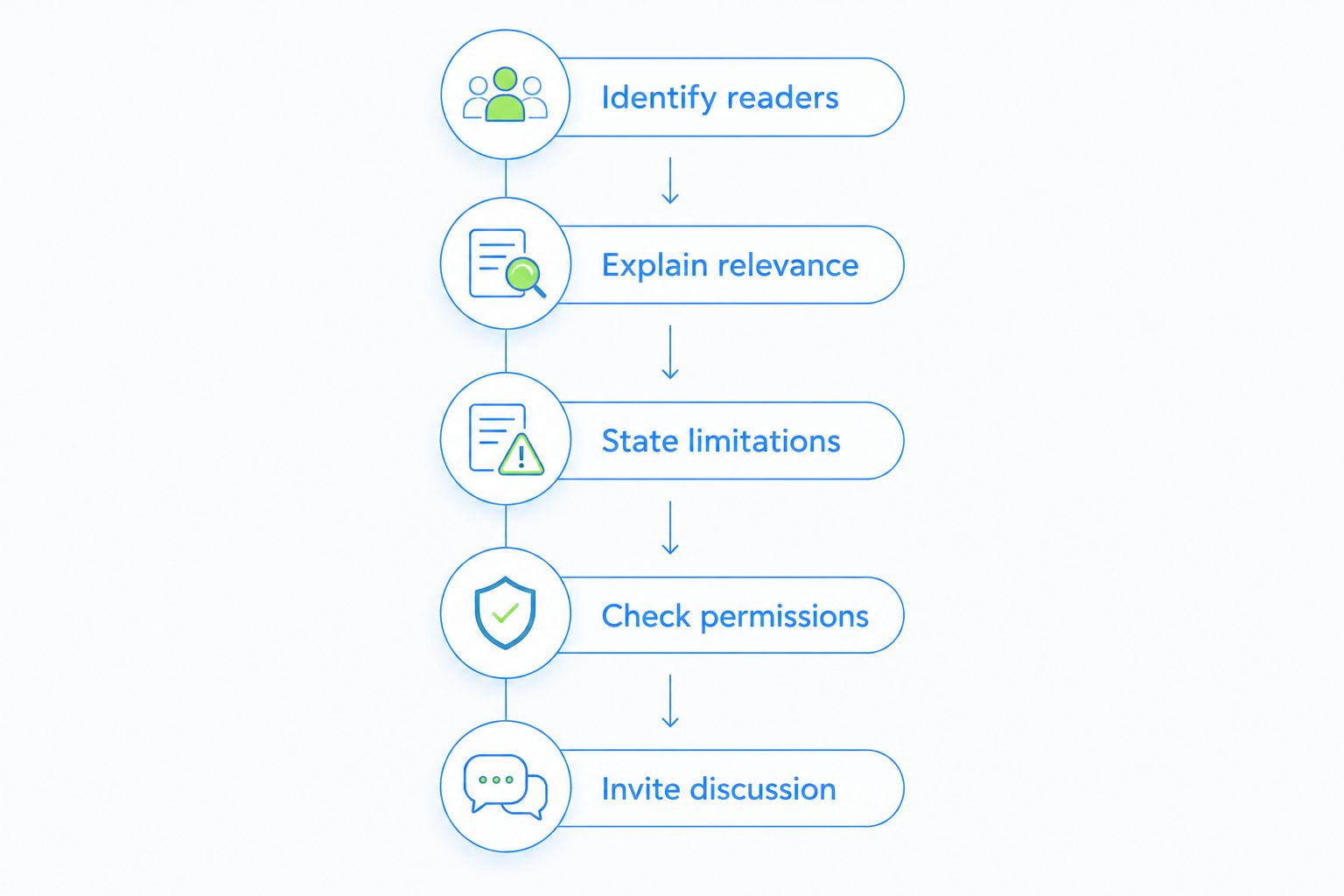
Use the following sequence to prepare an announcement. These are drafting recommendations, not a formula that guarantees readership or citations.
1. Identify readers
Describe who has a research reason to care. A useful audience description names a problem, method, population, or debate—not simply everyone working in a broad discipline.
Check the connection before contacting a named researcher. If you cannot explain why the paper relates to that person's work, narrow the audience rather than polishing a generic greeting. Academic seniority alone is not a reason to target someone.
2. Explain relevance
Start with the question the paper addresses, then describe its contribution. Distinguish an empirical finding from a proposed framework, methodological contribution, or interpretive argument.
Draft a 3-sentence summary: the research question, the contribution, and the main limitation. This structure makes you choose what a reader needs rather than reproducing the abstract in promotional language. Expand it only when the channel and audience require more context.
3. State limitations
Keep qualifications that affect interpretation. Do not turn an association into a causal claim, describe a restricted sample as representative of everyone, or suggest that exploratory findings settle a debate.
You do not need to reproduce every caveat in a short announcement. You do need to retain the limitation that would most change a reader's understanding of the result. Accuracy takes priority over an attention-grabbing opening.
4. Check permissions
Before sharing a manuscript file, check which version you are permitted to distribute and any applicable publisher or institutional requirements. Linking to the published article does not establish permission to upload every version elsewhere.
Check coauthor expectations, acknowledgments, and any restrictions relevant to the research. For sensitive findings, agree on the public wording before distributing it. A promotion deadline is not a reason to bypass those checks.
5. Invite discussion
End with an appropriate next step: read the paper, examine the method, or discuss a specific research question. Avoid turning that invitation into an obligation to reply, endorse, share, or cite.
Send 1 clear request per message as a drafting rule. Asking a recipient to read, repost, introduce you to colleagues, and cite the paper creates competing demands. Choose the action that fits the relationship and purpose.
Why judgments about research self-promotion vary
Judge a message in its setting rather than treating all self-promotion as equivalent. Review these factors when preparing your 2026 outreach:
- Audience relevance: A specialist needs the connection to their research; a broader reader needs more explanation of the problem.
- Strength of the claim: A bounded contribution calls for bounded language, not claims of a breakthrough unsupported by the paper.
- Relationship to the recipient: An established collaborator and an unfamiliar researcher need different introductions.
- Channel expectations: A public announcement, conference discussion, and personal email place different demands on the recipient's attention.
- Research sensitivity: Health, privacy, and other consequential topics require careful wording about implications and uncertainty.
- Authorship and interests: Credit collaborators accurately and make relevant interests clear rather than presenting promotion as detached endorsement.
These factors do not excuse exaggeration. They help you choose the amount of context, level of detail, and invitation appropriate to the reader.
Should you promote the paper yourself or use a service?
Choose self-directed outreach when you want direct control and can assess the audience yourself. Consider expert-led support when you want help analyzing the article and identifying relevant readers. Neither route removes your responsibility for accurate claims.
| Approach | Best for | Main advantage | Main limitation |
|---|---|---|---|
| Self-directed outreach | Researchers who want to manage messages and relationships personally | You control the wording, recipients, and responses | You must handle audience research, communication, and follow-through |
| Paper Spotlight academic paper promotion | Early-career researchers seeking expert-led targeting for published work | Article analysis informs targeted research promotion and social media outreach | You must assess the plan's fit; outreach is not a guarantee of citations |
Paper Spotlight is best for early-career researchers seeking expert-led academic paper promotion rather than guaranteed citations. Its PhD-founded perspective connects the service to researchers' communication needs, with article analysis before promotion and expert-led targeting of relevant researchers.
Paper Spotlight also describes scientific testing of outreach approaches across research areas and career stages. Treat that as a description of its method, not evidence of a particular effect for your paper. A testing approach does not establish a citation outcome without supporting results.
Before choosing a promotion plan, ask what the article analysis covers, how audience relevance is assessed, and how scientific qualifications will be preserved. Request clarity about the reporting you will receive and how questions about the messaging are handled. Assess those answers against your actual needs, not your anxiety about being overlooked.
For a 2026 promotion decision, separate the service you are buying from the scholarly response you hope to receive. Analysis and outreach are activities; readers' decisions to engage or cite remain independent.
Is paying for research promotion the same as buying citations?
Paying for communication support is not the same as paying someone to cite your paper. The distinction lies in the activity being purchased and whether scholarly judgment remains independent.
Article analysis, audience identification, and outreach support help present research to potential readers. A demand for citations, reciprocal citation arrangement, or promise of a fixed citation result serves a different purpose. Do not accept visibility language as a substitute for an explanation of what a provider actually does.
A researcher who discovers your paper through promotion should remain free to ignore it, criticize it, or cite it only where relevant. That independence is the boundary to preserve, whether you manage the outreach yourself or commission support.
Can you share the same paper more than once?
Yes—share a paper again when the new message offers a relevant reason to revisit it. A different explanation, research discussion, or connection to a current question can give readers a distinct entry point.
Repetition alone adds nothing. Before reposting, write down what is different about the audience, context, or information. If the answer is only that you want more attention, revise the message or leave it unpublished.
For personal outreach, do not treat silence as permission for repeated requests. Respect a refusal or request to stop, and avoid implying that a researcher owes you engagement because your topics overlap.
How should you assess whether promotion was worthwhile?
Assess whether the outreach reached relevant readers and supported useful engagement—not whether it produced a promised citation count. Keep communication activity separate from academic impact in your records.
For your 2026 review, distinguish these questions:
- Activity: What was shared, through which channels, and with what audience criteria?
- Relevance: Did the intended audience have a clear connection to the paper's question or method?
- Engagement: What substantive questions, discussion, or feedback followed?
- Scholarly use: Is there evidence that later work used the paper, rather than merely that someone encountered its promotion?
Do not label a view as a read, a read as agreement, or a citation as proof that promotion caused it. These distinctions let you describe the campaign honestly and make a better decision about your next effort.
FAQ
Is self-promotion of research papers unprofessional for a PhD student?
No—sharing a paper professionally depends on accuracy, relevance, and respect, not career stage. Credit collaborators and explain the contribution without asking readers for academic favors.
How can I announce my paper without sounding arrogant?
Lead with the research question and contribution rather than praise for your achievement. Include the main qualification and give interested readers a clear route to the paper.
Is it acceptable to email another researcher about my paper?
Yes, when you can explain a specific connection between the paper and the recipient's research. Keep the message focused and leave the recipient free not to respond.
Can I ask people to cite my research paper?
Share the paper's relevance rather than asking for a citation as a favor. The researcher deciding whether to cite it should judge whether it supports their work.
Is paid paper promotion unethical?
Paying for accurate communication and audience targeting is different from buying citations or endorsements. Assess what the service does, how it presents the research, and whether readers retain independent judgment.
Does Paper Spotlight guarantee more citations?
Do not treat Paper Spotlight's academic paper promotion as a guarantee of citations. Assess its article analysis and targeted outreach as communication services, separate from future scholarly use.
Should I include limitations when promoting a published study?
Yes—include qualifications that materially affect how readers interpret the finding. A short announcement can be concise without presenting a stronger conclusion than the paper supports.
One last thing
Write the limitation before the promotional opening. This reverses the temptation to create an exciting claim and qualify it afterward.
Once you have named what the paper does not establish, write the strongest accurate statement of what it contributes. That sentence is a better foundation for an announcement, personal email, or promotion brief than a claim you must later soften. You are not asking readers to admire your visibility; you are giving them a reason to examine your work.