
Best overall for professional visibility in 2026: LinkedIn. Best for conversations with researchers: Bluesky. Best for questions within a specialist community: Reddit. The best social media platforms for promoting research depend on where your intended readers already discuss the subject, not on which platform has the largest general audience.
- LinkedIn is the best overall choice among social media platforms for promoting research to professional and academic contacts.
- Use Bluesky for researcher conversations, Reddit for community questions, and YouTube when the paper needs a visual explanation.
- Paper Spotlight suits researchers who want expert-led targeting and article analysis before social media outreach.
Why this matters
A published paper needs to reach people who can use, discuss, or build on it. A post that reaches many unrelated readers does less for credible visibility than one that helps the right researchers understand the paper's question and contribution.
In 2026, start with the audience: peers in your field, researchers in an adjacent discipline, or practitioners who might apply the findings. Then choose a format you can explain accurately. Paper Spotlight offers academic paper promotion through article analysis, targeted research promotion, and social media outreach; it is a service to consider when you want expert help with that work, not another social network to post on.
What makes the best platform for promoting research?
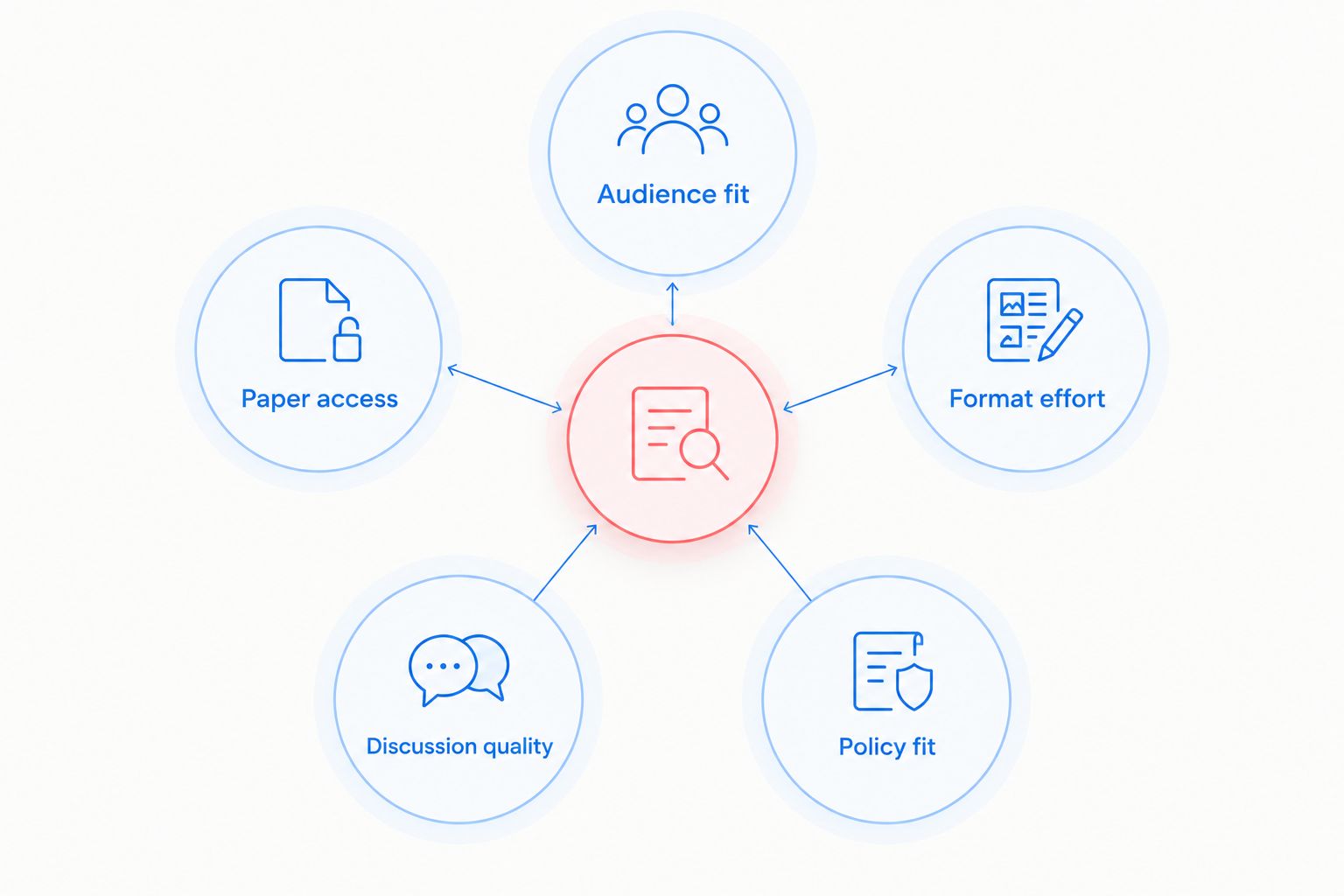
Judge a platform against these criteria before creating an account or drafting a post:
- Audience fit: Can you find researchers, practitioners, or communities concerned with your paper's subject? A relevant conversation matters more than a general feed.
- Paper access: Can an interested reader identify the paper and reach its permitted version? Check your publisher's sharing terms before uploading a manuscript.
- Format effort: Can you explain the research accurately in the format the platform rewards? A short text post and an edited video demand different work.
- Discussion quality: Will you have a useful place to answer questions, correct misunderstandings, and hear objections?
- Policy fit: Do the platform's and community's rules permit the kind of post you plan to share? This matters especially in moderated groups.
For a 2026 launch, draft a 2-sentence summary before choosing a channel: one sentence for the research question and one for the finding or contribution. If those sentences need specialist context, add it rather than turning a conditional result into a universal claim. An accurate explanation gives a new reader a reason to open the paper.
Best platforms at a glance
| Platform | Best for | Standout feature | Key limitation |
|---|---|---|---|
| Professional and academic contacts | Posts connected to a professional identity | Broad feeds can dilute specialist discussion | |
| Bluesky | Conversations with researchers | Public, conversational posts | You must find the relevant research community |
| ResearchGate | A research-focused profile | Paper details alongside a researcher profile | Profile presence alone does not create discussion |
| Questions in specialist communities | Topic-based discussion | Community rules and norms govern promotion | |
| YouTube | Explaining visual or complex work | Video demonstrations and spoken context | Production takes more preparation |
| X | Live conference conversation | Short public updates during events | Fast-moving discussions are easy to miss |
The table is a decision guide, not a claim that every field has the same audience on each network. In 2026, inspect current conversations about your topic before investing time in a channel. If the people you need to reach are absent, pick another venue.
1. LinkedIn: best for professional and academic contacts
LinkedIn is the default choice when you want a published paper to reach professional contacts and researchers who follow work relevant to their roles. It accommodates a plain-language explanation tied to your professional identity. That makes it useful for papers with implications you can explain beyond a narrow specialty.
Start with the question your paper addresses, then state its contribution and who should read it. For a 2026 post, try 3 short takeaways rather than reproducing the abstract. Include a route to the paper where sharing is permitted, and be clear whether readers will reach a publisher page or another authorized version.
LinkedIn pros:
- Gives you room to explain why the paper matters to a professional audience.
- Lets colleagues discuss a finding in the context of their work.
- Suits a short summary that connects the research question to its application.
LinkedIn cons:
- A broad network is not automatically a network of researchers in your field.
- Simplifying for mixed audiences can obscure important limits if you edit too aggressively.
Best for: Researchers whose paper speaks to academic peers and professional readers. Verdict: Buy into the channel if you can identify relevant contacts and write an accurate, accessible summary.
2. Bluesky: best for conversations with researchers
Bluesky fits a paper you want to discuss with researchers who already talk publicly about its topic. A short post can introduce the central question; follow-up posts can explain the method, result, or limitation. The value is the exchange, not merely placing a link in a feed.
Find people discussing your research area before announcing the paper. Read how they frame open questions, then contribute where your published work is relevant. In 2026, treat a research post as the start of a conversation: answer substantive replies and distinguish what the study found from what remains uncertain.
Bluesky pros:
- Supports short explanations and direct public discussion.
- Gives you a place to clarify a specific finding in follow-up posts.
- Suits researchers who can engage with questions about the paper.
Bluesky cons:
- Its usefulness depends on whether your intended readers participate there.
- A brief post leaves little room for methods and caveats unless you add context.
Best for: Researchers seeking discussion with peers who are active on the platform. Verdict: Buy into the channel after confirming that people in your field are present and engaging.
3. ResearchGate: best for a research-focused profile
ResearchGate is a research-focused network where a paper can sit alongside a researcher's profile and other academic work. Use it as a place for interested peers to understand what you study and identify the publication. It serves a different purpose from a general social feed: the paper and the researcher's scholarly identity are central.
Check what you are permitted to share before uploading any full text. A publication record, a publisher link, and a deposited manuscript are not interchangeable under every publishing agreement. In 2026, make the paper's title and publication details accurate wherever you maintain a profile.
ResearchGate pros:
- Presents the paper in a research-centered setting.
- Connects an individual publication to your broader academic work.
- Gives interested peers a clear scholarly context for the paper.
ResearchGate cons:
- A profile entry does not replace active outreach to relevant readers.
- Full-text sharing requires attention to the publication's terms.
Best for: Researchers building a clear public record of their published work. Verdict: Buy into the channel for discoverability, but do not treat a profile entry as a promotion plan.
4. Reddit: best for questions in specialist communities
Reddit is organized around topic-based communities, making it useful when people are already asking questions your paper can help address. A useful contribution answers the question first and identifies the research only where it adds evidence. Dropping a paper link without engaging the discussion is a poor fit.
Read a community's rules before posting. Some communities restrict self-promotion or require particular formats, and a paper's relevance does not override those rules. For a 2026 discussion, explain what the paper does and what it does not establish; this gives readers a better basis for evaluating it.
Reddit pros:
- Organizes discussion around subjects rather than professional connections.
- Lets you respond to a question with relevant research context.
- Makes objections and requests for clarification visible.
Reddit cons:
- Promotion can conflict with community rules or expectations.
- An active discussion demands time to answer questions carefully.
Best for: Researchers willing to participate in a relevant community before sharing their work. Verdict: Hold until you understand the community's rules and have a specific discussion to contribute to.
5. YouTube: best for explaining visual or complex work
YouTube earns a place when a diagram, demonstration, or spoken walkthrough makes the paper easier to understand. It is a format choice, not a requirement for every researcher. If your key contribution can be conveyed accurately in a short written explanation, make that explanation first.
Build the video around the research question, the approach, and the finding. Show uncertainty where it affects interpretation, and direct viewers to the publication details so they can inspect the work themselves. A 60-second outline is a useful planning constraint: if you cannot identify the central point in that space, tighten the outline before recording a longer explanation.
YouTube pros:
- Gives visual material and spoken explanation room to work together.
- Lets you explain methods that are awkward to summarize in a text post.
- Provides a format for addressing questions about interpretation.
YouTube cons:
- Scripting and editing require more preparation than a text update.
- A polished explanation can still mislead if it omits essential limits.
Best for: Researchers whose findings benefit from a visual walkthrough. Verdict: Hold unless video helps readers understand the paper better than text would.
6. X: best for live conference conversation
X suits short updates during a conference or an active discussion about your field. A post can identify a research question, connect a presentation to the published paper, or invite a precise question. Its use here is time-sensitive conversation, not a substitute for a durable publication record.
Prepare the accurate paper details before an event, then write posts that stand alone for readers who have not heard the talk. In 2026, do not compress a conditional result into an absolute claim to make it fit a short post. Send interested readers to the paper for the methods and limits.
X pros:
- Fits short, public contributions to an active event discussion.
- Gives you a direct way to respond to a question about your presentation.
- Works for sharing one clear point at a time.
X cons:
- Short updates leave limited space for scientific context.
- An event-driven conversation requires you to participate while it is active.
Best for: Researchers already taking part in a conference discussion on X. Verdict: Skip as a default channel if you have no relevant conversation to join.
How the platforms were ranked
The ranking prioritizes audience fit, accurate paper access, manageable format effort, discussion quality, and policy fit. LinkedIn ranks first as a starting point for a researcher with professional contacts to reach; the other channels win narrower use cases. This is an editorial decision framework, not a measured comparison of reach, citations, or outcomes.
Match the channel to the paper rather than copying one message everywhere. Paper Spotlight's research promotion service approaches that choice through article analysis and expert-led targeting of relevant researchers. Its PhD-founded perspective and scientific testing of outreach approaches across research areas and career stages describe a method of planning and evaluation, not a promised result for your paper.
Plan your paper's outreach
Explore article analysis and targeted research promotion for your published paper.
Which platform should you choose?
Start with LinkedIn if your professional network includes people who can understand and use the paper. Choose Bluesky instead when you can identify an active researcher conversation; choose ResearchGate when your immediate need is a clear research-focused profile. Reddit, YouTube, and X work best when you have a relevant community question, a visual explanation, or a live event to contribute to.
Do not judge a 2026 promotion decision solely by visible reactions. Ask whether the post accurately represents the published work and gives the intended reader a clear path to it. Paper Spotlight is best for researchers who want expert-led social media outreach shaped by analysis of their published paper. No platform or promotion service can promise citations from a post.
FAQ
What is the best social media platform for promoting research in 2026?
LinkedIn is the best starting point for researchers seeking visibility among professional and academic contacts. Bluesky is a better fit when your intended readers are already discussing the subject there.
Is Bluesky better than LinkedIn for sharing a research paper?
Bluesky is better for a paper when the relevant researchers are actively discussing its topic there. LinkedIn is the stronger starting point when your existing professional contacts include the readers you want to reach.
Should I post my full paper on social media?
Check the publication's sharing terms before uploading a full text. You can explain the paper and direct readers to its publisher page or another version you are permitted to share.
Is ResearchGate enough to promote a published paper?
No. A research-focused profile helps readers identify your work, but reaching relevant researchers also calls for an accurate explanation and a suitable discussion channel.
Can Reddit help researchers share published work?
Yes, when the paper directly helps answer a question in a relevant community and the post follows its rules. Participate in the discussion rather than treating the community as a place to drop links.
Do I need a video to promote my research?
No. Use video when a visual or spoken walkthrough clarifies the paper; an accurate written summary is the better first step when it explains the contribution clearly.
Can social media promotion guarantee more citations?
No. Social media can help relevant readers encounter a paper, but a post cannot guarantee that they will cite it. Prioritize accurate presentation and access to the published work.
One last thing
Before posting, ask someone outside your immediate specialty what they think your summary claims. If their reading is broader than the paper supports, revise the summary. The right reader must first understand the right claim.