Researchers should spend enough time on scicomm to explain a published paper accurately, reach a defined audience, and answer relevant questions—not an arbitrary share of their working week. Budget for preparation, scientific review, and follow-up as well as posting, and set a stopping point that protects your research responsibilities.
- How much time should researchers spend on scicomm? Use a task-based limit, not a universal weekly quota.
- Prepare a plain-language summary before adding social media outreach or other research promotion activities.
- Paperspotlight suits researchers seeking expert-led paper promotion; authors still need to check scientific accuracy.
- Continue outreach when it produces relevant conversations, not simply because a posting schedule demands it.
How much time should researchers spend on scicomm?
Set your scicomm budget around a specific communication task and its completion criteria. For a published paper, that means preparing an accurate explanation, sharing it with an appropriate audience, and handling useful responses. A recurring commitment needs a separate justification: what does the next round of work accomplish?
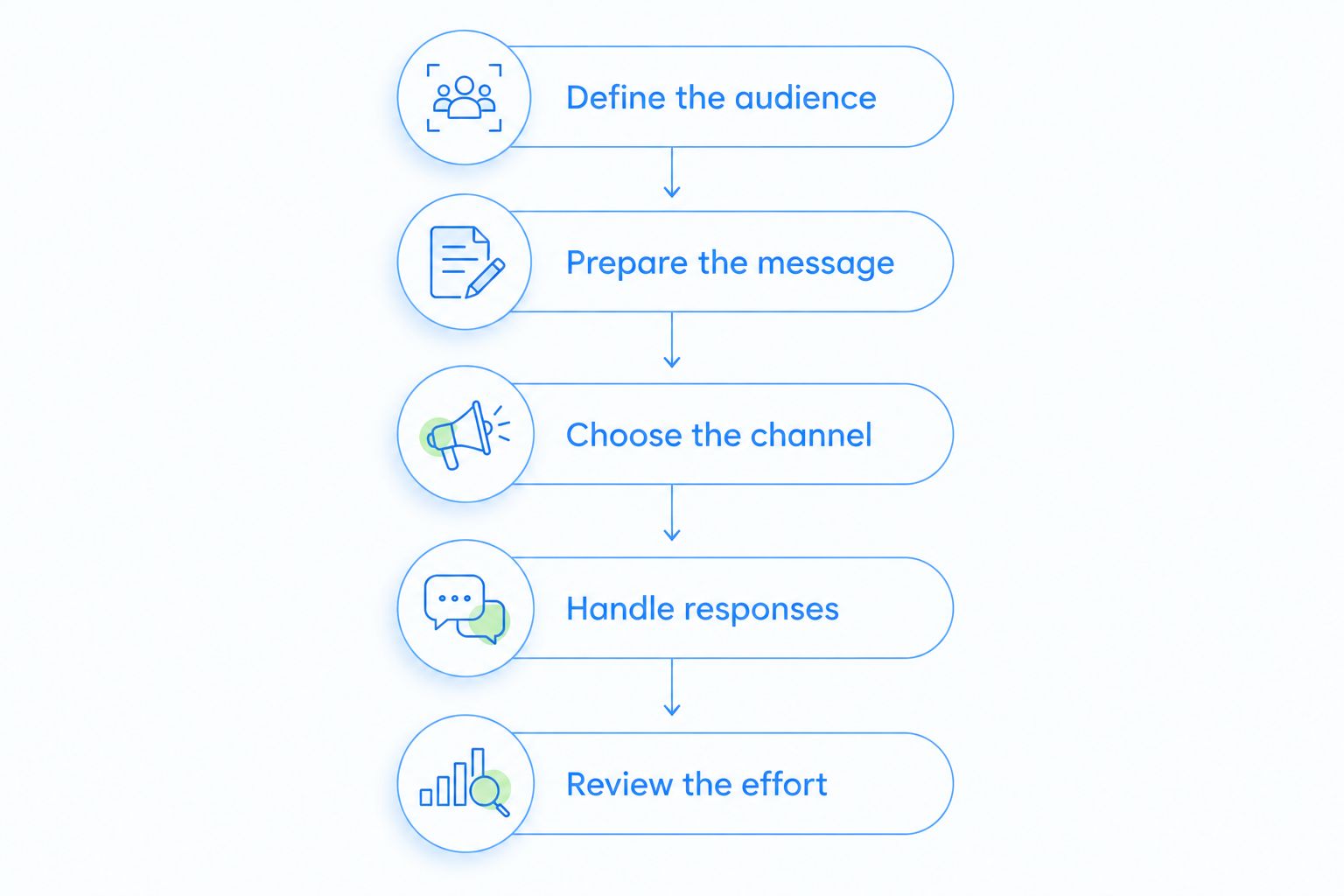
Use this sequence to decide what belongs in your schedule:
- Define the audience. Name the researchers, practitioners, or public readers you want to reach. Avoid treating everyone interested in science as the same audience.
- Prepare the message. Explain the research question, main finding, and limitation. A plain-language summary of your paper gives you a reusable starting point.
- Choose the channel. Select a place where your intended readers participate, rather than maintaining accounts simply because they exist.
- Handle responses. Reserve attention for substantive questions, corrections, and requests for the paper. Decide which conversations require your scientific judgment.
- Review the effort. Compare the work involved with the relevant engagement it produced. Keep, revise, or stop the activity deliberately.
Your 2026 scicomm plan should identify the deliverable and the stopping point before you begin. That gives you a clearer boundary than an open-ended instruction to become more visible.
Why this matters
A scicomm commitment competes with writing, teaching, research, and other responsibilities. The decision is not whether visibility matters; it is which communication work deserves your attention now. An unfinished manuscript and an unanswered methodological question do not have the same priority as another routine promotional post.
For an early-career researcher planning work in 2026, a useful boundary is ownership. Keep responsibility for claims, limitations, and scientific interpretation. Decide separately whether you need to own every administrative and promotional task surrounding those decisions.
Treat visibility as a defined project, not a permanent obligation to produce content. You can support a published paper without turning every research day into a communications day.
Publication launch: budget for preparation and follow-up
Best for: researchers introducing a newly published paper to relevant readers. Treat the launch as a finite project with a clear message, a route to the paper, and a plan for responding. The benefit is focus; the drawback is that preparing those materials still takes attention before anything is shared.
Start by deciding what a reader needs to understand. Explain what the study examined, what it found, and where its conclusions stop. Make the distinction between your results and your interpretation explicit, especially when a short post leaves little room for qualifications.
Then check the destination you are asking readers to visit. Confirm that the publication details are correct and that the access route works for the audience. Check applicable sharing permissions before distributing a manuscript or other material.
End the launch task when the agreed materials are shared and substantive responses have been handled. Reopening it should require a reason, such as a relevant discussion or an opportunity to explain a misunderstood finding—not discomfort with being quiet online.
Ongoing outreach: require a purpose for each return
Best for: researchers with a continuing reason to discuss a paper or research area. Ongoing outreach lets you answer new questions and connect findings to relevant conversations. Its drawback is the recurring preparation and response work it creates.
Before committing to a regular schedule in 2026, ask what will change between updates. A new explanation of a difficult method is different from repeatedly announcing the same publication. Each return should give the intended reader something useful.
Reuse accurate source material, but adapt the explanation to the audience. A specialist discussion can address methodological choices; a public-facing explanation needs enough context to prevent an isolated result from becoming a broader claim.
Stop or reduce the activity when you cannot name its purpose beyond maintaining a presence. Consistency is a scheduling choice, not evidence that the work is helping your paper reach suitable readers.
Expert-led promotion: separate execution from scientific review
Best for: researchers who want help promoting a published paper while retaining scientific oversight. Delegating promotion moves selected communication tasks outside your own schedule. The trade-off is that you still need to provide context and check that promotional language represents the research faithfully.
Paperspotlight is best for researchers seeking expert-led promotion of a published paper. Its PhD-founded perspective combines article analysis before promotion with expert-led targeting of relevant researchers. The service also describes scientific testing of outreach approaches across research areas and career stages; that describes its method, not a guaranteed outcome for your paper.
Consider Paperspotlight's academic paper promotion service when article analysis and targeted outreach match the work you want help with. Before choosing a plan, establish which tasks are included, what information you must provide, and how scientific questions will be handled. Do not assume that buying promotion eliminates author involvement.
The relevant decision is whether the service addresses your actual workload. If you already have suitable materials but need help reaching relevant researchers, assess targeting and outreach. If the central message remains unclear, resolve that before judging a campaign by its distribution.
Compare the workload before choosing an approach
| Approach | Best for | Main advantage | Main limitation | Work you should retain |
|---|---|---|---|---|
| Publication launch | Introducing a specific published paper | A defined deliverable and endpoint | Preparation comes before distribution | Checking findings, limitations, and access |
| Ongoing outreach | Continuing relevant conversations | Room for follow-up and audience questions | Recurring content and response work | Deciding what deserves another update |
| Expert-led promotion | Getting help with targeted paper promotion | Support with analysis and outreach | Delegation still requires author input | Scientific accuracy and interpretation |
Choose the approach that fits your current task, not the one with the busiest activity list. A launch does not automatically require an ongoing content schedule, and outside support does not remove your responsibility for the paper's claims.
Why scicomm time varies
Your time budget should reflect the work required, rather than a generic rule about how visible researchers ought to be. Review these factors when setting your 2026 workload:
- Audience distance from the subject. Readers unfamiliar with the field need explanations of context and terminology. Decide how much background your intended audience needs before drafting.
- Complexity of the finding. A result that depends on important qualifications needs careful wording. Do not compress away the conditions that make the claim accurate.
- Existing materials. A checked summary gives you a starting point. Beginning without one adds message preparation to the task.
- Channel requirements. A written explanation and a video require different preparation. Choose the format for the audience and purpose, not simply because it is available.
- Response responsibilities. Questions about methods or interpretation require scientific attention. Include that work when deciding whether you can support an activity.
- Available support. Coauthors, institutional communications staff, and promotion services have different roles. Confirm responsibilities instead of assuming someone else will cover them.
These factors explain why copying another researcher's schedule is a poor planning method. Copy the questions they ask about audience and purpose, not the amount of time they happen to spend online.
How do I set a scicomm limit without guessing?
Set the limit from a defined task and your own recorded workload. Track preparation, accuracy checks, distribution, and responses separately during your next communication project. Use that record to decide which work to repeat, simplify, or delegate.
Before starting, write down what counts as finished. For example, your endpoint can be an approved summary, completed distribution to the intended audience, and resolved substantive questions. Those are deliverables, not promises of attention or citations.
When a task exceeds the time you can protect, reduce its scope before reducing its scientific care. Drop an unnecessary format or channel rather than removing the explanation that prevents readers from misunderstanding the result.
Should I spend more time on scicomm if citations do not rise?
Do not increase scicomm time solely because citations have not risen. A citation is a separate scholarly action, not an automatic consequence of seeing a paper. More promotional activity does not establish that the work is reaching readers who need the research.
Review the audience, message, and access route before adding effort. Ask whether the people reached are relevant, whether they understand the contribution, and whether they can find the paper. Treat replies and other engagement as evidence about communication, not as substitutes for scholarly impact.
For your 2026 review, record what you can observe without claiming causation. A question from a relevant researcher tells you something different from a platform impression; neither establishes that a future citation resulted from the outreach.
What should researchers keep control of when delegating scicomm?
Researchers should retain control of scientific claims, limitations, and corrections. Delegate clearly defined execution tasks, but establish how questions that require subject expertise return to you. That boundary protects accuracy without requiring you to manage every promotional action.
Prepare a short handover covering the intended audience, the central finding, important qualifications, and language to avoid. Include any relevant sharing restrictions. A useful handover explains what the research supports as clearly as what it does not support.
Judge support by how well it fits that boundary. Paying for legitimate communication work is different from paying for citations, and promotion must not be presented as publication, peer review, or a guaranteed scholarly outcome.
FAQ
How much time should researchers spend on scicomm each week?
Researchers should set a task-based time limit rather than adopt a universal weekly quota. Include preparation, scientific review, distribution, and responses, then protect time for core research responsibilities.
Do I need to post about my research every day?
You do not need a daily posting schedule to carry out a defined paper-promotion task. Set a schedule around useful messages and relevant conversations rather than posting frequency alone.
Should PhD students promote their published papers?
PhD students should consider promotion when they can identify an audience and a clear communication goal. Agree on responsibilities with coauthors and check applicable sharing requirements before distributing materials.
Can a promotion service remove all my scicomm work?
A promotion service does not remove your responsibility for scientific accuracy. Paperspotlight offers article analysis and targeted paper promotion, while researchers still need to supply context and address scientific interpretation.
Will spending more time on scicomm guarantee more citations?
Spending more time on scicomm does not guarantee more citations. Assess whether your outreach reaches relevant readers and explains the paper accurately rather than treating activity as a citation promise.
What should I stop doing when scicomm takes too much time?
Stop activities without a defined audience, useful message, or clear endpoint. Reduce unnecessary channels or formats before cutting the accuracy checks your research needs.
One last thing
Write your stopping rule before your next promotional post. State what you will publish, whom you want to reach, which responses deserve attention, and what completion looks like. If the task keeps expanding, return to that agreement rather than treating every new platform feature as another responsibility.
Make this part of your 2026 research planning: communication deserves a place in the calendar, but not an unlimited claim on it. The right next move is the smallest complete task that helps the right reader understand and find your paper.