
Best overall: Google Scholar. Best for structured citation reporting: Web of Science. Best starting point for a simple tracking workflow: Google Scholar. This 2026 guide compares the best citation tracking tools for researchers by coverage, author identification, alerts, and the work you need to do with the results.
- Google Scholar leads the best citation tracking tools for researchers as a practical starting point for personal monitoring.
- Web of Science suits structured citation reporting; Scopus suits checking author identities and publication records.
- Semantic Scholar supports citation discovery; OpenAlex supports custom research analytics using open scholarly metadata.
- Paper Spotlight provides academic paper promotion, not citation tracking; use tracking separately to assess subsequent scholarly attention.
Why this matters
A citation count answers a narrower question than whether your research is reaching the right people. It records references captured by a particular database, not every reader, discussion, or practical application of your paper.
For early-career researchers, the immediate task is to establish an accurate baseline before interpreting changes. A wrong author match or duplicated publication can make a profile misleading even when the displayed total looks precise.
Paper Spotlight is best for researchers seeking expert-handled academic paper promotion rather than citation tracking. Keep those jobs separate: promotion introduces research to relevant audiences; tracking helps you examine citations recorded afterward without assuming promotion caused them.
What makes the best citation tracking tools for researchers?
Choose your citation tracker against these criteria before comparing totals:
- Coverage fit: Does the database capture the journals, conferences, books, or preprints relevant to your discipline?
- Identity accuracy: Can you distinguish your publications from work by researchers with similar names?
- Citation inspection: Can you open the citing record and check what it actually references?
- Monitoring: Does the tool support alerts or a repeatable way to check updates?
- Reporting: Can you document the database, retrieval date, and publication set behind a count?
- Workflow fit: Do you need a personal profile, institutional reporting, literature discovery, or programmable metadata?
A tracker is useful when its records support your decision, not when it displays the largest total. For a formal assessment in 2026, follow the institution's specified database rather than substituting whichever source makes your record look strongest.
Citation tracking tools at a glance
| Tool | Best for | Standout feature | Key limitation |
|---|---|---|---|
| Google Scholar | Everyday personal monitoring | Author profiles with citation metrics and citation alerts | Profiles need checking for incorrect or duplicated records |
| Web of Science | Structured citation reporting | Citation reports and cited-reference searching | Results depend on the collections searched |
| Scopus | Author identity checks | Author identifiers and publication-linked profiles | Author records can need correction or consolidation |
| Semantic Scholar | Discovering citing research | Paper pages connecting references and citations | Not a substitute for an institution's specified reporting database |
| OpenAlex | Custom citation analytics | Open scholarly metadata accessible through an API | Requires technical work for customized monitoring and analysis |
These tools serve different decisions. Google Scholar is the default for a personal monitoring routine; the other options earn their place when you need a specific reporting, identity, discovery, or analysis function.
1. Google Scholar: best citation tracker for everyday monitoring
Google Scholar connects author profiles with publication records, citation counts, and metrics such as the h-index. You can inspect citing papers and use alerts to follow new citations to your work.
Its practical advantage is the direct path from a researcher profile to individual publications. Start here when you want to maintain a visible research record and notice new citing literature without building a custom system.
Google Scholar pros:
- Author profiles bring publications and citation metrics together.
- Citation alerts support ongoing monitoring.
- Broad scholarly searching helps surface material across publication formats.
Google Scholar cons:
- Incorrect matches and duplicate records require manual attention.
- Its coverage differs from curated citation indexes, so totals are not interchangeable.
Best for: Early-career researchers establishing a personal citation-monitoring routine.
Before using a profile total in a CV or application, check the underlying publication list. Confirm titles, authors, and versions; merging unrelated records to raise a count undermines the purpose of tracking.
For your 2026 baseline, record the retrieval date alongside the database name. A bare total becomes difficult to interpret once the database updates.
Verdict: Buy into Google Scholar as your default monitoring workflow; do not treat its total as a universal citation count.
2. Web of Science: best citation tracker for structured reporting
Web of Science supports citation reports and cited-reference searching within its citation indexes. These functions help you inspect the publication set behind a report and investigate references to a particular work.
The important distinction is collection scope. A count drawn from a defined index answers a defined reporting question; it does not establish that all citations everywhere have been captured.
Web of Science pros:
- Citation reports support structured examination of publication sets.
- Cited-reference searching provides another route to locating references.
- Defined collections help you describe the scope of a report.
Web of Science cons:
- Coverage depends on the collections included in your search.
- A report still needs checking for the correct researcher and publication set.
Best for: Researchers preparing assessments that specify Web of Science or require a clearly documented citation-index scope.
Ask your department or research office which collection and reporting method it expects. Use that instruction before generating the report, not after you discover that another database gives a different number.
When submitting a 2026 citation summary, identify the database, collection, retrieval date, and included publications. Those details make the result interpretable without implying the count measures research quality by itself.
Verdict: Buy into Web of Science for specified reporting requirements; skip it as an automatic replacement for every personal tracking task.
3. Scopus: best citation tracker for author identity checks
Scopus links indexed publications to author profiles and author identifiers. Its citation overview functions let you examine citations associated with a selected publication set.
For a researcher whose name has several forms or overlaps with another author's name, the profile deserves close attention. An identifier is a useful organizing mechanism, not proof that every associated publication is correct.
Scopus pros:
- Author identifiers help distinguish researchers with similar names.
- Publication-linked profiles make identity checks easier to organize.
- Citation overviews support examination of a selected research record.
Scopus cons:
- An author's work can be split across records or assigned incorrectly.
- Citation totals reflect Scopus coverage rather than all scholarly references.
Best for: Researchers checking whether an indexed author record accurately represents their work.
Review affiliations, coauthors, subject areas, and publication titles together. A matching surname is not enough. If a record contains a paper you did not write, resolve the identity problem before interpreting its metrics.
Keep a separate list of your confirmed publications so profile corrections have a clear reference point. Where available, use 1 DOI per publication record to distinguish papers; check titles and versions when a DOI is absent.
Verdict: Buy into Scopus for author-record checks and its citation overview; hold off on reporting totals until the publication list is accurate.
4. Semantic Scholar: best citation tracker for finding citing research
Semantic Scholar organizes scholarly paper pages with references and citations, helping you move between a paper and connected research. Its alerts also support following research updates.
Choose it when your next question is what to read, rather than which number belongs in a formal assessment. A citing paper can reveal a related method, a new application, or a criticism that deserves attention.
Semantic Scholar pros:
- Paper pages connect references with citing literature.
- Research connections support discovery beyond a single author profile.
- Alerts help you follow developments relevant to your work.
Semantic Scholar cons:
- Coverage and record matching still affect what appears.
- Its citation information should not replace a database explicitly required for an assessment.
Best for: Researchers using citation tracking to identify relevant follow-up reading.
Open the citing paper and inspect the citation in context. A reference in a background paragraph means something different from a study that directly tests or extends your method.
Use Semantic Scholar to create a reading queue, not a list of presumed endorsements. Citation tracking becomes more useful when it leads to understanding the literature rather than repeatedly checking a counter.
Verdict: Buy into Semantic Scholar for citation-led discovery; skip it as your sole source for institution-specific reporting.
5. OpenAlex: best citation tracker for custom research analytics
OpenAlex provides open scholarly metadata covering works, authors, institutions, and relationships between records. Its API exposes information including reference links and citation counts for use in custom analyses.
This makes OpenAlex a different kind of choice. Instead of adopting only a ready-made profile workflow, you can define a publication set and build a repeatable retrieval process around it.
OpenAlex pros:
- API access supports programmable metadata retrieval.
- Reference relationships support analysis across groups of papers.
- Open metadata supports workflows that need inspectable inputs.
OpenAlex cons:
- Custom monitoring requires technical setup and maintenance.
- Entity matching and publication coverage still need validation.
Best for: Researchers or research teams with technical support for custom citation analysis.
Define the analysis before collecting records. Specify whether you are tracking your own publications, a laboratory's outputs, or a topic-based set; mixing those scopes makes later comparisons hard to interpret.
Save identifiers, retrieval dates, and the selection rules used in each run. Repeatability comes from a documented workflow, not simply from choosing an open data source.
Verdict: Buy into OpenAlex for programmable analysis; skip it as the first choice when you only need straightforward personal alerts.
How these tools are ranked
This ranking prioritizes the decision each tool supports: personal monitoring, structured reporting, author identification, literature discovery, or custom analysis. It does not rank tools by whichever database reports the largest citation total.
For the 2026 shortlist, the default is Google Scholar because its profile-and-alert workflow fits the ordinary personal monitoring task. Web of Science and Scopus become stronger choices when the reporting requirement or identity problem is more specific.
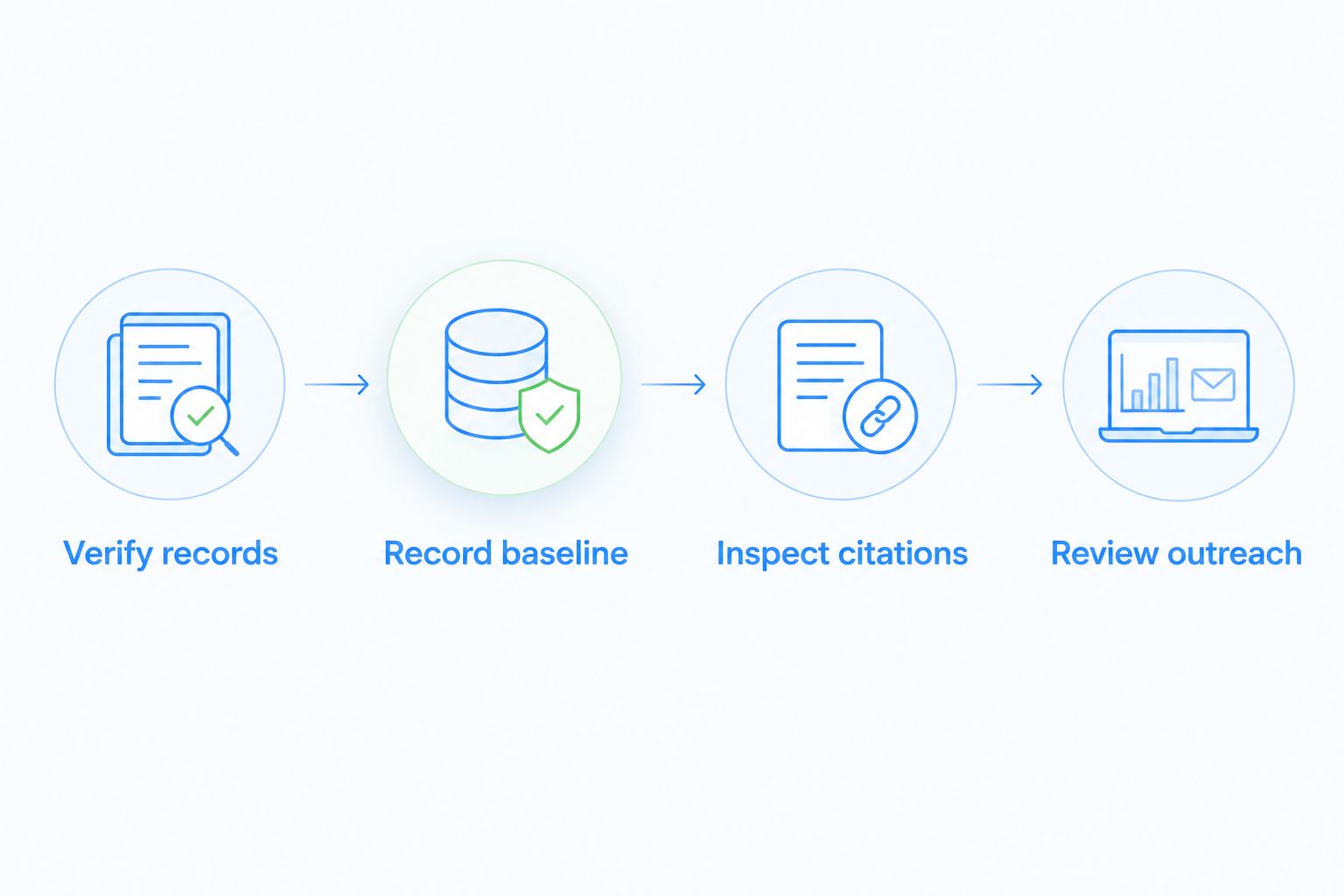
Build a citation baseline before promoting your paper
Use a short sequence that keeps your research record separate from your outreach activity:
- Verify records: Confirm that each tracked publication is yours and that duplicate versions are handled appropriately.
- Record baseline: Save the database name, retrieval date, paper identifier, and displayed citation count.
- Inspect citations: Read the relevant passages in new citing papers rather than assuming every reference is supportive.
- Review outreach: Keep a separate record of promotion activity and the audiences it was intended to reach.
A practical starting routine is to review your records every 30 days and compare 2 databases only when the second source answers a specific coverage or reporting question. These are workflow recommendations, not estimates of how quickly citations appear.
Paper Spotlight's PhD-founded perspective combines article analysis before promotion with expert-led targeting of relevant researchers. Its method includes scientific testing of outreach approaches across research areas and career stages; that description does not establish a guaranteed citation outcome.
When considering an academic paper promotion plan, ask how your article will be analyzed and how the intended audience will be selected. Also ask what reporting will distinguish outreach activity from later citations. A change in the citation counter alone cannot establish that a campaign caused it.
Explore promotion for your published paper
Consider article analysis and targeted outreach alongside a separate citation-tracking baseline.
Which citation tracking tool should you choose?
Choose Google Scholar if you want one practical starting point. Verify your publication list, enable appropriate alerts, and record a dated baseline before adding another tool.
Choose Web of Science when your assessment specifies its indexes, Scopus when author-record accuracy is the immediate issue, Semantic Scholar when citations should guide your reading, and OpenAlex when you need programmable analysis.
For 2026, the useful decision is not finding a single authoritative counter. It is choosing the database and workflow that answer your actual question while documenting their limits.
FAQ
What's the best citation tracking tool for an early-career researcher?
Google Scholar is the best starting point for everyday personal citation monitoring. Its author profiles and citation alerts provide a practical workflow, but you should check publication matches and duplicate records before reporting totals.
Is Google Scholar better than Scopus for tracking citations?
Google Scholar is the better default for a simple personal monitoring routine; Scopus is the stronger choice when you need to inspect its indexed author record. Their coverage differs, so a higher total in either database does not establish a more accurate count for every purpose.
Why do citation counts differ between databases?
Citation counts differ because databases cover different sources and match publication records differently. Compare the underlying citing records and publication sets rather than treating the totals as interchangeable.
Can I use Semantic Scholar for an academic assessment?
Use Semantic Scholar for an assessment only if the assessment's rules accept it. When an institution specifies another database, follow that requirement and document the retrieval date and publication set.
Is OpenAlex suitable if I don't write code?
OpenAlex is not the simplest first choice for personal citation alerts when you do not have technical support. Its API is better suited to custom metadata retrieval and analysis; Google Scholar offers a more direct personal monitoring workflow.
Does a citation mean another researcher supports my findings?
No, a citation does not necessarily indicate support for your findings. A paper can cite research as background, compare it with another method, or criticize it, so read the reference in context.
Does Paper Spotlight track citations or promote research?
Paper Spotlight provides academic paper promotion through article analysis, targeted research promotion, and social media outreach. Use a separate citation tracker to examine scholarly references; promotion does not guarantee a particular citation count.
One last thing
The most useful new citation is not necessarily the one that increases your total. It can be the paper that identifies a limitation, applies your method in another setting, or gives you a concrete question for follow-up research.
Read the citing passage before deciding what the citation means. That habit turns tracking into research intelligence rather than a recurring check of your profile.


