Yes, video abstracts can improve paper discovery by giving readers another way to encounter a study and judge its relevance before opening the paper. The benefit depends on accurate presentation, distribution to relevant audiences, and a clear route to the published article—not simply producing a video. A video view is not evidence of a paper read or a future citation.
- Can video abstracts improve paper discovery? Yes—but relevant distribution and a clear article link matter more than production polish.
- Use video abstracts for research visibility when motion, narration, or visual explanation helps readers understand the study.
- Paperspotlight offers academic paper promotion; assess its targeting approach separately from your video production needs.
- Measure video engagement, article visits, and citations separately; none is interchangeable with another.
Why this matters
For an early-career researcher planning outreach in 2026, the useful question is not whether video looks more engaging. It is whether the format helps the right reader recognize why your published work deserves attention.
Treat the video as part of promoting a research paper after publication, not as a substitute for an accessible article, accurate summary, or audience plan. Choose the audience and destination before choosing the editing tool.
Can video abstracts improve paper discovery?
Yes. A video abstract provides an additional explanation of your study that you can share alongside its title, written abstract, and article link. Its practical value is helping a viewer decide whether the underlying research addresses a question they care about.
That is a communication mechanism, not a guaranteed outcome. Discovery still requires someone to encounter the video, understand its relevance, and find the paper afterward.
Use this comparison to decide whether video is the right format for your 2026 promotion plan:
| Format | Best for | Main advantage | Main limitation |
|---|---|---|---|
| Video abstract | Explaining movement, a process, or a narrated visual argument | Combines spoken explanation with visuals | Requires scripting, accessibility work, and distribution |
| Graphical abstract | Showing a relationship or workflow at a glance | Presents the central structure in a single visual | Has limited room for qualifications and detailed explanation |
| Plain-language summary | Explaining findings in searchable, readable text | Lets readers scan the argument without playing media | Cannot demonstrate motion or use spoken explanation |
These formats are not competing measures of research quality. Choose the format that makes your specific contribution easier to understand without changing what the paper establishes.
What counts as discovery?
Define discovery before measuring success. A viewer encountering your research topic is different from a reader reaching the published paper, and both differ from another researcher using the work.
Keep those stages separate:
- Exposure: someone encounters the video or its accompanying post.
- Article discovery: someone reaches the paper's landing page or an appropriate accessible version.
- Research use: someone reads, discusses, applies, or cites the study.
A dashboard showing video activity does not establish all these outcomes. Report only the stage your measurement actually captures.
When is a video abstract the right choice?
Use a video abstract when the explanation benefits from time, sequence, or narration. A method demonstration, changing pattern, or guided explanation of a figure gives the format a clear purpose.
Do not produce video merely because you have published a paper. If your central contribution is easier to understand in a short paragraph and a static figure, begin there.
Video abstract: best for explaining a sequence
A narrated sequence lets you introduce a problem, explain the approach, and show the result in a deliberate order. It is a sensible choice when readers need that sequence to understand the contribution.
The limitation is compression. Removing essential conditions or uncertainty to keep the video moving can distort the paper, so retain the qualifications that change how a finding should be interpreted.
Graphical abstract: best for showing a relationship
A graphical abstract suits a study whose central relationship can be shown without animation. Readers can examine the visual at their own pace rather than following a playback sequence.
Its limitation is explanatory space. If the image needs extensive narration to make sense, simplify the visual or pair it with a written explanation instead of crowding it with text.
Plain-language summary: best for a direct explanation
A plain-language summary is a practical starting point when your main challenge is explaining the question and finding clearly. Writing it first also helps you identify which parts of a later video genuinely need visuals.
Text alone cannot demonstrate movement. But if movement adds nothing to the argument, that is not a reason to commission animation.
How do you make a video abstract useful for discovery?
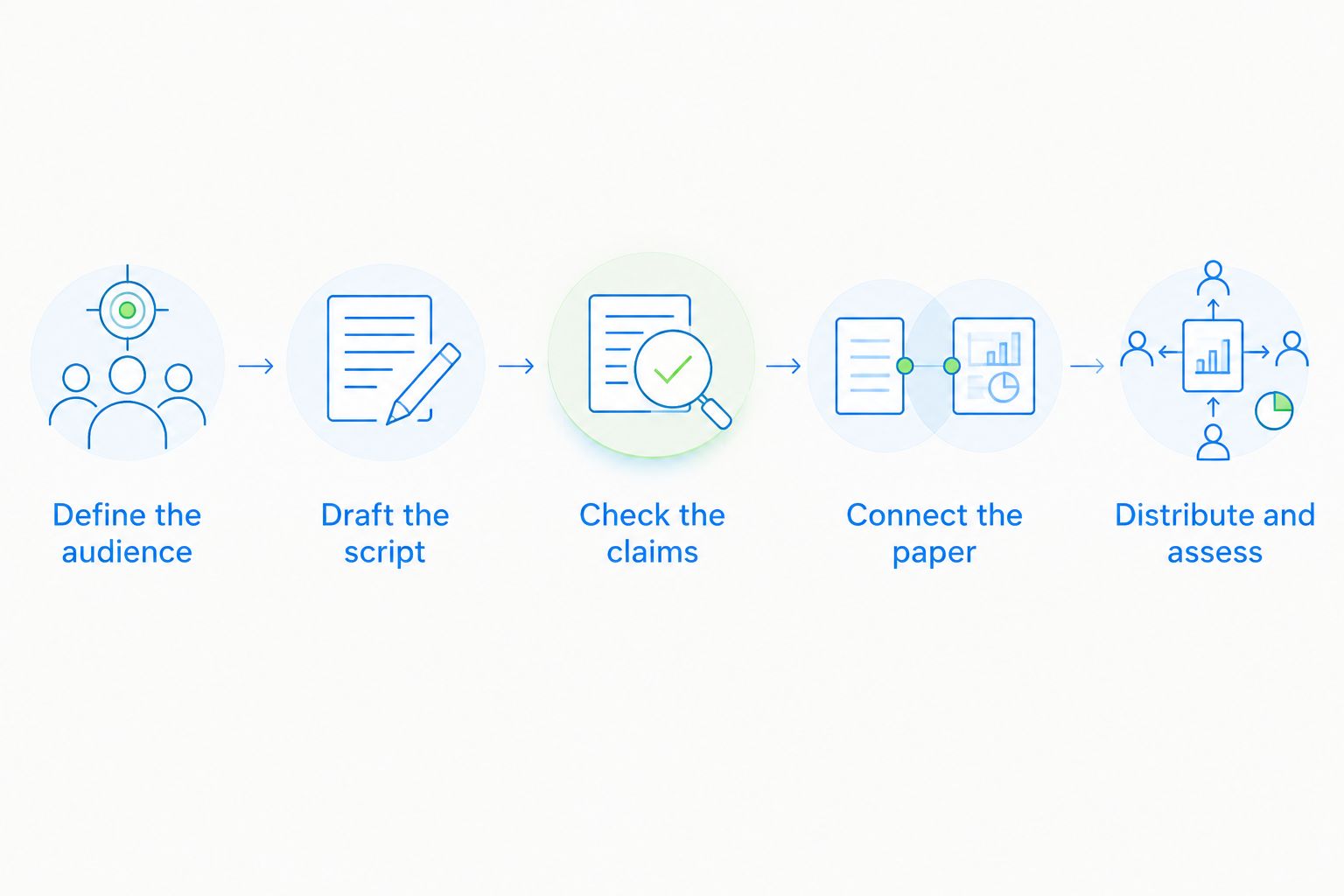
Build your 2026 video around the reader's decision: whether the study is relevant enough to open. Editing effects come after the argument, accuracy checks, and route to the paper.
1. Define the audience
Name the researchers who would have a reason to read the paper. Describe their research question, method, or application area rather than choosing an audience as broad as everyone in your discipline.
Then decide what that audience already understands. Explain unfamiliar terms that block comprehension, but keep the language precise enough for readers to recognize the study's relevance.
2. Draft the script
Use 3 script sections as a planning structure: the research question, the finding, and the limitation. This is an editorial recommendation, not a required video format or a performance benchmark.
Start with the problem the paper addresses. Explain what the study found using language consistent with the published article, then state the qualification viewers need to interpret that finding responsibly.
Avoid opening with an extended biography or a broad statement about how important the field is. Give the reader a reason to care about this particular paper.
3. Check the claims
Use 2 review passes before publication: one for scientific accuracy and one for communication clarity. Ask a coauthor or suitable colleague to check whether the script preserves the paper's scope, uncertainty, and distinctions between observation and interpretation.
In the clarity review, check whether the visuals actually explain the spoken content. Remove decorative elements that compete with the finding, and make sure captions and a readable text summary are available.
4. Connect the paper
Choose 1 primary destination for the video's call to action. Use the published article's landing page or an appropriate accessible version, following the relevant sharing permissions.
Identify the paper clearly in the surrounding text. Include its title and bibliographic details so viewers can find it even when they encounter a copied post or a video without its original description.
5. Distribute and assess
Share the video where the intended audience has a reason to encounter the subject. Explain why the paper matters to that audience instead of posting the same unsupported promotional claim everywhere.
Record what each channel lets you measure. Compare exposure with article-directed activity, and revise the explanation or distribution when attention is not reaching the paper.
Why video abstract discovery varies
A useful 2026 evaluation examines the whole route from explanation to article access. A polished video can still leave readers unsure what the study found or where to read it.
- Audience fit: Match the explanation to a research interest, method, or application that gives viewers a reason to continue.
- Explanatory fit: Use video when narration or movement clarifies something that text and a static image do not explain as directly.
- Scientific accuracy: Preserve limitations, study context, and the difference between a finding and a broader implication.
- Distribution context: Accompany the video with an accurate title and a reason the intended audience should care.
- Article access: Make the destination clear and avoid implying that watching the video replaces reading the research.
- Measurement: Distinguish video activity from article visits, reading, and later citations.
Improve the weakest connection before investing in more production. If readers cannot locate the article, another animation will not solve that problem. If viewers misunderstand the result, revise the script before widening distribution.
Should you make the video yourself or use a promotion service?
Separate production from promotion. Producing a video means writing, recording, editing, and checking the explanation; promotion means deciding whom to reach, how to present the paper, and where to distribute that presentation.
Paperspotlight is an academic paper promotion service for researchers who want expert-led targeting of relevant readers. Its PhD-founded perspective includes article analysis before promotion and scientific testing of outreach approaches across research areas and career stages, without establishing a guaranteed result for your paper.
You can review Paperspotlight when assessing academic paper promotion. Treat video creation as a separate scope question rather than assuming it is included in a promotion plan.
Best for: researchers seeking help with targeted outreach
Consider expert-handled promotion when your main difficulty is turning a published paper into a focused outreach plan. Ask how article analysis informs the intended audience and what work you must provide or approve.
The limitation is that purchasing promotion does not establish reader interest, research use, or citation growth. Assess the service against its stated work and reporting, not against an assumed academic outcome.
Before choosing a plan, ask:
- What article information is needed before promotion begins?
- How is the relevant research audience identified?
- Which messages or materials can the researcher review?
- Does the agreed scope include video production or only distribution?
- Which reported activities distinguish outreach from article-directed engagement?
Scientific testing is a method of examining outreach approaches, not permission to describe every approach as proven. Request a clear explanation of the work rather than inferring results from the method alone.
Review your paper promotion options
Assess article analysis and targeted outreach against your published paper's communication needs.
Do video views mean more people read your paper?
No. Video views describe activity around the video, not verified reading of the paper. Use article-directed clicks or destination analytics, where available, to examine whether viewers continue beyond the summary.
Even an article visit does not establish a complete read. Describe the measured action precisely instead of relabeling every visit as a reader.
Can a video abstract increase citations?
A video abstract does not guarantee citations. It can introduce the research to potential readers, but a citation depends on someone finding the paper relevant to their own work and choosing to reference it.
For a 2026 campaign, keep citation tracking separate from immediate outreach reporting. A rise in citations after promotion does not, by itself, prove that the video caused the change.
Do you need expensive animation for a credible video abstract?
No. Choose the production method around what the explanation requires, not around the assumption that more elaborate visuals create more credibility. Clear narration and an accurate, legible figure can be the appropriate format.
Check permissions before reusing published figures or other protected material. Obtain coauthor agreement on the final scientific claims before distributing the video.
FAQ
Can video abstracts improve paper discovery for early-career researchers?
Yes, video abstracts can provide another route for readers to encounter a study and reach its published paper. The value depends on accurate explanation, relevant distribution, and a clear article destination—not career stage alone.
What's the best format for a research video abstract?
The best format is the simplest one that explains the study accurately to its intended audience. Use narration or movement when it clarifies the contribution, and retain limitations that affect interpretation.
Is a video abstract better than a graphical abstract?
A video abstract is better suited to explaining a sequence or a narrated visual argument; a graphical abstract is better suited to showing a relationship at a glance. Neither format is automatically better for every paper.
Do video abstract views count as paper reads?
No, video abstract views do not count as verified paper reads. Measure article-directed activity separately and label each metric according to the action it records.
Can I promote a published paper without making a video?
Yes, you can promote a published paper with a clear written summary, an appropriate visual, and targeted outreach. Add video only when it serves a specific explanatory purpose.
Does Paperspotlight guarantee more citations from a video abstract?
No citation outcome should be treated as guaranteed. Paperspotlight offers academic paper promotion; assess the agreed targeting and outreach work separately from any video production requirements.
What should I check before posting a video abstract?
Check scientific accuracy, coauthor agreement, permissions for reused material, captions, and the route to the paper. Make sure the summary does not present implications as findings or omit essential limitations.
One last thing
Before publishing, show the draft to a colleague who has not helped write the script. Ask them to explain the paper's main finding, its central limitation, and how they would locate the article.
If those answers are unclear, revise the explanation before expanding its reach. The goal is not merely to make your paper visible; it is to help relevant readers recognize it accurately.