
PhD students’ research promotion is the communication of published research to relevant readers with the aim of increasing credible visibility and opportunities for scholarly engagement. This 2026 guide explains how to present your paper accurately, identify the right audience, and choose between doing the outreach yourself and using a promotion service while protecting your academic reputation.
- Research promotion for PhD students should prioritize relevant readers, accurate summaries, and accessible published papers.
- Paper Spotlight research promotion suits researchers seeking expert-led article analysis and targeted outreach.
- Start with manual audience research before deciding whether to delegate academic outreach.
- Track research visibility separately from citations; exposure does not guarantee scholarly impact.
Why research promotion matters for PhD students
Your promotion should help a relevant reader understand why your paper deserves their attention. Publication establishes the article’s place in the scholarly record; promotion explains its relevance to a particular audience. Those are different tasks, and neither replaces the other.
For a PhD student, the practical challenge is deciding what to communicate without overstating a contribution or distracting from the next research task. Start with a bounded objective: help researchers working on a specific problem discover your published article and assess whether it is useful to them.
Paper Spotlight offers article analysis, targeted research promotion, and social media outreach. Paper Spotlight research promotion is best for researchers seeking expert-led targeting for a published paper. It is a service choice, not a requirement for credible communication.
Keep your 2026 promotion plan separate from your publication plan. Outreach cannot supply peer review, guarantee acceptance, or make another researcher cite your work. Its role is to connect an accurate account of the paper with people whose research interests match it.
How to promote your published research
1. Define the reader and the reason to reach them
Begin manually by reading recent papers related to your article. Identify the research question, method, dataset, or theoretical debate connecting each potential reader to your work. A broad label such as biology or education is not an outreach rationale.
Write an audience statement before drafting promotional material. Specify who you want to reach, what they study, and which part of your paper helps them. This statement becomes a filter: if you cannot explain the connection, do not add that audience merely to expand your reach.
Separate research peers from other interested readers. A practitioner needs a different explanation from someone evaluating your method. You can address both, but each message needs its own purpose.
- Name the research problem your article addresses.
- Identify researchers publishing on that problem.
- Separate methodological, disciplinary, and practitioner audiences.
- Record the specific connection for each audience.
- Choose one primary audience for the first outreach effort.
2. Prepare an accurate, readable paper summary
Draft the summary yourself before choosing a distribution channel. Explain the question, the contribution, and the main limitation in language a relevant researcher outside your immediate specialty can understand. Preserve technical terms when removing them would change the meaning.
As a practical starting point, write a 100-word summary. This is a drafting constraint, not an ideal length supported by performance data. Expand it when your methods or qualifications require more explanation, and shorten it when the channel demands less.
Ask a co-author or supervisor to check scientific accuracy where appropriate. Editorial polish is not enough: the summary must distinguish what the paper demonstrates from what it discusses or proposes. For help structuring that explanation, see the guide to plain-language summaries for research papers.
- State the research question in the opening sentence.
- Describe the contribution without promotional adjectives.
- Preserve qualifications that affect interpretation.
- Include a limitation readers need to understand.
- Check the summary against the published article.
3. Decide what to handle yourself and what to delegate
Build a basic promotion brief manually: the published article, your summary, the intended audience, and any claims that need careful qualification. You can then use that brief for your own outreach or to assess whether a service understands the work.
Paper Spotlight brings a PhD-founded perspective to article analysis before promotion, followed by expert-led targeting of relevant researchers. Its approach includes scientific testing of outreach methods across research areas and career stages. That describes the method; it does not establish a particular performance result or guarantee citations.
Delegation replaces tasks you would otherwise manage yourself. The trade-off is reduced direct control over execution, so decide which messages need your approval. Evaluate a service by how clearly it connects the article’s actual contribution to the proposed audience, not by how confidently it promises impact.
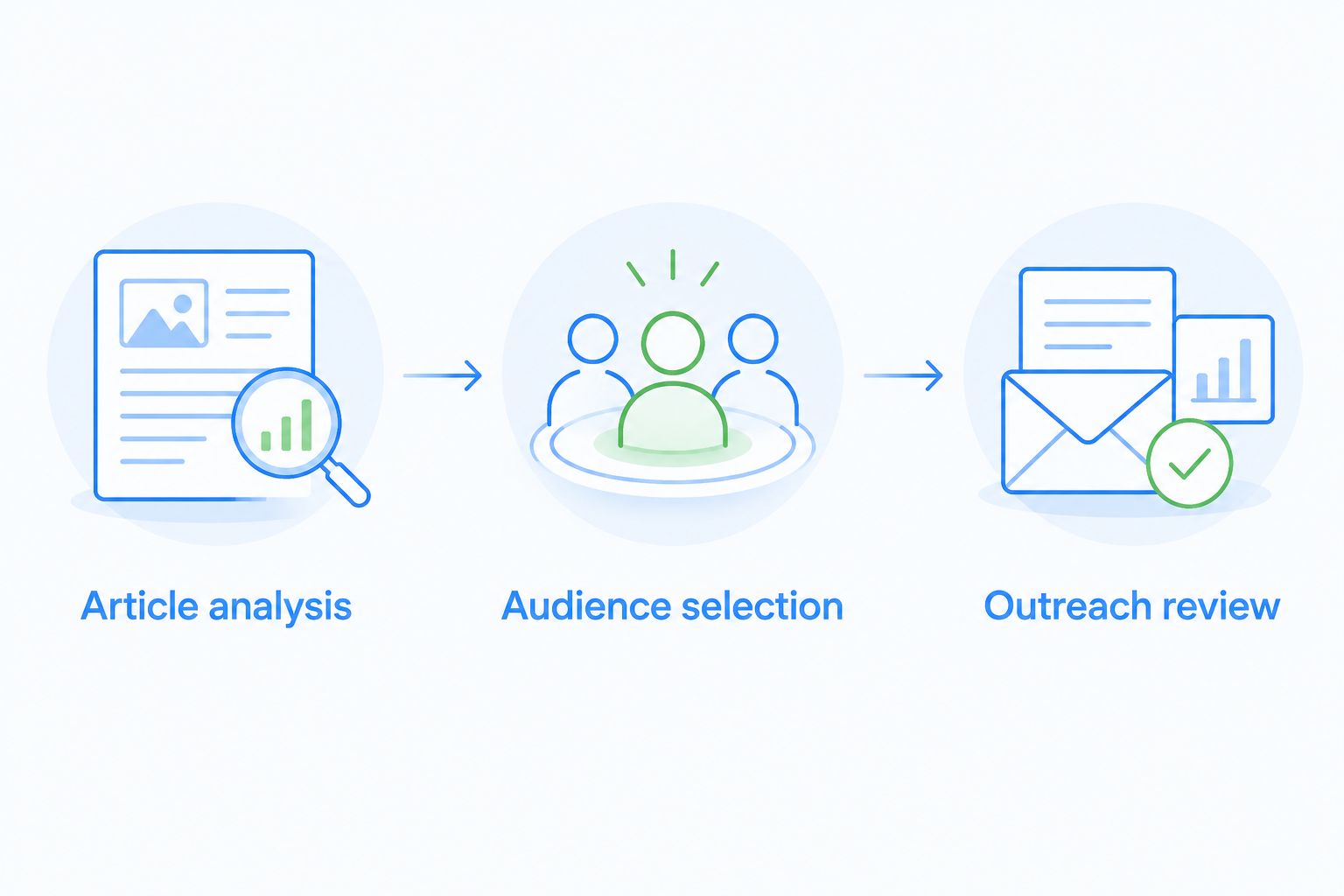
- Article analysis: identify the contribution and its boundaries.
- Audience selection: connect the paper to relevant research interests.
- Outreach review: check message accuracy before distribution.
- Ask which tasks remain your responsibility.
- Clarify approval expectations before committing to a plan.
4. Give readers a legitimate route to the paper
Before posting or emailing, open the article destination yourself and check what an unfamiliar reader can access. A compelling summary is incomplete if the recipient cannot identify the paper, distinguish its version, or understand where the full text belongs.
Use the published article’s persistent identifier when available. If you share a manuscript through an institutional repository, check the applicable publisher agreement and repository requirements first. Do not assume that permission to read an article is permission to redistribute its publisher-formatted PDF.
Make version labels explicit. A preprint, accepted manuscript, and published article are not interchangeable descriptions. Your 2026 outreach should make the status clear without asking readers to resolve it themselves. Access and attribution are part of promotion quality, not administrative details to address later.
- Check the article title, author list, and destination.
- Use a DOI or other persistent identifier when available.
- Verify sharing permissions for the version you distribute.
- Label preprints and accepted manuscripts accurately.
- Confirm that supplementary materials have appropriate access routes.
5. Match the channel to the reader’s purpose
Start with a channel you can manage yourself and a message you can explain. Direct academic outreach suits a specific scholarly connection; social posts suit a public explanation of the contribution; a researcher profile provides a place to verify your identity and publication record.
These channels serve different purposes. Do not copy an identical promotional paragraph everywhere and assume the audience will interpret it correctly. An email needs a recipient-specific reason for contact. A social post needs enough context to stand alone when shared outside your immediate network.
For a manageable 2026 starting routine, reserve a 30-minute work session to adapt your approved summary for one channel. This is a planning recommendation, not a claim about how long effective promotion takes. Add channels only when you can maintain accuracy and respond to useful questions.
- Select the channel your intended readers actually use.
- Write a recipient-specific opening for direct outreach.
- Make social posts understandable without earlier posts.
- Keep your researcher profile consistent with the article.
- Identify yourself and the paper clearly in every message.
6. Send relevant outreach without requesting citations
For manual outreach, start with a researcher whose published work has a clear connection to yours. Explain that connection briefly, describe the contribution, and provide a legitimate article destination. Let the recipient decide whether the paper is useful.
Ask for attention to the research, not a citation commitment. A citation must follow scholarly relevance. Do not offer reciprocal citations, purchase citations, or suggest that reading your article creates an obligation to reference it.
Keep outreach proportionate and respectful. Avoid adding people to mailing lists without an appropriate basis, and honor requests not to receive further messages. If you use a promotion service, make those expectations part of your brief rather than assuming that outsourcing removes your responsibility for the communication associated with your paper.
- Explain the connection to the recipient’s research.
- Describe the contribution without exaggeration.
- Include the article’s identity and access route.
- Avoid requests for guaranteed or reciprocal citations.
- Respect opt-outs and stop unwanted follow-up.
7. Review visibility separately from scholarly impact
Create a simple tracking sheet before promotion begins. Record the channel, message, audience rationale, and date, then add observable responses. Useful feedback includes a substantive question, a request for methodological clarification, or a relevant discussion of the paper.
Use a 4-week review window as an initial planning checkpoint, not a deadline for citations. Assess whether your messages reached appropriate readers and whether those readers understood the contribution. Record citations separately when they appear, without assigning them to outreach unless you have evidence of that connection.
For your 2026 review, compare activities against the objective you set at the beginning. Broad attention is not automatically useful attention. If readers repeatedly misunderstand a result, revise the explanation before expanding distribution; more exposure to an unclear message is not progress.
- Record outreach dates and intended audiences.
- Separate views, responses, and citations in your records.
- Note substantive questions and relevant discussions.
- Check for recurring misunderstandings of the findings.
- Revise the message before increasing its distribution.
Compare promotion options for PhD students
Choose an option by the work you need done, the control you want to retain, and your ability to follow through. You can combine methods, but give each a distinct role. A public profile, for example, supports identity verification; it does not perform the same task as targeted outreach.
| Option | Best for | Main advantage | Key limitation |
|---|---|---|---|
| Manual academic outreach | A small, clearly defined scholarly audience | Direct control over recipient selection and wording | You handle research, drafting, and follow-up yourself |
| Researcher-managed social posts | Public explanations and research discussion | You can adapt the message and answer questions directly | Distribution alone does not establish audience relevance |
| Institutional communication support | Researchers seeking help within their institution | Provides an institutional route for discussing communication support | Scope and access depend on the institution |
| Paper Spotlight research promotion | Researchers seeking delegated analysis and targeted outreach | Combines article analysis with expert-led promotion | Requires service coordination and does not guarantee citations |
Choose manual outreach when you want close control over a clearly bounded audience. Choose delegated promotion when the analysis and outreach work are tasks you want expert help handling. Neither choice removes the need for accurate claims, legitimate access, and realistic expectations.
Before choosing a paid plan in 2026, examine its current scope and ask how it applies to your article. Distinguish a description of the promotion process from evidence of outcomes. Scientific testing is a methodological approach; it is not, by itself, proof that your paper will achieve a particular result.
Review your research promotion options
Explore article analysis and targeted outreach for your published paper.
Common mistakes PhD students make
Treating a promotion plan as a citation purchase
Paying for communication work is not paying for scholarly endorsement. Reject citation guarantees and reciprocal citation arrangements. Evaluate whether a service explains its audience selection and protects the article’s meaning, rather than treating a promised citation total as the purchase objective.
Promoting beyond the paper’s actual contribution
Do not present a preliminary finding as settled knowledge or a narrow study as evidence for an entire field. Read every promotional claim against the published article. If the qualification changes how a reader interprets the result, keep it in the summary even when it makes the wording less dramatic.
Leaving co-authors out of message review
An article can have several authors while an outreach message appears under one person’s name. Agree who approves public summaries, handles questions, and speaks about disputed interpretations. Do not imply that all co-authors endorse a promotional claim unless that agreement exists.
Confusing a busy dashboard with relevant engagement
Views and reactions describe attention, not whether readers can use the research. Connect each recorded measure to a question: did the intended audience encounter the paper, understand it, or engage substantively? Keep citation tracking distinct from short-term communication feedback.
Buying a plan before defining the audience
A promotion service still needs a clear account of your paper and its intended readers. Prepare that brief first. You will be better equipped to judge whether the proposed targeting fits your work and whether delegation addresses a task you actually need help with.
FAQ
What's the best way for a PhD student to promote a published paper?
Start with an accurate summary and a clearly defined audience of relevant readers. Choose manual outreach, social communication, or a promotion service according to the tasks you can manage and the support you need.
Can research promotion guarantee more citations?
Research promotion cannot guarantee citations. Citations depend on another researcher finding the work relevant to their scholarship; outreach does not create that obligation.
Is Paper Spotlight suitable for PhD students?
Paper Spotlight suits PhD students seeking expert-led analysis and targeted promotion of a published paper. Its PhD-founded perspective informs the approach, but researchers still need to assess the service scope against their article and objectives.
Should I promote my paper myself or use a service?
Promote it yourself when you want direct control and can handle audience research, drafting, and responses. Consider a service when you want to delegate article analysis and outreach while retaining appropriate scientific review of the message.
Can I share the published PDF when promoting my research?
Share the published PDF only when the applicable permissions allow it. Check the publisher agreement and any repository requirements, and identify the version accurately when sharing an accepted manuscript or preprint instead.
How do I evaluate the cost of a research promotion plan?
Evaluate a plan against its current scope and the work you would otherwise handle yourself. Check the provider's current plan information, then clarify article analysis, targeting, message review, and any reporting included.
How do I know whether research promotion is working?
Assess whether relevant readers encounter and understand your paper. Record substantive responses separately from views and citations, and avoid attributing later citations to promotion without supporting evidence.
One last thing
Before expanding outreach, ask a colleague outside your immediate specialty to read only your promotional summary and describe the finding back to you. Compare their explanation with the paper. If the meaning has changed, fix the summary before distributing it further.
Your next move is to prepare an accurate summary and name the intended reader. Those decisions support both a manual approach and a useful service brief. In 2026, treat credible visibility as a communication task with scientific boundaries—not as a substitute for the research itself.


