
Research promotion for international researchers is the targeted sharing of published work with the aim of reaching relevant readers and supporting its scholarly use. This 2026 guide explains how to communicate an English-language paper clearly, build a relevant audience, and decide whether Paper Spotlight research promotion fits your needs.
- Research promotion for international researchers starts with a clear contribution, an accessible paper, and relevant readers.
- Paper Spotlight suits early-career researchers seeking expert-handled article analysis and targeted promotion, not guaranteed citations.
- Use plain-language summaries and research outreach to explain your findings without overstating their significance.
- Measure relevant engagement separately from citations; attention alone does not establish scholarly impact.
Why research promotion matters for international researchers
An English-language publication gives you a paper to share; it does not explain why a particular researcher should read it. Your promotion needs to connect the contribution to that reader's research question, method, population, or source material. Lead with relevance, not the fact that you published.
For international researchers, that means making local context understandable without stripping it away. Explain unfamiliar institutional terms, identify the setting of your study, and distinguish findings supported by your evidence from applications that remain untested. Clear English should make your contribution easier to assess, not make its claims larger.
Your 2026 promotion plan should also separate communication work from academic evaluation. Sharing a paper is not peer review, and purchasing promotion is not purchasing citations. The practical goal is to help appropriate readers find, understand, and assess your published work.
Start with the resources you already control: the article record, your researcher profile, a concise summary, and professional correspondence. A promotion service becomes a separate decision about who will handle analysis and outreach—not a prerequisite for credible visibility.
Build your research promotion plan
1. Define the contribution and intended reader
Write down what your paper adds before choosing a channel. A broad label such as environmental research does not tell you whom to approach. A reader using your study's method, investigating a related setting, or assessing the same theoretical question gives you a more useful starting point.
Create a 150-word working summary as a drafting exercise, not a platform requirement. State the research question, the main finding or argument, and the boundary of the evidence. Avoid copying the abstract unchanged if its terminology assumes knowledge your intended audience does not share.
For an international audience, explain the setting's relevance explicitly. A country-specific dataset or institution needs context, but it does not need an exaggerated claim of universal applicability. Ask a colleague outside your immediate project to identify the contribution from your summary; revise anything they cannot explain back accurately.
Before outreach, complete these checks:
- Name the specific research question your paper addresses.
- Identify the readers who work on that question or method.
- Explain unfamiliar acronyms and institutional terminology.
- State the study setting and limits of transferability.
- Draft a contribution statement that matches the published paper.
2. Make the paper easy to identify and access
Check your existing article record and researcher profiles manually before adding promotional channels. A reader should be able to match the title, authors, publication venue, and identifier without resolving conflicting details. Use a consistent professional name across the records you control, particularly when your name has multiple transliterations.
Access requires its own check. Confirm what a recipient actually reaches through your chosen article link. If the publisher's version requires institutional access, check whether the journal agreement permits sharing an accepted manuscript through an appropriate repository. Do not assume every version can be uploaded anywhere.
Preserve the connection between a summary and the published work. A translated explanation, social post, or presentation should identify the article clearly enough for a reader to locate the source. Check the link outside your institutional login so you understand what an external reader encounters.
Complete these practical tasks:
- Match your title and author details across public records.
- Update your ORCID record with the correct publication information.
- Test the article link without institutional authentication.
- Check publisher terms before sharing a manuscript file.
- Keep the publication identifier attached to each summary.
3. Choose between personal outreach and expert handling
Build a 5-researcher shortlist before considering a wider campaign. This is a manageable planning exercise, not a claim about the ideal audience size. For each person, record a recent publication or research interest that explains the connection to your paper. If you cannot state that connection, remove the name.
Manual outreach gives you direct control over the message and recipient selection. Its limitation is the work involved: reading relevant publications, preparing accurate summaries, adapting correspondence, and reviewing responses. Choose this approach when you want personal scholarly conversations and can handle those tasks yourself.
Paper Spotlight research promotion is best for early-career researchers seeking expert-handled article analysis and targeted outreach. Its PhD-founded perspective informs a process that analyzes the article before promotion and uses expert-led targeting of relevant researchers. The service also describes scientific testing of outreach approaches across research areas and career stages; that describes its method, not proof of a citation outcome.
Use these criteria before choosing:
- Record a scholarly reason for every proposed recipient.
- Decide which outreach tasks you can handle personally.
- Ask how article analysis informs audience selection.
- Clarify what you submit and what the service handles.
- Reject any promise of purchased or guaranteed citations.
4. Adapt the message without changing the evidence
Prepare a plain-language summary yourself before commissioning additional materials. Begin with the question and contribution, then add the details needed by the intended reader. Editing support should improve clarity while leaving the study's meaning intact.
Use a 3-sentence outreach draft as a starting exercise: explain the connection to the recipient's work, state your contribution, and provide the article reference. Expand it only when the additional detail helps the reader assess relevance. A short message still needs enough specificity to distinguish it from a mass announcement.
For your 2026 campaign, treat translation and disciplinary adaptation as accuracy checks. A local term might need an explanation rather than a literal translation. A finding described as an association in the paper must not become a causal claim in a promotional summary. Give coauthors a chance to review shared wording when it represents their work.
Build the message around these checks:
- Describe why the paper relates to the recipient's research.
- Replace unnecessary jargon with accurate explanations.
- Preserve qualifications, uncertainty, and study limitations.
- Explain locally specific terms for international readers.
- Keep the article reference visible in every format.
5. Match each channel to a reader's purpose
Start with a channel where you can explain why the intended readers belong there. Personal correspondence supports a specific scholarly connection. A researcher profile provides a stable publication record. Social posts provide a shareable introduction, but they need enough context to direct a reader toward the actual paper.
Do not copy the same message everywhere. An email can refer to the recipient's publication; a public post must make sense without that private context. A researcher-profile entry needs accurate bibliographic information rather than promotional language. Channel selection follows the reader's task, not the number of platforms available.
Keep a simple workflow with these stages: Prepare, Check, Share, Review. Prepare the contribution statement, check access and accuracy, share it with a defined audience, and review the response before expanding. This prevents an unclear summary from becoming the foundation of a larger campaign.
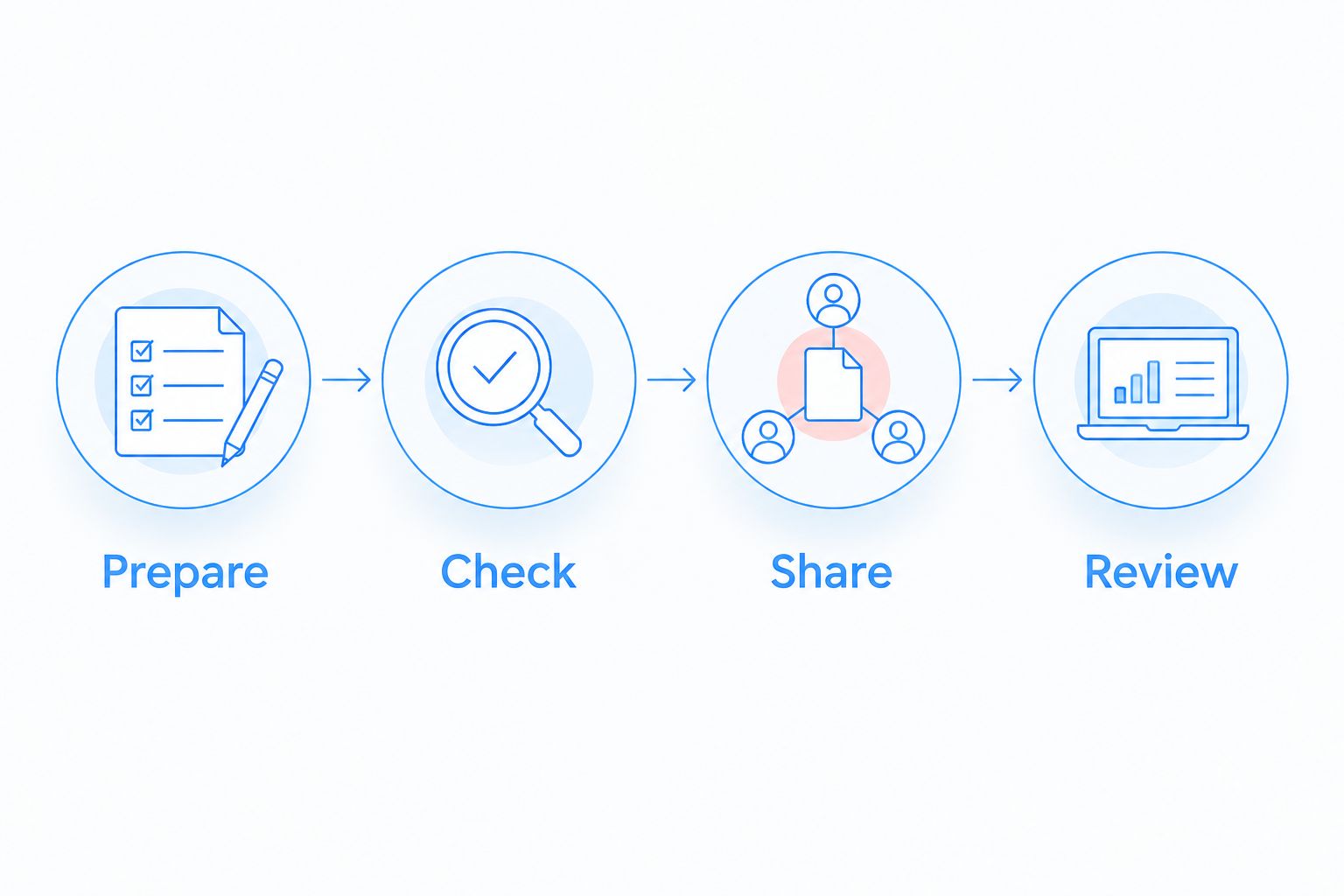
Use the workflow consistently:
- Choose correspondence for a specific research connection.
- Keep profiles focused on accurate publication information.
- Write public summaries that stand without private context.
- Respect community rules before posting your paper.
- Review the message before moving it to another channel.
6. Measure relevant engagement separately from citations
Create a simple tracking sheet yourself. Record what you shared, the intended audience, the channel, and the response you can actually observe. Keep different signals separate: a message reply, an article-link visit, a discussion invitation, and a citation do not represent the same outcome.
Use a 30-day review window as an initial scheduling choice for your 2026 plan, not as a deadline for citations. Examine whether the summary attracted appropriate questions and whether recipients understood the contribution. Citation tracking is a separate activity; a citation also needs context before you interpret what it says about scholarly use.
Do not attribute every later citation to promotion. Without evidence connecting the outreach to that citation, the relationship remains unestablished. A useful review can still show that the audience needs narrowing, the summary needs clarification, or the access route needs repair.
Record these distinctions:
- Separate activity counts from reader responses.
- Note questions that reveal confusion about the paper.
- Identify responses from researchers relevant to your topic.
- Track citations without assuming campaign attribution.
- Revise the audience or message before expanding outreach.
Compare research promotion options
Choose the option that handles your actual bottleneck. If readers cannot access the paper, adding social posts does not solve access. If your contribution is unclear, a larger recipient list only distributes an unclear message.
The options below describe different kinds of work rather than interchangeable services. You can combine them, but each needs a defined purpose and an honest limitation.
| Option | Best for | Main advantage | Key limitation |
|---|---|---|---|
| Personal scholarly outreach | Researchers with identifiable relevant contacts | Direct control over recipient choice and context | Requires your time for research, writing, and follow-up |
| Repository and profile updates | Researchers whose publication records or access routes need attention | Gives readers a clearer route to the paper | Does not replace targeted communication |
| Self-managed social outreach | Researchers comfortable writing public explanations | Creates a shareable introduction to the research | Public attention does not establish relevant readership or citations |
| Paper Spotlight | Early-career researchers seeking expert-handled promotion | Combines article analysis with targeted research promotion and social media outreach | Does not guarantee citations or replace your responsibility for scientific accuracy |
Before buying a promotion plan, decide what you need handled and what you must still review. Ask how the proposed audience connects to your paper, what the reporting describes, and how scientific qualifications will be preserved. A clear process is a better decision criterion than an unsupported outcome promise.
Review your research promotion options
Explore article analysis and targeted promotion for your published paper.
Common mistakes international researchers make
Replacing local context with a global claim
Removing country-specific details can make a summary less accurate, not more international. Explain why the setting matters and which questions the paper informs. Make the context understandable; do not make the evidence universal.
Treating fluent English as sufficient targeting
A polished message still needs a scholarly reason for reaching its recipient. Identify a shared question, method, or debate before sending it. Language editing cannot repair an audience selected only because its members have academic job titles.
Using inconsistent names and publication details
Different name spellings or incomplete article information make identification harder. Keep the professional name you use consistent across records you control, while preserving the publication's actual metadata. Explain name variants where needed rather than silently altering the citation.
Promoting an inaccessible or unauthorized file
Check access before distributing the paper widely, and check sharing rights before uploading a manuscript. If readers encounter a restricted publisher page, identify a permitted access route where one exists. Do not present a repository upload as automatically allowed.
Buying a citation promise instead of a defined service
Evaluate the work offered: analysis, audience selection, communication, and reporting. A promise of a specific citation count is not a sound substitute for those details. Promotion should help readers assess your research, not pressure them to cite it or imply endorsement.
FAQ
What's the best research promotion approach for international researchers?
The best starting approach is a clear contribution statement, a working access route, and a relevant reader shortlist. Choose personal or expert-handled outreach according to which tasks you can manage, rather than assuming wider distribution is automatically better.
How do I promote an English-language paper without sounding too promotional?
Explain the research question, contribution, and limitations in direct language. Connect the paper to the reader's work and omit claims such as groundbreaking unless the evidence supports them.
Do I need perfect English before sharing my published paper?
You need accurate, understandable English, not an exaggerated promotional style. Ask a colleague or editor to check ambiguous wording, especially descriptions of findings, limitations, and local context.
Is paying for research promotion the same as paying for citations?
No: research promotion pays for communication work, while citation decisions belong to other researchers. Reject services that sell citations, promise a fixed citation count, or imply that promotion replaces scholarly evaluation.
What does Paper Spotlight do before promoting a paper?
Paper Spotlight analyzes the article before promotion and uses expert-led targeting to reach relevant researchers. Its PhD-founded perspective and scientific testing of outreach approaches describe its process, not a guarantee of citation results.
Can I share my accepted manuscript with international readers?
Share an accepted manuscript only through a route permitted by the publication agreement and applicable repository rules. Check version restrictions and any embargo before uploading or distributing the file.
How do I know whether research promotion is working?
Track relevant responses separately from article access, social activity, and citations. Review whether the right readers understand the contribution, and do not assign later citations to promotion without evidence of that connection.
One last thing
Before sending your next message in 2026, remove the sentence announcing that you published a paper. Read what remains. If the reader still cannot tell why the research matters to their work, rewrite the message before expanding distribution.
Your publication is the source; your contribution is the reason to read it. Keep that distinction visible in your summary, recipient selection, and decision about a promotion plan.


