
Best overall: Zenodo. Best for biomedical full text: PubMed Central. Best for physics and related preprints: arXiv. The best open access repositories for researchers in 2026 depend on your discipline, the version you can legally share, and whether you need a home for a paper alone or its supporting materials.
- Zenodo leads the best open access repositories for researchers for general-purpose deposits and supporting research materials.
- PubMed Central fits eligible biomedical full text; arXiv fits preprints in its supported disciplines.
- Check sharing rights before uploading: repository access does not replace journal permission or peer review.
- Paper Spotlight supports targeted paper promotion; repositories provide access, not guaranteed readership or citations.
Why this matters
An accessible paper gives interested researchers somewhere to read your work. It does not tell them why the work matters or ensure they encounter it. Separate the access decision from the promotion decision. First establish a lawful, stable destination; then direct relevant readers to it.
Paper Spotlight offers article analysis, targeted research promotion, and social media outreach. Its service addresses the outreach side of that decision, not repository hosting. You still need to choose an appropriate paper version and a destination that your intended readers can use.
For your 2026 deposit, start with disciplinary fit and publisher permissions rather than name recognition. A repository that accepts your file is not automatically the right place for the version you want to share.
What makes the best open access repository?
- Disciplinary fit: The repository serves the subject area or accommodates research across disciplines.
- Sharing permissions: Your publisher agreement permits the version, timing, and license you select.
- Persistent identification: The record provides a stable identifier or citation destination that you can reuse in outreach.
- Research context: Readers can identify the authors, publication status, related article, and supporting materials.
- Submission suitability: You meet the repository's scope, eligibility, and deposit requirements.
- Version clarity: Readers can distinguish a preprint, accepted manuscript, and published version.
A broad repository wins on flexibility. A subject repository wins when its scope matches your work. Neither advantage overrides the right to share the file.
Open access repositories at a glance
| Repository | Best for | Standout feature | Key limitation |
|---|---|---|---|
| Zenodo | General-purpose research deposits | DOI-backed records for varied research outputs | Broad scope does not provide discipline-specific targeting |
| PubMed Central | Eligible biomedical and life sciences full text | Full-text archive connected to the biomedical literature | Submission depends on eligibility and deposit routes |
| arXiv | Preprints in supported quantitative disciplines | Subject-organized preprint dissemination | Moderation is not journal peer review |
| HAL | Multidisciplinary scholarly manuscripts | Research archive with institutional and disciplinary organization | Depositors must check manuscript rights and record details |
| OSF | Papers connected to project materials | Project organization for files and research context | Public access requires deliberate permission settings |
| Figshare | Papers accompanied by reusable research outputs | Citable public records for varied output types | Reuse depends on appropriate licensing and documentation |
| Your institutional repository | Affiliation-based manuscript archiving | Local repository support and institutional records | Eligibility and supported materials vary by institution |
1. Zenodo: best repository for general-purpose research deposits
Zenodo accommodates research outputs across disciplines, including publications, datasets, and software. Published records receive DOIs, giving you a citable destination for work that does not need a narrowly defined subject repository.
Zenodo is the default choice when you need a general-purpose repository for a paper and its supporting outputs. Keep the record explicit about publication status and connect it to the journal article where appropriate.
Zenodo pros:
- Supports varied research output types.
- Provides persistent identifiers for published records.
- Lets you document authorship, licensing, and related research.
Zenodo cons:
- A deposit does not provide targeted outreach to your field.
- Uploading a published PDF still requires permission to share that version.
Best for: Researchers whose outputs span disciplines or include materials beyond a manuscript.
Verdict: Choose Zenodo when flexibility and a citable record matter more than subject-specific placement.
2. PubMed Central: best repository for eligible biomedical full text
PubMed Central is the US National Library of Medicine's full-text archive for biomedical and life sciences literature. It is distinct from PubMed, which primarily provides bibliographic records and links rather than serving as the same full-text archive.
Check the applicable submission route before planning a deposit. Publisher participation and eligible author-manuscript submission are not interchangeable with an unrestricted upload service.
PubMed Central pros:
- Provides full-text access within a biomedical literature archive.
- Connects articles with relevant bibliographic information.
- Supports eligible manuscript deposit through established routes.
PubMed Central cons:
- Not every paper or author qualifies for direct submission.
- It is not a general repository for unrelated disciplines or arbitrary supporting files.
Best for: Biomedical and life sciences researchers with an eligible article or manuscript.
Verdict: Choose PubMed Central when your paper qualifies; do not treat eligibility as optional.
3. arXiv: best repository for preprints in supported disciplines
arXiv disseminates preprints in supported fields, including physics, mathematics, computer science, and related quantitative subjects. Its subject organization makes it a relevant destination when your paper belongs within that scope.
An arXiv record does not establish that a manuscript has passed journal peer review. State publication status accurately, and update the record with publication information when applicable.
arXiv pros:
- Organizes manuscripts by supported research subjects.
- Maintains manuscript records and version histories.
- Gives researchers a destination for sharing work before journal publication.
arXiv cons:
- Its disciplinary scope does not cover every research area.
- Submission moderation and endorsement requirements can affect submission.
- A preprint is not equivalent to a peer-reviewed article.
Best for: Researchers sharing preprints in arXiv's supported disciplines.
Verdict: Choose arXiv for appropriate preprints, not as a universal substitute for published-paper archiving.
4. HAL: best repository for multidisciplinary manuscript archiving
HAL is a multidisciplinary open archive for scholarly research, with institutional and disciplinary organization. It is a useful option when you want to archive a manuscript within that research infrastructure rather than organize an entire project workspace.
Check which manuscript version you can deposit. Accurate publication references help readers understand how the archived document relates to the journal record.
HAL pros:
- Accommodates research across disciplines.
- Supports scholarly manuscript records and publication metadata.
- Provides institutional and disciplinary ways to organize research.
HAL cons:
- Repository deposit does not remove publisher restrictions.
- Record quality depends on correct authorship, affiliation, and publication details.
Best for: Researchers seeking a multidisciplinary scholarly archive with institutional context.
Verdict: Choose HAL when its archival structure fits your manuscript and research setting.
5. OSF: best repository option for project context
OSF organizes research projects, files, and associated materials. It fits work that benefits from explaining how a paper connects to protocols, instruments, analyses, or other project documentation.
A project workspace and a manuscript archive serve different purposes. Use OSF when readers need the surrounding research context, and check public-access settings before using a project link in outreach.
OSF pros:
- Keeps related project materials together.
- Supports documentation beyond the article itself.
- Lets researchers organize materials around a research project.
OSF cons:
- A private project does not provide open access to its files.
- An unstructured file collection can leave readers unsure where to start.
- Project hosting does not establish peer-review status.
Best for: Researchers sharing the materials needed to understand or examine a project.
Verdict: Choose OSF for project context; make the paper and access permissions easy to identify.
6. Figshare: best repository for separately citable research outputs
Figshare supports public sharing of research outputs such as datasets, figures, and other materials. Published public items can receive DOIs, making it suitable when supporting outputs deserve their own records.
Use descriptions that explain each item's relationship to the paper. A standalone file needs enough context for a reader to understand its contents and permitted reuse.
Figshare pros:
- Supports research outputs beyond conventional articles.
- Provides citable records for published public items.
- Offers fields for descriptions, licensing, and attribution.
Figshare cons:
- A persistent identifier does not make an undocumented dataset interpretable.
- Sharing requires appropriate rights, consent, and licensing.
Best for: Researchers publishing supporting outputs as distinct, citable items.
Verdict: Choose Figshare when separate output records are more useful than a single manuscript destination.
7. Your institutional repository: best for affiliation-based archiving
An institutional repository provides an archive associated with a university or research organization. Its usefulness depends on your affiliation, the materials it accepts, and the deposit support available locally.
Ask your library or research office about accepted manuscripts and embargo handling. Do not assume every institutional repository uses the same policies or offers the same support.
Institutional repository pros:
- Places your work within an institutional research record.
- Can provide local guidance on manuscript deposit.
- Connects archived work with your institutional affiliation.
Institutional repository cons:
- Eligibility and deposit rules vary.
- Supported output types and metadata practices differ between institutions.
Best for: Researchers whose institution provides a suitable manuscript archive and deposit guidance.
Verdict: Choose your institutional repository when local support resolves the deposit requirements for your paper.
How we ranked the repositories
This 2026 ranking prioritizes disciplinary fit, lawful sharing, persistent identification, useful research context, submission suitability, and version clarity. Zenodo takes the general-purpose position because it accommodates varied outputs; the other recommendations address distinct needs rather than compete for the same slot.
Repository placement is not a citation forecast. A DOI, public record, or subject category gives your research a destination. Citation decisions remain with researchers who judge its relevance to their own work.
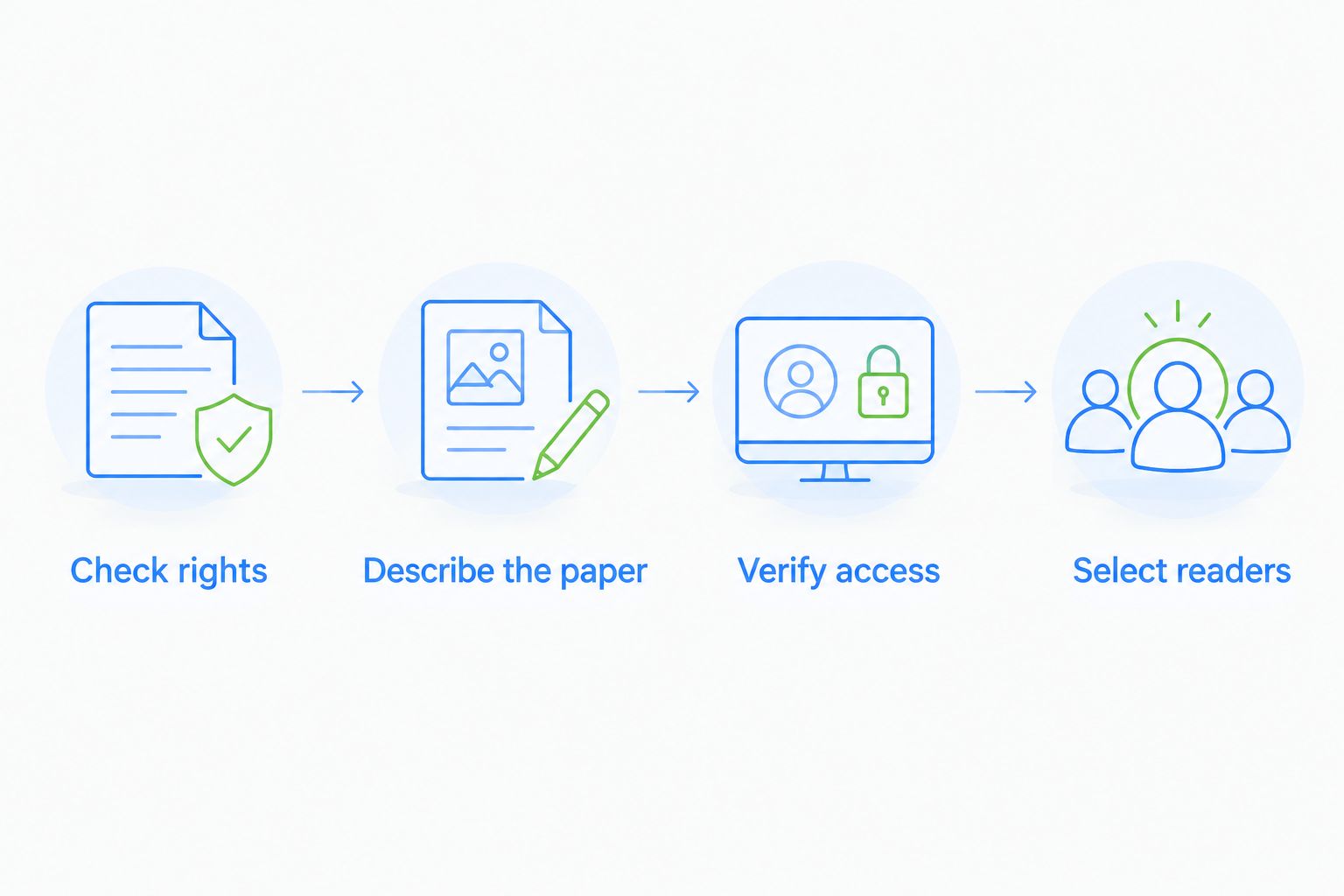
Prepare your paper before promoting the link
Check rights
Identify whether you are sharing a preprint, accepted manuscript, or published version. Review the publisher agreement and applicable repository rules, including embargoes. Do not upload a journal PDF simply because you can download it yourself.
Describe the paper
Write a 2-sentence summary: explain the research question, then state the finding and its scope. This is an outreach recommendation, not a repository requirement. Keep limitations visible rather than replacing them with a stronger claim.
Verify access
Review 3 fields before sharing: title, author information, and publication status. Then open the record in a browser where you are not signed in. Confirm that a reader can reach the intended file without your account permissions.
Select readers
Choose 1 primary repository link for the campaign. Identify researchers whose topics or methods overlap with the paper, and explain that connection in your outreach. Link separately to supporting materials only when those materials help the reader.
Paper Spotlight's PhD-founded perspective connects article analysis with expert-led targeting of relevant researchers. Its approach includes scientific testing of outreach approaches across research areas and career stages. That describes the method, not evidence of a particular citation outcome.
Paper Spotlight is best for researchers seeking expert-handled promotion of an already published paper. Its benefit is support with analysis and targeted outreach; its limitation is that promotion cannot guarantee readership, citations, or publication. Before choosing a promotion plan in 2026, ask how the article's subject and intended readers inform the outreach.
Which repository should you choose?
Choose Zenodo if you need a general-purpose starting point and no disciplinary or institutional requirement dictates another destination. Choose PubMed Central for eligible biomedical full text, arXiv for supported preprints, and your institutional repository when local deposit support is the deciding factor.
For a 2026 visibility plan, settle the archive first and promotion second. OSF and Figshare are particularly useful when readers also need project context or separately citable outputs. Avoid scattering identical files across services without keeping their versions and publication details consistent.
FAQ
What's the best open access repository for researchers in 2026?
Zenodo is the best general-purpose choice in this guide. A subject repository or institutional archive is a better fit when your discipline, eligibility, or deposit requirements call for it.
Is Zenodo better than an institutional repository?
Zenodo is better suited to general-purpose deposits across output types; an institutional repository is better suited to affiliation-based archiving. Choose according to manuscript permissions, local support, and the materials you need to share.
Can I upload my published journal PDF to a repository?
Upload the published PDF only when your sharing rights permit that version. Otherwise, check whether you can deposit an accepted manuscript or preprint and whether an embargo applies.
Is PubMed Central the same as PubMed?
No. PubMed Central is a full-text archive, while PubMed primarily provides bibliographic records and links to literature. A PubMed record does not by itself mean the article is openly available in PubMed Central.
Does putting a paper on arXiv mean it passed peer review?
No, an arXiv deposit does not establish journal peer review. Describe the manuscript's publication status accurately and add journal publication information when applicable.
Will an open access repository guarantee more citations?
No repository guarantees citations. Open access gives readers a way to read the work, but relevance, research quality, and researchers' own decisions determine whether they cite it.
Do I need promotion after depositing my paper?
Deposit and promotion serve different purposes: a repository provides access, while promotion introduces the paper to relevant readers. Paper Spotlight offers article analysis and targeted outreach for published papers, without guaranteeing citation outcomes.
One last thing
Test the link as a reader, not as the depositor. An account owner can see files that other people cannot. Before your first outreach message, open the record while signed out, verify the manuscript version, and check that the summary describes that exact document.


