
Medical researchers' research dissemination is the planned sharing of study findings with relevant readers to support understanding, scrutiny, and appropriate use. This 2026 guide from Paper Spotlight explains how to promote a published medical paper without overstating clinical relevance, overlooking access barriers, or confusing attention with scientific impact.
- Research dissemination for medical researchers should prioritize relevant readers, accurate summaries, and accessible publication records.
- PubMed supports literature discovery; targeted outreach helps explain why a published paper matters to a specific audience.
- Separate research promotion from clinical recommendations, and preserve study limitations in every summary.
- Measure qualified attention and citations separately; neither social engagement nor paid promotion guarantees scientific impact.
Why research dissemination matters for medical researchers
Publication makes a medical study part of the literature. Dissemination gives researchers, clinicians, and other relevant readers a clear reason to examine it. Your first objective is relevant readership, not the largest possible audience.
Medical research needs particularly careful framing because a promotional summary can be mistaken for treatment advice. An observational association, laboratory finding, and clinical trial result require different explanations; collapsing those distinctions creates a misleading message even when the underlying paper is accurate.
Early-career researchers also face a practical constraint: the person responsible for promotion often has research and clinical responsibilities competing for the same time. Your 2026 dissemination plan should therefore specify which readers matter, what they need to understand, and which outreach tasks you can sustain. A small, well-defined campaign is easier to assess than disconnected posts across every available channel.
Build your medical research dissemination plan
Use the following sequence to move from publication checks to measured outreach. Complete the scientific and access checks before creating promotional material; otherwise, you risk distributing a message that readers cannot verify or that your coauthors would not approve.
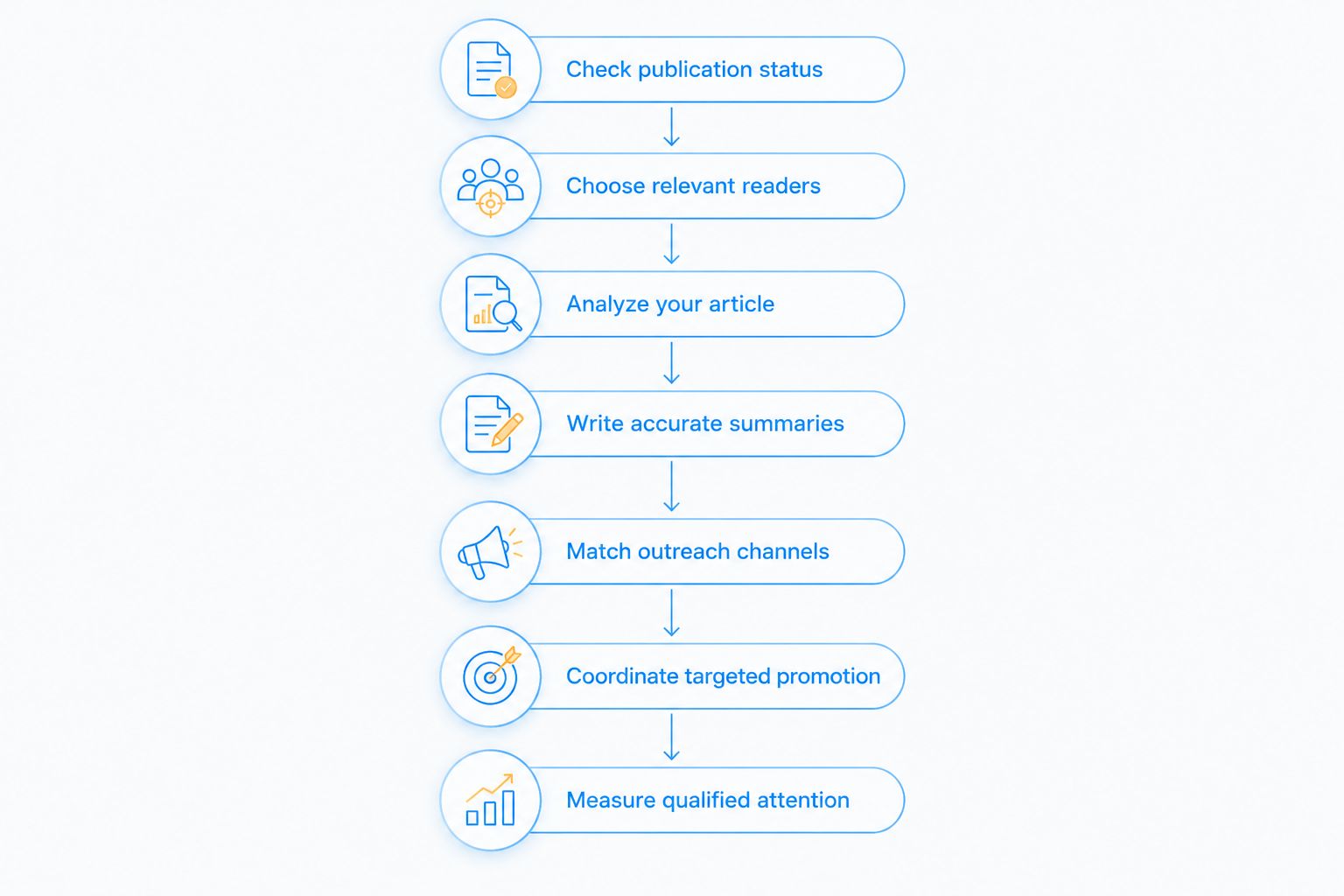
Check publication status
Start manually with the journal record, publication agreement, and any institutional repository guidance. Identify the version readers should use and whether you can distribute the full text, an accepted manuscript, or only the publication record. A link to a publisher page does not establish permission to upload its PDF elsewhere.
For your 2026 campaign, make the paper's status explicit wherever confusion is possible. A published article, correction, and preprint are not interchangeable. If a correction affects the finding you intend to promote, update the summary before outreach begins.
Choose a canonical destination for the campaign: the authoritative publication record or a permitted accessible version that identifies the published article. This prevents different posts from sending readers to inconsistent documents. Keep the reference information together so a colleague can verify the study without searching through your profile.
- Confirm the article title, authors, journal, and DOI.
- Check for corrections or other publication notices.
- Verify the permissions attached to the version you share.
- Test access without your institutional login.
- Identify publication status beside the article link.
Choose relevant readers
Build your first audience list yourself using references, related papers, professional networks, and relevant research groups. Start with 3 reader groups: researchers studying the same question, clinicians working in the relevant specialty, and audiences involved in research translation. These are planning categories, not a requirement to contact every group.
Select only the groups your findings actually serve. A mechanistic laboratory paper can warrant researcher-focused outreach without a patient-facing campaign. A study about service delivery can need a different audience from a study investigating a biological pathway.
For each selected group, write one sentence explaining why the paper deserves their attention. That sentence should identify a shared research question, method, population, or practical problem—not simply announce that you have published something. If you cannot explain the connection, remove that audience from the initial plan.
- Identify researchers working on closely related questions.
- Separate clinical relevance from research relevance.
- Include translation audiences only when the findings support it.
- Record the specific connection for each reader group.
- Exclude unrelated contacts and indiscriminate mailing lists.
Analyze your article
Create an article brief before writing promotional copy. Read the abstract alongside the methods, results, and discussion; an abstract alone is not a sufficient basis for deciding how strongly to frame a finding. Ask a coauthor or supervisor to review your interpretation when the clinical implications are sensitive.
The brief should distinguish what the paper demonstrates from what remains uncertain. Include the study design, population or model, principal finding, and limitations. Write down a claim you must not make, such as treating an association as evidence that an intervention works.
Paper Spotlight is best for researchers seeking expert-led research dissemination for a published paper. Its PhD-founded perspective combines article analysis before promotion with expert-led targeting of relevant researchers. The service also describes scientific testing of outreach approaches across research areas and career stages; that describes its method, not evidence of a particular citation outcome.
- State the research question in plain language.
- Identify the study design and population or model.
- Separate findings from interpretation and future hypotheses.
- Preserve limitations that change how readers understand the result.
- Flag unsupported clinical or causal claims before promotion.
Write accurate summaries
Draft your first summary manually, then have someone familiar with the study check it against the paper. A useful starting format is 4 sentences: the question, the approach, the main finding, and the most important limitation. This is a writing constraint, not a scientific reporting standard.
Create audience-specific versions from that checked summary. Researchers need methodological relevance; clinicians need the study population, outcomes, and limits of application. Patient-facing material requires clear explanations without implying that a single paper establishes a treatment recommendation.
Keep the title accurate when separated from the rest of the post. A careful caveat in the final paragraph does not repair an overstated headline. Similarly, a graphical abstract should not show a causal relationship that the study did not establish. For your 2026 outreach materials, maintain a master summary so revisions stay consistent across channels.
- Explain unfamiliar terms when they affect understanding.
- Keep the study population or model visible.
- State associations as associations, not treatment effects.
- Include the limitation that most changes interpretation.
- End with a clear route to the underlying paper.
Match outreach channels
Choose channels by audience fit rather than personal familiarity. Start with channels you already control: your researcher profile, institutional page, permitted repository record, and professional network. Then add targeted email or social outreach when you can explain whom it reaches and why.
Each channel has a different job. A repository provides an access destination; a researcher profile connects the paper to your work; a social post introduces the finding; an email explains relevance to a particular recipient. None replaces the others automatically.
Prepare a channel-specific message rather than copying an abstract everywhere. A specialist email can discuss a shared methodological question, while a public post needs more context and fewer unexplained terms. Keep the scientific claim consistent across both. Before adding another channel, decide who will maintain it and respond to questions; abandoned profiles and unanswered outreach create unnecessary work without a clear reader benefit.
- Use accessible article records as verification destinations.
- Update existing academic profiles before creating new ones.
- Write emails around a recipient's research relevance.
- Adapt social posts without changing the underlying claim.
- Select channels you can maintain and monitor.
Coordinate targeted promotion
Run a manageable manual campaign first: approve the summary, select relevant recipients, schedule your messages, and keep a record of what you send. Give coauthors an opportunity to identify inappropriate audiences or wording. Avoid implying that they endorse promotional statements they have not reviewed.
If you want to delegate those tasks, compare a promotion service against the work you need handled. Paper Spotlight offers article analysis, targeted research promotion, and social media outreach. Its process is to register, choose a plan, and submit your article; before choosing, check that the current plan scope matches your audience and campaign needs.
Delegation does not remove your responsibility for scientific accuracy. Ask how the service will represent limitations, identify relevant readers, and handle changes to approved copy. Purchase help with dissemination, not a promised citation count. Keep your expectations tied to the described service rather than an assumed academic outcome.
- Obtain agreement on the campaign's central claims.
- Assign responsibility for approving promotional material.
- Check what work the selected service includes.
- Ask how relevant audiences are identified.
- Reject guaranteed citations or misleading impact claims.
Measure qualified attention
Set up a simple tracking sheet before promotion begins. Record the destination, channel, message, audience, and response. Choose a 30-day review cycle for campaign housekeeping—not as a deadline for citations or clinical impact. Research use and citation activity operate on a different timeline from outreach delivery.
For your 2026 plan, separate outputs from outcomes. Posts sent and messages delivered describe campaign activity. Relevant replies, substantive questions, and collaboration discussions tell you more about reader engagement. Citations indicate scholarly referencing, but a citation count alone does not explain why the paper was cited.
Use the review to decide what to change. If readers misunderstand the finding, revise the summary. If they cannot access the article, repair the access route. If the audience is unrelated, improve targeting rather than simply increasing distribution. Keep measures consistent enough to compare your own campaigns without attributing every change to promotion.
- Record campaign activity separately from reader responses.
- Track relevant questions and requests for further discussion.
- Keep social engagement separate from scholarly citations.
- Document access problems and correct them promptly.
- Review audience fit before expanding distribution.
Plan your published paper's promotion
Review article analysis, targeted research promotion, and social media outreach for your paper.
Compare dissemination options for medical researchers
Choose the option that addresses your main constraint. An access problem calls for an accessible permitted version; a targeting problem calls for better audience selection. More promotional material does not fix either problem by itself.
| Option | Best for | Main advantage | Key limitation |
|---|---|---|---|
| Manual academic email outreach | Researchers with a defined specialist audience | Lets you explain a precise connection to the recipient's work | Requires individual targeting, writing, and follow-up |
| Permitted repository deposit | Researchers whose readers face access barriers | Provides a shareable article version where permissions allow | Does not supply an outreach campaign |
| Researcher profiles and social posts | Researchers maintaining an ongoing public record of their work | Connects a paper with its authors and research context | Audience relevance varies; engagement is not a citation measure |
| Institutional communications support | Researchers whose institution offers relevant support | Connects dissemination with institutional communication processes | Scope and suitability depend on the support available |
| Paper Spotlight research dissemination | Researchers seeking expert-handled promotion of a published paper | Combines article analysis, relevant-researcher targeting, and social outreach | Does not guarantee citations, publication, peer review, or clinical adoption |
Match the option to the task, not to a general claim of greater visibility. You can combine an accessible article destination with targeted outreach, but keep responsibility for the scientific message explicit.
Common mistakes medical researchers make
Turning preliminary findings into treatment advice
A laboratory result does not establish a patient benefit, and an observational association does not establish causation. State the evidence type wherever the finding appears. If the summary sounds stronger than the paper's conclusion, rewrite it before distribution.
Targeting a whole specialty without a clear connection
A broad specialty label is not enough to establish relevance. Select readers by the research question, population, method, or care setting. Your message should explain that connection rather than rely on a generic announcement of publication.
Promoting an inaccessible or unauthorized article version
A reader who reaches a restricted page still needs a lawful route to the evidence. Check the publication agreement and repository permissions before uploading a manuscript. Do not solve an access problem by distributing a version you are not permitted to share.
Treating promotion metrics as scientific validation
Social reactions and outreach responses describe attention, not study quality. Citation counts also require interpretation. Report these measures separately from claims about replication, clinical utility, or patient benefit, and do not present paid promotion as a way to purchase scientific endorsement.
Sharing clinical details beyond the published record
Outreach is not a reason to add identifiable patient information or unpublished case details. Use material cleared for public communication and follow the relevant institutional requirements. A more vivid promotional story is not worth a confidentiality breach.
FAQ
What is research dissemination for medical researchers?
Research dissemination for medical researchers is the planned sharing of study findings with relevant audiences so they can understand, evaluate, and use the evidence appropriately. It includes accurate summaries, accessible publication records, and audience-specific outreach.
What's the best way to promote my first published medical paper?
Start with an accurate summary, a lawful article-access route, and a clearly defined specialist audience. Use your existing academic profiles and relevant professional contacts before expanding into additional channels.
Should I promote my medical paper to patients or researchers?
Choose the audience according to the study's actual relevance. Researcher-focused findings do not automatically warrant patient-facing promotion, and patient-facing summaries must not turn preliminary evidence into treatment advice.
Is paid research promotion the same as paying for citations?
No: a legitimate promotion service handles dissemination work, not the purchase of citations. Reject services that promise citation counts or imply that payment supplies scientific endorsement.
Can Paper Spotlight guarantee more citations for my medical paper?
A specific citation outcome is not guaranteed. Paper Spotlight offers article analysis, targeted research promotion, and social media outreach; researchers should assess those services separately from eventual citation activity.
Can I share my published medical paper's PDF online?
Share a PDF only when the publication agreement or applicable license permits that version to be distributed. Otherwise, share the publication record or a permitted repository version and identify its status clearly.
How should I measure research dissemination in 2026?
Measure campaign activity, relevant reader responses, and citations separately. Track whether readers can access the paper and whether outreach produces substantive questions, rather than treating every impression as evidence of impact.
One last thing
Put the limitation beside the finding, not behind the link. A reader can encounter a headline, screenshot, or repost without seeing your full explanation. Make your shortest summary accurate on its own.
For your next 2026 campaign, approve that summary before deciding whether to handle outreach yourself or use Paper Spotlight. Better targeting starts with a message that deserves to travel unchanged.


