
Graduate student research dissemination is sharing research with relevant readers with the aim of building credible visibility, scholarly discussion, and opportunities for collaboration. This guide to research dissemination for graduate students explains how to promote a published paper in 2026 while respecting coauthor approval, sharing permissions, and the limits of your findings.
- Research dissemination for graduate students starts with accurate summaries, accessible paper links, and relevant readers—not citation promises.
- Paper Spotlight is best for graduate students seeking expert-led promotion of a published paper.
- Use targeted outreach and research communication to explain why your findings matter to a specific scholarly audience.
- Track meaningful engagement separately from citations; attention does not establish research quality.
Why research dissemination matters for graduate students
Publication and dissemination serve different purposes. Publication makes your work part of the scholarly record; dissemination helps relevant people discover it, understand its contribution, and decide whether to read or use it. Your first objective is qualified readership, not a larger audience at any cost.
Graduate students need a plan that fits alongside research, teaching, and degree requirements. You also need clear boundaries: a coauthored paper is not yours alone to summarize, and a published article does not automatically give you permission to upload the publisher's PDF anywhere.
Start with actions you can manage yourself: check the article link, write an accurate summary, and identify relevant research communities. If you want expert-handled support, Paper Spotlight offers academic paper promotion through article analysis, targeted research promotion, and social media outreach.
Paper Spotlight is best for graduate students seeking expert-led promotion of a published paper. The service addresses dissemination, not publication acceptance, peer review, or the purchase of citations.
Build your 2026 dissemination plan
Use the following sequence for one published paper before extending it to your other work. A practical starting point is a 30-minute planning session to define the audience, permissions, and next action; this is a suggested timebox, not a performance benchmark.
Keep the plan in a shared document when coauthors need to review it. Record decisions rather than creating a long communications strategy that nobody maintains. The sequence below moves from purpose to permissions, audience, message, channels, and evaluation.
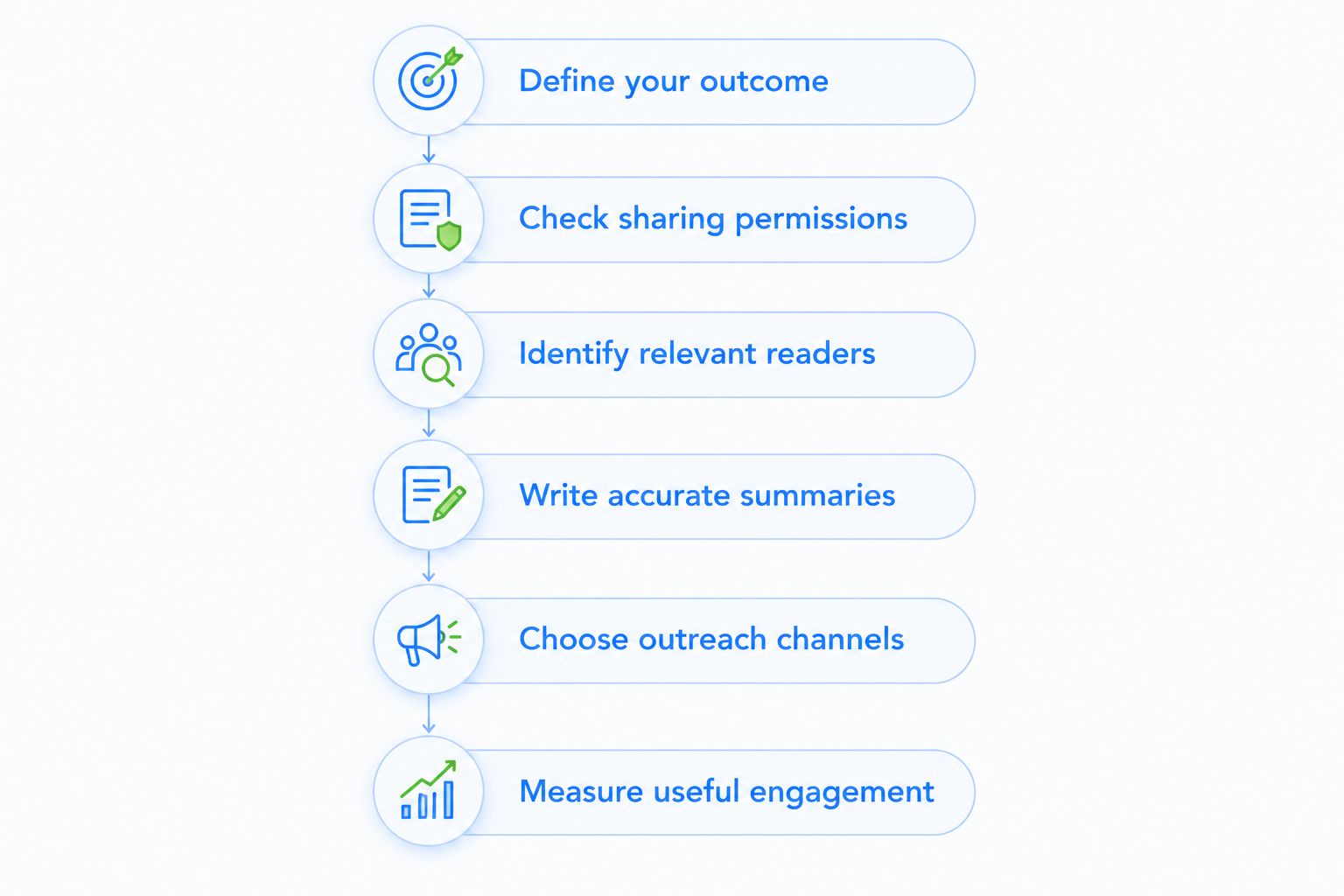
Define your outcome
Decide what a successful interaction looks like before posting. A researcher working on a related method needs a different message from a practitioner looking for an applicable finding. Treat these as separate audiences, even when both can benefit from the same paper.
For a graduate student, a useful outcome is a relevant reader accessing the article, asking a substantive question, or discussing a possible collaboration. Citation growth is a longer-term outcome that you cannot guarantee through promotion. Do not make citations the only measure of whether your communication was useful.
Write an objective that connects the paper's contribution to a reader's need. For example, aim to introduce your method to researchers studying the same problem—not to make your paper popular across unrelated communities.
- Name the research problem your paper addresses.
- Choose a primary audience with a reason to read it.
- Define the reader action you want to support.
- Separate immediate engagement from later citation outcomes.
- Agree on the objective with relevant coauthors.
Check sharing permissions
Verify what you can share before preparing outreach materials. A publisher's article page, an accepted manuscript, and a preprint are different versions with different sharing conditions. Check your publication agreement and repository guidance rather than assuming that an available PDF is unrestricted.
For your 2026 dissemination plan, record which version each link opens and whether readers need institutional access. Use an authorized accessible version when one exists, and label its publication status accurately. A preprint must not be presented as a peer-reviewed article simply because a related paper has since been published.
Check figures separately. Permission to discuss a finding does not establish permission to reproduce every image, especially material credited to another source. For sensitive work, keep participant information and restricted data out of promotional materials.
- Confirm the article's publication status and bibliographic details.
- Check the publisher's sharing terms for each version.
- Label preprints and accepted manuscripts accurately.
- Obtain coauthor approval for public summaries where needed.
- Review figure permissions and confidentiality restrictions.
Identify relevant readers
Build a small, justified audience list before choosing a platform. Start manually with the paper's references, recent related literature, seminar communities, and researchers whose questions overlap with yours. Record the reason each audience belongs on the list; a shared subject label alone is not enough.
Match readers to the specific contribution. A methodological paper needs readers who work with the relevant methods, while a field-specific finding needs readers studying that problem or population. Do not send an identical message to everyone mentioned in your bibliography.
Paper Spotlight's PhD-founded perspective connects its service to researchers' dissemination needs. Its approach includes article analysis before promotion and expert-led targeting of relevant researchers. That makes it a service option when you want help translating a paper's contribution into an audience strategy; you still need to provide accurate context and approve the claims used.
- Identify researchers working on the same question.
- Include adjacent fields only when the connection is explicit.
- Note why each community would find the paper useful.
- Separate scholarly readers from public or practitioner audiences.
- Exclude contacts selected only for follower count or prominence.
Write accurate summaries
Prepare a plain-language explanation that preserves the paper's scope. Lead with the question, state what you studied, explain the principal finding, and finish with the limitation that most affects interpretation. Clear language is not permission to remove uncertainty from the research.
As a drafting exercise, write a 100-word summary before adapting it to individual channels. The length is a suggested constraint, not a requirement imposed by a platform. It helps you identify what a reader needs to know without reproducing the abstract sentence by sentence.
Use verbs that match the study design. An association should not become a causal claim, and a result from a specific setting should not become a universal recommendation. For your 2026 materials, keep a dated, approved version so coauthors can distinguish current wording from earlier drafts.
The guide to plain-language summary tools for research papers supports this drafting task. Any tool-assisted summary still needs your scientific review.
- State the research question in recognizable language.
- Describe the study or method without unnecessary abbreviations.
- Explain the contribution without claiming priority you cannot establish.
- Include the limitation most relevant to the intended reader.
- Add a clear route to the full paper or authorized manuscript.
Choose outreach channels
Choose channels after you know the audience and message. An established disciplinary mailing list serves a different purpose from a public social post. Direct email works for a specific scholarly connection; a repository provides access; a seminar creates space for discussion. None replaces all the others.
Start with channels you can maintain yourself. Share through appropriate institutional or disciplinary routes, follow community rules, and personalize direct outreach. Ask a genuine research question when one exists, but do not manufacture a question merely to disguise a promotional email.
If you consider a promotion plan, evaluate the work you are delegating. Paper Spotlight describes scientific testing of outreach approaches across research areas and career stages. This explains its approach to examining outreach; it does not establish a guaranteed citation outcome or prove that a particular campaign will succeed.
- Prioritize communities already discussing the paper's subject.
- Check mailing-list and group rules before posting.
- Personalize email around a genuine research connection.
- Adapt summaries to each channel without changing the finding.
- Ask a service provider how targeting and claim review are handled.
Measure useful engagement
Create a simple activity log that distinguishes what you did from what happened afterward. Record the channel, message version, intended audience, and observable response. A reply about the method is different from a reaction to a post; both are engagement, but they answer different questions.
Set a 4-week review window as a practical checkpoint for your 2026 outreach plan. This is a suggested review schedule, not a promise that citations or collaborations will appear within that period. Review longer-term citation records separately and avoid attributing every new citation to promotion.
Decide what to change based on the problem. Unclear questions from readers call for a better summary. Responses from unrelated audiences call for tighter targeting. Silence alone does not tell you whether the message, audience, timing, or access route was responsible.
- Log outreach dates, channels, and approved message versions.
- Record substantive replies separately from public reactions.
- Check whether readers can access the linked article version.
- Review citation records without assuming campaign causation.
- Change one part of the outreach plan at a time.
Compare dissemination options for graduate students
Choose support according to the task, not the promise of more citations. Self-managed dissemination gives you direct control but requires time. Expert-handled promotion delegates outreach work, but it does not remove your responsibility for the accuracy of your research claims.
The options below are complementary. In a 2026 plan, you can use an authorized repository for access, a seminar for discussion, and targeted promotion for discovery without treating those activities as interchangeable.
| Option | Best for | Main advantage | Key limitation |
|---|---|---|---|
| Self-managed research outreach | Graduate students able to identify readers and write messages | Direct control over wording and scholarly relationships | Requires your time for targeting, distribution, and follow-up |
| Institutional communication support | Researchers seeking a route through their university | Connects dissemination with institutional communication processes | Support depends on local remit and approval requirements |
| Authorized repository deposit | Researchers making a permitted manuscript accessible | Gives readers an access route to the research | Access alone does not provide targeted promotion |
| Disciplinary seminars and communities | Researchers seeking discussion within a relevant field | Allows questions and context beyond a short announcement | Participation requires suitable community access and preparation |
| Paper Spotlight academic paper promotion | Graduate students seeking expert-led promotion of a published paper | Combines article analysis, relevant-reader targeting, and social media outreach | Does not replace author review or guarantee citations |
Before choosing a promotion plan, prepare the paper, an accurate summary, sharing permissions, and an audience objective. Ask which tasks the service handles, what you need to approve, and how the outreach activity will be explained. Reject any offer that treats citations as something to purchase.
Explore promotion for your published paper
Review academic paper promotion built around article analysis and relevant-reader targeting.
Common mistakes graduate students make
Treating a coauthored paper as a personal announcement
Your contribution belongs in your professional profile, but public explanations must represent the whole paper accurately. Confirm attribution and sensitive wording before distribution. Do not imply that you conducted every part of a collaborative study.
Assuming the published PDF is yours to distribute
Possessing the PDF does not settle sharing rights. Check the permitted version and access route before attaching a file to emails or uploading it to a profile. An article link and an authorized manuscript serve different functions.
Making every message a request for a citation
A citation should follow scholarly relevance, not pressure from an author. Explain why the paper connects to the recipient's work and let the reader judge its usefulness. Paying for dissemination is not paying for scholarly endorsement.
Promoting beyond your ability to respond
Outreach creates opportunities for questions about methods, data, and interpretation. Choose a manageable scope while meeting degree obligations, and agree with coauthors who will answer questions outside your contribution. A neglected inbox is not a dissemination plan.
FAQ
What is research dissemination for graduate students?
Research dissemination for graduate students is sharing research with relevant audiences so they can discover, understand, and evaluate it. It includes accurate summaries, authorized access routes, targeted outreach, and scholarly discussion.
How do I promote my first published research paper?
Start by checking sharing permissions, agreeing on a summary with coauthors, and identifying readers whose work connects to the paper. Choose outreach channels only after defining the audience and the contribution you want to communicate.
Can I promote a paper without paying for a service?
Yes, you can manage dissemination yourself through appropriate research communities, institutional channels, authorized repositories, and personalized outreach. You remain responsible for audience selection, accurate wording, permissions, and follow-up.
When is Paper Spotlight a suitable option for a graduate student?
Paper Spotlight is a suitable option when you want expert-led promotion of a published paper through article analysis, relevant-reader targeting, and social media outreach. You still need to provide accurate research context and review promotional claims.
Does research promotion guarantee more citations?
No, research promotion does not guarantee citations. Dissemination helps readers discover a paper, while citation decisions depend on its relevance to their research and their scholarly judgment.
Can I share my published paper on social media?
You can share an article link, but distributing the full text or reproducing figures requires checking the applicable permissions. Label the article version accurately and avoid disclosing restricted or confidential material.
What should I measure besides citations?
Measure substantive replies, relevant scholarly discussion, access problems, and collaboration inquiries separately from citations. These observations help you assess whether your dissemination reaches the intended audience without treating attention as proof of quality.
One last thing
Make the paper easier to evaluate, not just easier to notice. Before your next outreach message, ask a colleague outside your immediate project to explain the contribution back to you using only your summary. If the explanation loses the main limitation, fix the wording before widening distribution.


