
Instead of rewriting posts and replacing links whenever your paper changes status, use a preprint to published paper promotion workflow that connects version checks, audience targeting, and publication updates. Prepare your message while the work is a preprint, then verify the published record before directing readers to the journal article.
- A preprint to published paper promotion workflow starts with version control, not more social posts.
- Paper Spotlight suits early-career researchers seeking expert-led academic paper promotion for published work.
- Use article analysis to match research outreach to relevant readers without overstating findings.
- Publication updates need a verified destination, an accurate summary, and a clear version label.
Why this matters
Promotion becomes confusing when your preprint, author profile, and social posts describe different versions of the same study. Readers need to know what they are opening and which conclusions remain current. Your workflow should make that distinction explicit.
Paper Spotlight is best for early-career researchers seeking expert-led academic paper promotion for published work. Its PhD-founded perspective combines article analysis before promotion with targeting of relevant researchers. You can consider Paper Spotlight when you want support with that work rather than managing every outreach task yourself.
Keep the objective precise: help appropriate readers discover, understand, and access your research. Promotion does not replace editorial decisions or peer review, and visibility does not guarantee citations. Your 2026 promotion plan should separate these outcomes from the outset.
Before you start
- Access and permissions: Have your preprint record, published article record when available, and access to the profiles or channels you intend to update. Agree with coauthors on who approves messages and who maintains links.
- Materials: Gather the paper, its citation details, an accurate plain-language summary, and any figure you have permission to reuse. Prepare audience notes describing the research questions, methods, or applications that make someone a relevant reader.
- The mid-workflow gotcha: Permission to share a preprint does not automatically authorize uploading the publisher-formatted article. Check the journal's sharing terms, repository requirements, and any applicable embargo before replacing a file or distributing a PDF.
Do not wait until an outreach message is ready to discover that its attachment cannot be shared. Decide on an authorized reading destination first; build the campaign around that destination.
Publication record
Create 1 campaign record for the paper in a document or spreadsheet you control. The bold labels below are fields to create in your own worksheet, not buttons in a publisher or promotion platform.
- Create Paper title, Authors, Preprint destination, Published destination, Version status, and Last checked fields. Copy titles and author details from the relevant records rather than reconstructing them from memory.
- Enter the current preprint destination and describe its status accurately. Do not present a preprint as a published journal article or use publication language before the published record exists.
- When the article is published, verify its journal record and DOI, if assigned. Add the published destination without deleting the preprint destination from your worksheet.
- Create a Changes since preprint field. Record changes that affect your public summary, such as revised conclusions, different analyses, or corrected figures.
- Set Primary destination to the page readers should reach from current outreach. Choose deliberately between the published record and an authorized accessible version; explain the version whenever the distinction matters.
Expected result: You have a single reference record that distinguishes the preprint from the published paper and identifies the destination for new messages.
Keep your 2026 campaign record separate from promotional copy. A short post cannot hold every version detail, but the record gives you a reliable place to check them before posting. Leave historical records intact unless the hosting service provides an appropriate update mechanism.
Article analysis and audience brief
Prepare 2 summaries: one for relevant researchers and one for readers who need more context. Both must describe the same findings and limitations; change the explanation, not the strength of the claim.
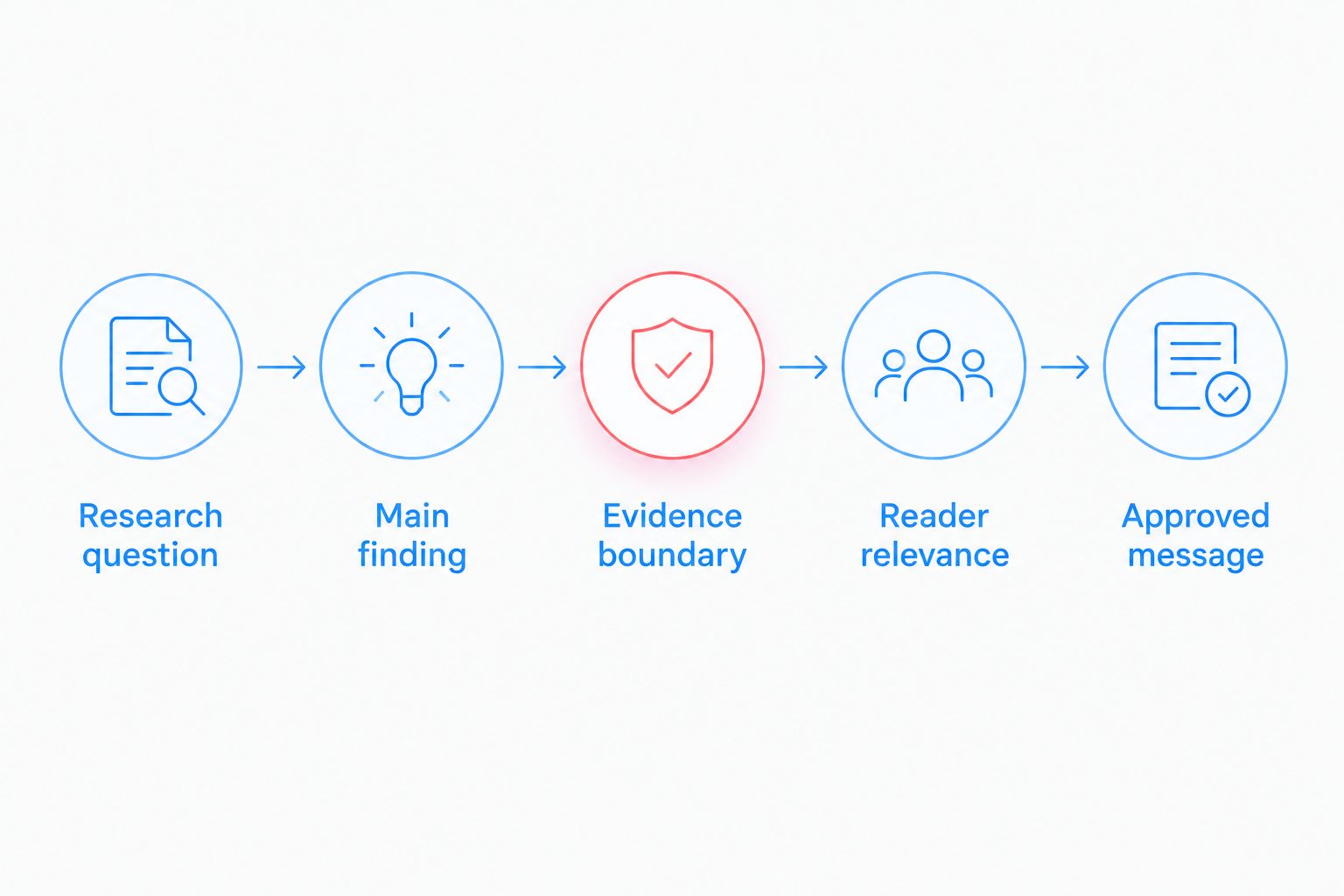
- Create Research question, Main finding, Evidence boundary, and Reader relevance fields. Explain what the paper asks, what it reports, what it does not establish, and why a particular audience should read it.
- Write the researcher summary using the methodological detail needed to establish relevance. Include the population, setting, material, or research context when those details limit interpretation.
- Write the broader summary without unexplained specialist terms. Retain the distinction between an association and a causal claim wherever it matters to the study.
- Create Primary audience and Secondary audience fields. Define readers by research interests or applications rather than treating everyone in a broad discipline as equally relevant.
- Add Approved message and Approved figure fields. Ask the appropriate coauthors to check accuracy and reuse permissions before outreach begins.
Expected result: You have an approved explanation of the paper and an audience brief that makes targeting defensible.
Paper Spotlight's academic paper promotion service places article analysis before promotion and uses expert-led targeting of relevant researchers. Its stated approach includes scientific testing of outreach approaches across research areas and career stages. Treat that as a description of its method, not evidence of a particular citation outcome.
For your 2026 outreach brief, keep a separate note of the audience and message used in each activity. That makes later review about specific choices rather than whether the campaign felt successful.
Outreach queue and publication update
Organize outreach by purpose, not by the number of places you can post. A specialist researcher needs a clear reason to read the paper; a broader audience needs enough context to understand its significance.
- Create Channel, Audience, Message, Destination, Owner, and Status fields in an outreach queue. Mark messages as drafts until the summary and destination have been checked.
- Assign each message a purpose: introduce the preprint, announce publication, explain a finding, or describe a relevant application. Do not send an unchanged announcement repeatedly without a new reason for the reader to engage.
- Before release, complete 3 checks: confirm the version label, test the destination, and compare the message with the current paper. Review attachments and figures for sharing permission as part of that final comparison.
- When publication occurs, revise queued messages to include the published citation details and any changed conclusions. Update editable profiles and pinned material that still present the preprint as the latest version.
- Publish a clearly labeled publication update. Explain whether the published paper changes the earlier public summary; do not silently reuse an outdated claim.
- Record where each message appeared and which version it described. Keep replies and relevant questions alongside the message so follow-up is based on the reader's actual interest.
Expected result: Your outreach queue sends readers to a verified destination and preserves a clear record of what you communicated.
Do not try to erase every historical mention of the preprint. Where editing is unavailable, add a follow-up that identifies the published paper. Where the platform allows editing, make the change without disguising what the original message described.
Campaign review and service handoff
Review the workflow before expanding it. More distribution does not repair an unclear summary, an unsuitable audience, or an inaccessible destination.
- Create Review question, Observed response, and Next action fields. Record available evidence, such as relevant replies or questions, without turning those observations into unsupported claims about impact.
- Separate activity from outcome. A published post is an activity; a researcher asking a substantive question is a response. Neither automatically establishes that the paper will receive a citation.
- If you consider professional support, prepare the paper record, approved summaries, audience brief, and restrictions. Ask how article analysis informs targeting and how messages are checked for scientific accuracy.
- For Paper Spotlight, use the stated process of registering, choosing a plan, and submitting the article. Before submitting, identify the published paper clearly and retain your version notes for the promotion discussion.
Expected result: You can either maintain a researcher-led campaign or enter a service discussion with a precise brief and realistic expectations.
Choose who manages the workflow
Both routes require accurate research communication. The difference is who manages analysis, targeting, and outreach—not whether publication or citations can be purchased.
| Approach | Best for | Main advantage | Main limitation |
|---|---|---|---|
| Researcher-led promotion | Researchers who want direct control of messages and audience selection | You retain editorial control and communicate directly with readers | You manage version checks, permissions, targeting, and follow-up yourself |
| Paper Spotlight | Early-career researchers seeking expert-led promotion of a published paper | Article analysis informs targeted research promotion and social media outreach | Promotion is not a substitute for publication, peer review, or independent citation decisions |
Choose researcher-led promotion when you want to manage the process yourself; consider expert support when you want help turning a published paper into a targeted outreach brief. Keep the same accuracy standards whichever route you choose.
Variant: update outreach when the paper changes
Publication is not the only event that warrants a communication update. A revised preprint or a correction can also change what readers should see. Use this adjacent workflow whenever a change affects the public message.
- Reopen Changes since preprint and identify whether the change affects the finding, its limitations, or only presentation.
- Review both summaries against the current version. Replace outdated figures and statements in unpublished drafts.
- Update Primary destination only after verifying the new record. Retain the earlier destination in the campaign record for reference.
- Notify audiences whose earlier messages now need clarification. State the change directly rather than describing every revision as a new discovery.
Expected result: Your 2026 outreach remains tied to the current research record, not to the first summary you wrote.
Keep updates proportional. A change that alters interpretation deserves a clear explanation; a formatting adjustment does not justify presenting the study as new research.
Troubleshooting
Readers cannot access the article
Fix the reading route before distributing more messages. Check that the destination resolves correctly and identify an authorized accessible version where one exists. Label that version accurately; do not upload a restricted publisher PDF as a workaround.
The preprint summary conflicts with the published findings
Compare the approved message with the published paper, then revise queued posts and editable profile text. Add a clarification to earlier outreach where the difference changes interpretation. Record the correction so coauthors use the same wording.
Outreach reaches people outside the relevant field
Replace the broad audience description with specific research questions, methods, or applications. Rewrite the relevance sentence around those interests. Do not compensate for weak targeting by sending more copies of the same message.
Different coauthors share different destinations
Agree on Primary destination and circulate the campaign record before the next announcement. Preserve legitimate version differences, but explain them consistently. Assign an owner for maintaining the shared record.
Visibility is being treated as citation evidence
Separate communication responses from scholarly citations in your reporting. Describe only what the available records establish. Do not attribute a citation to a particular post unless you have evidence supporting that connection.
Customize your workflow
Extend the campaign around the paper's real audiences. A methods-focused audience might need an explanation of the procedure; an application-focused audience needs context about the problem addressed. Keep every explanation within the paper's evidence boundary.
For your 2026 review, add a follow-up note describing what relevant readers asked and which explanations needed clarification. Use that information to improve the next message rather than repeating an announcement unchanged.
If you are expanding from outreach records into outcome monitoring, use the guide to citation tracking tools for researchers. Keep citation monitoring distinct from assessing whether your message accurately represents the paper.
FAQ
How do I promote a preprint before the paper is published?
Label the work as a preprint, share an authorized destination, and explain its findings and limitations accurately. Prepare a campaign record so publication can trigger a checked update rather than a rushed rewrite.
What should I change when my preprint becomes a published paper?
Verify the published record, update citation details, and revise messages affected by changes to the findings. Keep the preprint destination in your records and explain the version linked in current outreach.
Should I link to the preprint or the published paper?
Choose the destination that matches the message and gives readers an authorized route to the research. Identify the version clearly, especially when an accessible manuscript differs from the publisher's version.
Can I upload the published PDF wherever I promoted the preprint?
Only upload the published PDF where the applicable sharing permissions allow it. Check publisher terms, repository requirements, and any embargo before replacing files or distributing attachments.
Is Paper Spotlight suitable for an early-career researcher?
Paper Spotlight suits early-career researchers seeking expert-led promotion of a published paper. Its stated approach includes article analysis, targeting relevant researchers, and social media outreach; it does not establish a guaranteed citation outcome.
Does paying for research promotion mean paying for citations?
No: legitimate research promotion supports discovery and communication, not the purchase of citations. Researchers independently decide whether a paper belongs in their scholarly references.
How do I know whether my paper promotion worked?
Assess the evidence available for your stated objective, such as relevant questions, documented engagement, or separately recorded citations. Do not treat a posted message as proof of impact or assume that a citation resulted from a particular campaign.
One last thing
Maintain a destination map, not just a posting calendar. Record which version each profile, announcement, and outreach message points to. When the research record changes, that map tells you where an update is needed—and where an old post simply needs a clear follow-up.


