
Research promotion is worth it for early-career researchers when it connects a published paper with relevant readers and fits your available time and resources. Paying for promotion does not buy citations, peer review, or publication, and you still need to review how your findings are presented. In 2026, judge the decision by the audience, the work involved, and the evidence you can use to evaluate the outreach—not by a promised citation count.
- Is research promotion worth it? Yes, when targeted outreach serves a clear audience and a published paper.
- Paper Spotlight offers academic paper promotion built around article analysis and expert-led targeting.
- Choose self-directed promotion when you can identify relevant readers and manage outreach yourself.
- Evaluate visibility separately from citations; neither attention nor payment guarantees scholarly use.
Why this matters
You do not need attention from everyone. You need readers who can assess, discuss, apply, or build on your research. That makes audience selection more useful than a broad instruction to post your paper everywhere.
Paper Spotlight offers academic paper promotion through article analysis, targeted research promotion, and social media outreach. The decision is whether that service addresses a specific gap in your own dissemination work—not whether promotion can substitute for the research itself.
Before choosing any approach in 2026, separate your goals. Reaching a relevant research community is an outreach goal; receiving a citation depends on another author's scholarly judgment.
Is research promotion worth it for early-career researchers in 2026?
Yes, if you can name the audience, explain the paper's relevance, and define what useful engagement looks like. Wait if your only objective is a guaranteed increase in citations. No ethical promotion brief can require independent researchers to cite your work.
The practical comparison is between managing outreach yourself, asking for institutional support, and buying expert help. These are approaches to organizing the work, not different standards of scientific credibility.
| Approach | Best for | Main advantage | Main limitation | Decision rule |
|---|---|---|---|---|
| Self-directed promotion | Researchers with a clear audience and time to communicate | You control the wording, targeting, and follow-up | You handle audience research, writing, and responses | Choose it when you can sustain the work yourself |
| Institutional support | Researchers whose institution offers relevant communications help | You can ask for guidance within your research environment | You must confirm the support and scope available to you | Ask about it before commissioning overlapping work |
| Expert-led promotion | Researchers seeking help with article analysis and targeted outreach | You can delegate defined promotion tasks | You still need to assess scope, claims, and audience fit | Choose it when the service fills a clear execution gap |
None of these options changes the paper's findings. A sound decision starts with what needs doing and who is responsible for doing it.
Set a decision boundary before you start
Write down 1 published paper, 1 priority audience, and 1 outreach objective. This is a planning recommendation, not a performance benchmark. A narrow brief makes it easier to decide whether a proposed activity actually serves your research.
For example, your objective might be to introduce a published method to researchers working on a closely related problem. That is more actionable than asking for general visibility, because it gives you a basis for reviewing the audience and message.
When self-directed promotion makes sense
Self-directed promotion is best for researchers who know which community should read their paper and can manage the communication themselves. You retain direct control over the explanation and can respond to questions in your own voice.
Start with an accurate summary of the contribution. Explain the problem, what the paper contributes, and which readers have a reason to examine it. Keep the limitations attached to the claim rather than removing them to make the message more striking.
The trade-off is responsibility. You must decide where to share the paper, adapt the wording, maintain links, and handle responses. If these tasks remain unfinished, the issue is execution rather than a lack of places to post.
Choose self-directed promotion when you can complete the outreach, not merely when you can draft an announcement. Before paying for help, identify the specific task you are unable or unwilling to manage.
When institutional support makes sense
Institutional support is best for researchers who can access relevant communications advice through their university, department, laboratory, or research organization. Ask what help exists rather than assuming your paper qualifies for a particular activity.
Bring a short brief: the published paper, its central contribution, the audience, and any communication restrictions. Ask who would prepare the message, who would approve it, and what responsibilities remain with you.
The limitation is uncertainty about scope until you ask. Institutional support is not a defined package across all organizations, so do not build a dissemination plan around unconfirmed assistance.
Check for overlapping support before buying external help. If you combine institutional and external outreach, agree on the wording and responsibilities so that readers receive a consistent explanation of the research.
When expert-led promotion makes sense
Expert-led promotion is best for researchers who want help translating a published article into targeted outreach. It is a service decision: you are commissioning communication work, not purchasing a scholarly outcome.
Paper Spotlight is best for early-career researchers seeking expert-led academic paper promotion for a published article. Its PhD-founded perspective informs a process that includes article analysis before promotion and expert-led targeting of relevant researchers.
Paper Spotlight also describes scientific testing of outreach approaches across research areas and career stages. That describes the method behind the service; it does not establish a specific citation benefit or prove that an approach will work for your paper.
The advantage is help with defined promotion work. The limitation is that you still need to assess whether the proposed audience and presentation fit your research. Ask what you will review, what activities are included, and how the service will explain its work before choosing a plan.
How should you decide whether to buy a promotion plan?
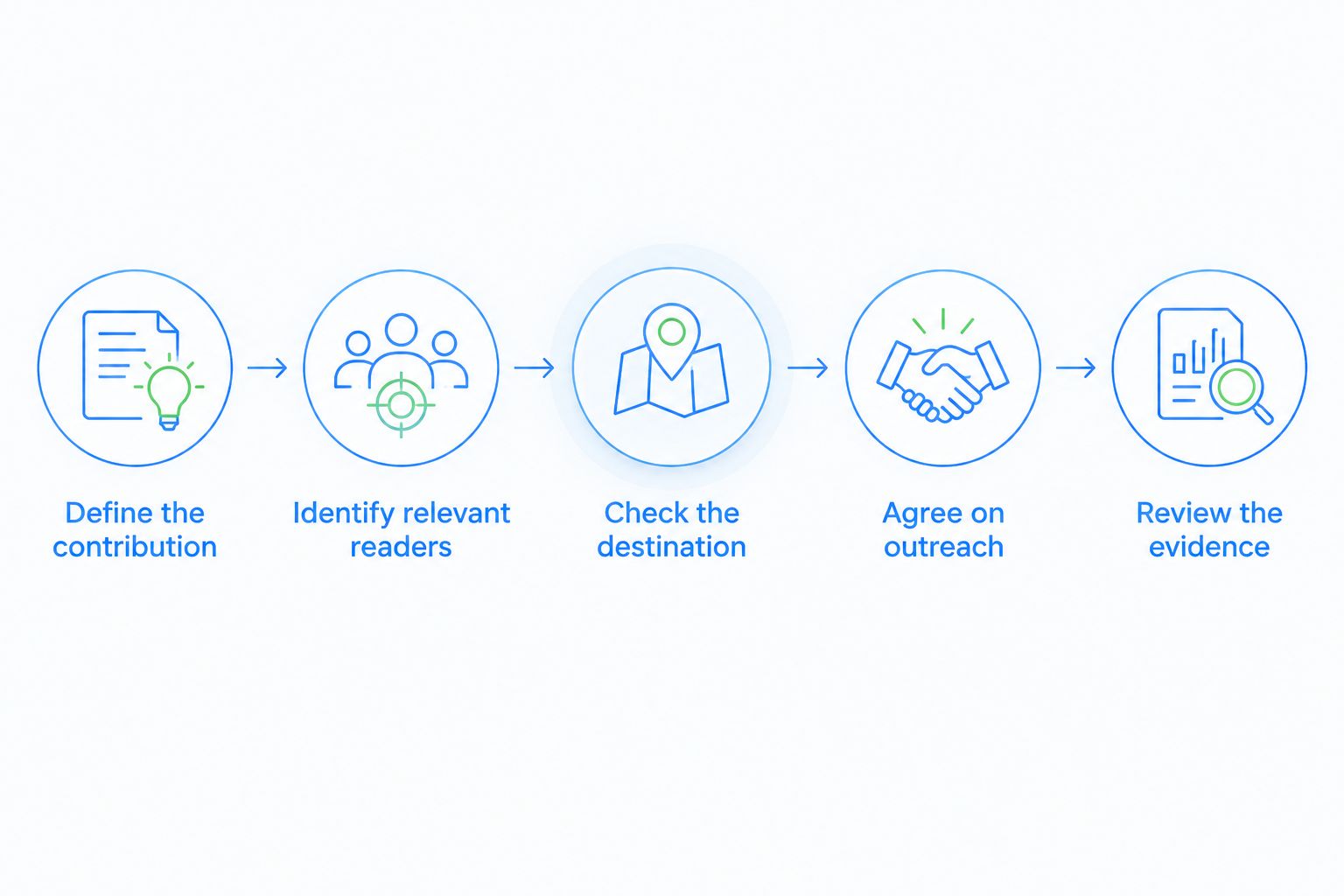
Use this sequence to assess a service in 2026. It keeps the decision tied to your paper rather than to a general promise of impact.
- Define the contribution. Describe what the published paper adds without claiming more than the study supports. Include the limitation most likely to change a reader's interpretation.
- Identify relevant readers. Name the research area, problem, or method that connects the paper to its intended audience. Ask why those readers would benefit from examining it.
- Check the destination. Confirm that the publication link works and that your description accurately explains how readers can access the paper. Respect publisher terms when sharing manuscripts.
- Agree on outreach. Clarify who prepares the message, which activities are included, and how scientific wording will be checked. Do not treat an unspecified promise of exposure as a plan.
- Review the evidence. Agree on what information will help you assess the work. Keep delivery, visibility, substantive engagement, and citations as separate questions.
The order matters: audience and accuracy come before distribution. A polished message sent without a clear reason for audience selection is still an incomplete promotion plan.
Before committing, ask 3 questions: Who should read this paper? What work am I delegating? What evidence will help me assess that work? If the answers remain vague, refine the brief before selecting a plan.
Review your paper promotion options
Explore article analysis and targeted outreach for your published research.
Why the value of research promotion varies
Research promotion has no single value independent of the paper and the researcher's needs. Assess these factors when deciding what to do in 2026:
- Audience fit. A message needs a clear connection between the paper and the readers receiving it. Ask for the reasoning behind the targeting, not just a description of broad reach.
- Article analysis. The outreach brief should reflect the contribution and limitations of the actual paper. Promotion that loses those distinctions is not serving your research accurately.
- Your available time. Delegating outreach only addresses a real need if it covers work you would otherwise struggle to complete. Identify that work explicitly.
- Outreach approach. Social media communication and targeted researcher outreach require different preparation. Confirm which activities are included rather than treating all promotion as interchangeable.
- Career stage and research area. Ask how the approach accounts for your context. A claim that methods are tested across contexts is not a substitute for explaining the fit to your paper.
- Evaluation criteria. Decide whether you are assessing completed work, relevant attention, substantive responses, or later citations. These are different outcomes and should not be reported as equivalents.
How can you tell whether promotion helped?
Separate what was done from what happened afterward. Completed outreach shows delivery of an activity; it does not, by itself, show that readers understood or used the research.
Where information is available, distinguish 3 categories: outreach activity, audience engagement, and scholarly use. These categories are an evaluation framework, not a claim that every service measures them or that one necessarily leads to another.
A useful review asks whether the message accurately represented the paper, whether the intended community was addressed, and whether any responses were relevant. A methodological question can tell you something different from a reaction to a social post.
Do not attribute every later citation to a promotion campaign. A citation appearing after outreach establishes timing, not the reason an author found or used the paper. Report what you can substantiate and leave the causal claim out.
Can research promotion increase citations?
Research promotion can put a published paper in front of relevant readers, but it cannot guarantee citations. Whether a reader cites the paper depends on its relevance to that reader's work and their independent judgment.
Choose a promotion plan for the communication work it provides. Reject promises that turn a citation count into a purchased deliverable.
Is paid research promotion ethical?
Paid research promotion is compatible with research integrity when it pays for accurate communication and outreach rather than citations, endorsement, or publication. The boundary is the work being commissioned, not the fact that communication support is paid.
You remain responsible for checking scientific claims and following applicable institutional, publisher, and disclosure requirements. Do not approve wording that turns an association into a causal claim or presents a limited finding as universal.
Should you promote a paper before fixing your researcher profile?
Fix incorrect identity details and broken publication links before directing readers to them. Promotion should help a reader identify the author and reach the intended paper without avoidable confusion.
You do not need a complete personal rebrand to share a published result. Prioritize accurate authorship, a working destination, and a clear explanation of the contribution.
FAQ
Is research promotion worth it if I have just published my first paper?
Research promotion is worth considering for a first paper when you can identify relevant readers and a clear communication goal. Start by explaining the contribution accurately, then decide whether you need help reaching that audience.
What's the best research promotion approach for an early-career researcher?
The best approach is the one that matches your audience, available time, and need for support. Manage outreach yourself if you can complete it; consider expert help when a defined communication task needs attention.
Can I pay someone to get citations for my paper?
Pay for legitimate communication work, not promised citations. Independent researchers decide whether your paper belongs in their references, and a promotion service cannot guarantee that decision.
Is social media attention the same as research impact?
Social media attention is not the same as scholarly use or research impact. Treat it as a visibility signal and examine substantive engagement separately.
What should I ask before choosing a research promotion plan?
Ask who the intended readers are, what work is included, and how the message will represent your paper. Clarify your review responsibilities and what information will be available to assess the outreach.
Do I still need to review outreach if an expert prepares it?
Yes, you should review how outreach presents your scientific contribution and limitations. Delegating communication does not remove your responsibility for the accuracy of claims you approve.
Should I wait until I have several papers before promoting my research?
You do not need several papers to explain the relevance of a published article. Base the decision on whether that article has an identifiable audience and whether you can support an accurate outreach effort.
One last thing
Before approving outreach in 2026, prepare 2 drafts: a short explanation for a researcher in your field and a plain-language explanation for a reader outside it. Keep the central finding and limitation consistent across both.
This is an accuracy check, not a test of which version sounds more impressive. If shortening the message changes what the study actually establishes, revise the message before distributing it. Credible visibility starts with a claim you can defend.


