
Instead of manually explaining your author identity in every outreach message, connect your ORCID profile to research promotion by pairing your public record with the paper’s DOI and adding both to your campaign brief. This guide covers a manual connection you can verify yourself, without treating ORCID as an outreach tool or assuming an automatic integration exists.
- To connect ORCID profile to research promotion, include your public ORCID record and paper DOI in your campaign brief.
- ORCID identifies the researcher; the publication link gives readers access to the paper.
- Paper Spotlight suits early-career researchers seeking expert-led research promotion, not guaranteed citations.
- Check public visibility before outreach, and never share your ORCID password with a promotion provider.
Why this matters
A promotion campaign needs to answer two different questions: who conducted the research, and where readers can examine it. ORCID supports the first; the publication record supports the second. Sending readers only to your researcher profile adds another step between interest and the paper.
Use ORCID as the identity reference, not the main destination for every campaign message. A paper-specific message should direct readers to the relevant publication, with your ORCID record available as supporting context.
Paper Spotlight offers academic paper promotion through article analysis, targeted research promotion, and social media outreach. Connecting your author record to that process means supplying clear identity and publication references; it does not mean ORCID runs or endorses the campaign.
For a 2026 campaign, keep the identity record, paper link, and outreach summary consistent. Readers should encounter the same author, the same work, and the same research claim wherever they arrive.
Before you start
- Account access: Have access to your own ORCID account and permission to edit your record. Your ORCID iD is a persistent, 16-character identifier; copy it from your account rather than reconstructing it from memory.
- Publication materials: Prepare the published paper’s DOI, full title, author list, and a concise explanation of its contribution. Include any restrictions that affect sharing the manuscript or figures.
- The visibility gotcha: Information visible when you are signed in is not necessarily visible to campaign readers. ORCID supports Everyone, Trusted parties, and Only me visibility settings; check the relevant work from a signed-out browser before outreach.
You do not need to give a promotion provider your ORCID password to share your public record. Sharing an identifier, granting authenticated account permissions, and authorizing record updates are separate actions. Keep them separate during setup.
Author record
Your first configuration unit is the public author record. Make it useful for someone encountering your research through an outreach message rather than through your institution.
- Sign in to your ORCID account and confirm that you are editing your own record. Compare the displayed name and identifier with the details you intend to provide for promotion.
- Review your name, research context, and current affiliation information. Correct outdated details where appropriate, without making private information public merely to fill out the profile.
- Locate the Works section and find the paper you want to promote. Match the title, DOI, and author information to the published version.
- If the paper is missing, add it using the available work-entry or import controls. Review imported metadata rather than assuming every field matches the publication.
- Set the promoted work’s visibility to Everyone if you want campaign readers to see it. Choose other visibility settings deliberately for information outside the campaign’s scope.
- Open your public record while signed out and confirm that the intended paper is visible.
Expected result: A reader who does not have access to your account can identify you and find the promoted work on your ORCID record.
Do not turn profile completion into an unrelated administrative project. For this campaign, prioritize the identity details and publication entry that readers need to verify the connection between you and the paper. Other updates can happen separately.
Publication destination
Your second configuration unit is the destination readers reach after seeing the promotion. Choose it before writing outreach copy, because the destination determines what you can honestly invite readers to do.
- Open the paper’s DOI destination and verify that it resolves to the intended publication. Check the title and author list rather than relying on a familiar-looking page.
- Check whether readers can access the abstract and whether the full text requires additional access. Describe the destination accurately in the campaign brief.
- If you also provide a repository manuscript, label its version clearly. Check your permission to share that version; do not assume a published paper and an accepted manuscript are interchangeable.
- Prepare 2 reference links for the brief: your public ORCID record and the paper’s DOI destination. Add another reading link only when it serves a clear access need.
- Test the links while signed out. Confirm that neither points to an account dashboard, a private file, or an editing view.
Expected result: The campaign has a working publication destination and a separate author-identity reference, each with an explicit purpose.
In your 2026 campaign materials, distinguish the published article from any related preprint or manuscript. A reader should not have to infer which version supports the claim in the outreach message.
Link roles at a glance
These references complement each other. Choose the main destination according to the action you want the reader to take.
| Reference | Best for | Advantage | Limitation |
|---|---|---|---|
| Public ORCID record | Verifying author identity and research context | Connects the researcher with listed works | Does not replace a paper-specific reading destination |
| DOI destination | Finding the identified publication | Provides a persistent publication reference | A DOI does not guarantee full-text access |
| Repository manuscript | Reading a permitted manuscript version | Provides another reading route when sharing is permitted | Version and sharing permissions require checking |
Keep the publication reference primary in paper-specific outreach. Use the ORCID record when author context helps the reader, rather than adding every possible link to every message.
Campaign brief
Your third configuration unit is the handoff between the author record and the promotion work. The brief makes the connection explicit without requiring an unverified software integration.
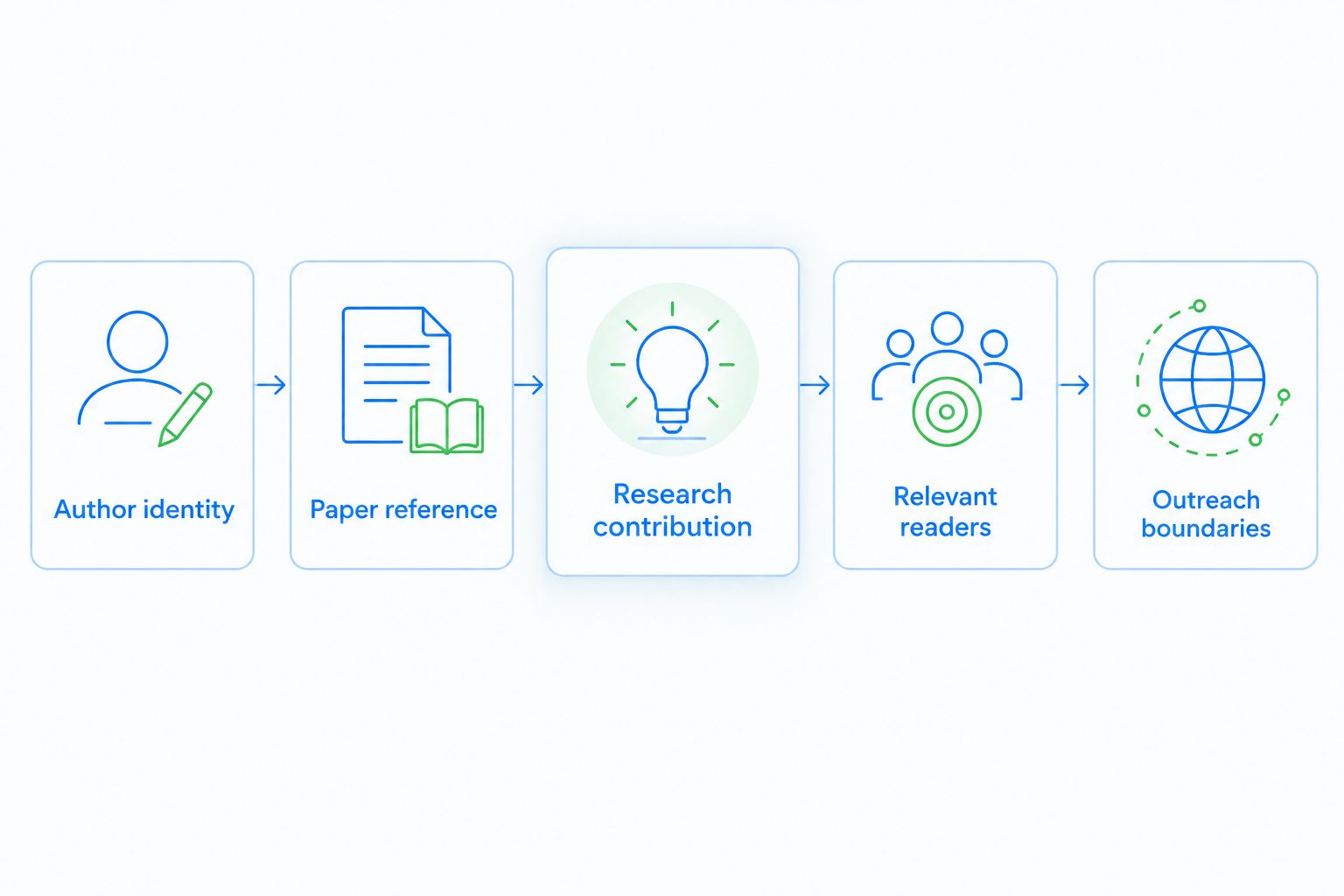
- Create a short campaign brief with these headings: Author identity, Paper reference, Research contribution, Relevant readers, and Outreach boundaries. These are document headings you create, not claimed interface fields in a promotion platform.
- Under Author identity, provide your name, public ORCID record, and the affiliation wording you want used. Explain any difference between your current affiliation and the affiliation printed on the paper.
- Under Paper reference, provide the exact title and DOI. Identify any additional manuscript link by version so the campaign does not silently substitute it for the published paper.
- Under Research contribution, explain the research question, principal finding, and important limitation in plain language. Keep claims within what the paper supports.
- Under Relevant readers, describe researchers whose questions, methods, or subject areas connect with the work. Define relevance before selecting outreach channels.
- Under Outreach boundaries, record sharing restrictions, sensitive wording, and statements that require your approval. Specify that outreach must not request citations as a condition of engagement.
Expected result: A promotion specialist can match the author to the paper, understand the intended audience, and draft outreach without guessing what the research claims.
Paper Spotlight’s PhD-founded perspective places article analysis before promotion. Its service approach includes expert-led targeting of relevant researchers and scientific testing of outreach approaches across research areas and career stages. Those methods describe the process; they do not establish a promised citation outcome.
Paper Spotlight is best for early-career researchers seeking expert-led research promotion rather than guaranteed citations. The advantage is a service-oriented approach to analysis and outreach; the limitation is that promotion cannot determine whether another researcher reads, uses, or cites your work.
Before choosing a promotion plan, clarify what materials you must submit, how targeting decisions are communicated, and how you will review research claims. Keep your 2026 campaign brief as the reference for those decisions. It should remain useful whether you handle outreach yourself or commission support.
Explore promotion for your paper
Review the service before preparing your publication details and campaign brief.
A second workflow: when your record changes
A profile update is a reason to review a campaign, not an automatic instruction to promote every new work. Keep the workflow manual unless you have verified a specific integration and its permissions.
- After adding a publication or changing relevant identity information, inspect the public ORCID record again. Confirm that the intended change is visible outside your account.
- Compare the update with active campaign materials. An affiliation change affects author context; a corrected publication entry affects the paper reference.
- Update the campaign brief and any outreach copy that contains the changed information. Tell the person managing promotion exactly what changed.
- For a new paper, create a separate brief and audience definition. Do not reuse the previous paper’s claims or assume its intended readers are identical.
Expected result: Changes to your author record reach campaign materials through a deliberate review, rather than through an assumed synchronization.
For ongoing research promotion in 2026, keep a simple change log with the update date, affected material, and action taken. This is a coordination aid, not evidence that outreach increased citations.
Troubleshooting
The paper disappears when you sign out
Check the visibility setting on the work entry itself. A public profile does not make every individual item public. Select Everyone for the work you intend readers to inspect, then repeat the signed-out check.
The DOI leads to the wrong publication
Compare the identifier against the published paper and its publisher record. Correct the DOI in both the ORCID entry and campaign brief. Test the destination again before distributing updated outreach.
The same paper appears more than once
Inspect each entry’s DOI, title, and version before changing anything. Duplicate records and distinct manuscript versions are different problems; use the available grouping or editing controls only after identifying which situation you have.
Outreach sends readers to a login screen
Replace account-specific or private sharing links with a public publication destination. Test the replacement while signed out. If full text requires access, say so accurately rather than describing the article as freely readable.
A provider requests your ORCID password
Do not share it. Ask whether the provider needs only your public identifier or a specific authenticated permission. If you choose an authenticated connection, review the requested permissions through ORCID’s authorization process instead of sending credentials.
Customize your workflow
Start with 3 checkpoints: public identity, correct publication destination, and approved campaign brief. These are setup checks, not performance targets. Complete them before expanding outreach.
If your author record needs further work, use the guide to ORCID profile optimization tools. Prioritize corrections that help readers identify your work; adding information without a purpose does not improve the campaign brief.
Then adapt the brief to the audience. A methods-focused reader needs an accurate explanation of the method’s use; a subject-area reader needs the research question and finding. Neither needs an exaggerated claim of importance.
Ask Paper Spotlight to keep article analysis, audience targeting, and message approval connected to that brief. Review visibility measures separately from citations: attention to a paper and its use in later scholarship are different outcomes. A 2026 report should not treat a shared link as evidence of research impact.
FAQ
How do I connect ORCID profile to research promotion?
Add your public ORCID record and the paper’s DOI to your campaign brief, then verify both while signed out. This connects author identity to the promoted publication without requiring an automatic integration.
Does ORCID promote my paper automatically?
ORCID is a researcher identifier and record system, not an automatic promotion campaign. Outreach requires a separate process for audience selection, messaging, and distribution.
Do I need to make my entire ORCID record public?
No, you do not need to make every item public. Make the promoted work and intended identity information visible to readers while choosing privacy settings deliberately for other information.
Should I send readers to my ORCID profile or my paper?
Send readers to the publication when your message asks them to read a specific paper. Include the public ORCID record as supporting author context when it helps them verify identity.
Can a promotion service update my ORCID record?
Public access to your ORCID record does not authorize a service to change it. Record updates require an appropriate authenticated connection and permissions; do not assume a promotion service provides that connection.
Will connecting ORCID increase my citations?
Connecting ORCID does not guarantee additional citations. It clarifies author identity, while citation decisions depend on other researchers finding the work relevant to their scholarship.
What should I check before buying research promotion in 2026?
Check how the service analyzes your paper, selects relevant readers, handles claim approval, and reports activity. Distinguish outreach deliverables from citation promises, and keep your ORCID password private.
One last thing
The most useful final test is to stop viewing the campaign as its author. Sign out, open the references, and read the outreach message as a researcher who has never encountered your work.
Can that reader identify you, locate the intended paper, and understand why it relates to their research? If any answer is unclear, fix that connection before expanding distribution. More outreach does not repair a confusing destination.


