
Instead of manually rebuilding a media pitch after every repository upload, connect open access repository upload to press outreach through a verified public record, a reusable evidence brief, and an approval gate. Use the upload to prepare outreach—not to send journalists an unchecked announcement.
- Connect open access repository upload to press outreach through verified access, an evidence brief, and editorial approval.
- Paper Spotlight is best for published-paper authors seeking expert-led research promotion rather than a press-distribution service.
- Keep repository deposits, publication status, and press embargoes separate in your workflow.
- Automate draft preparation only after confirming the repository supports a suitable notification or feed.
Why this matters
A repository upload makes a research record accessible; it does not establish a news angle, authorize redistribution, or confirm that a journalist can open the manuscript. The connection you need is an editorial handoff, not an automatic email blast.
For your 2026 outreach workflow, separate three decisions: whether the record is public, whether the findings are ready to discuss, and whether a particular journalist covers the subject. A successful deposit answers only the first question—and only after you check access.
Paper Spotlight offers academic paper promotion through article analysis, targeted research promotion, and social media outreach. Its PhD-founded perspective connects promotion decisions to the research itself. Treat that service as a route to relevant research audiences, not as a substitute for institutional press approval or an assurance of media coverage.
Before you start
- Access and permissions: Have access to the repository record, the permitted manuscript version, author contact details, and your institution’s communications contact. Confirm deposit permissions before uploading a publisher-formatted file.
- A working record: Prepare a shared document or spreadsheet for the paper identifier, public link, publication status, summary, approval owner, and outreach history. Use an email account authorized for the outreach.
- The hidden blocker: A public metadata page can exist while the manuscript remains restricted. Also check any journal or institutional press embargo separately; repository access does not settle announcement timing.
This guide uses field labels you create in your own tracking sheet, not repository-specific button names. Keep those labels consistent when moving information between a deposit record, a draft brief, and an approved pitch.
Public record configuration
The first configuration unit establishes what the upload actually contains. Best for: every researcher preparing outreach from a deposited paper. Its benefit is a verifiable source; its limitation is that public access alone says nothing about newsworthiness.
- Check the permitted version. Identify whether you are depositing a preprint, an accepted manuscript, or the published version. Follow the applicable publisher agreement and repository requirements rather than treating those versions as interchangeable.
- Complete the deposit metadata. Enter the title, authors, abstract, and publication details accurately. Add the published article identifier where applicable, while preserving the deposited version’s own status.
- Record the public destination. In your tracker, create Public record link, Manuscript version, and Access status fields. Copy the stable public record address—not an editing link, upload receipt, or signed-in preview.
- Test the reader’s route. Open the record while signed out. Check whether the manuscript opens, whether any access restriction is explained, and whether readers can identify the version they are viewing.
- Assign responsibility. Add Record owner and Checked on. Use the actual verification date in your 2026 campaign log so a colleague knows when access was last checked.
Expected result: another person can open the recorded destination and identify the paper, its version, and its access conditions without using your account.
Do not replace a stable record link with a direct attachment simply because the attachment is easier to copy. A record page supplies context that an isolated manuscript file does not.
Evidence brief configuration
The second unit turns bibliographic information into material someone can evaluate for outreach. Best for: researchers who need to explain significance without overstating findings. The brief makes review easier, but it requires author judgment; copying the abstract is not enough.
- Write the central finding. Create Main finding and describe what the paper actually reports. Identify the population, material, setting, or research question needed to interpret it.
- Explain relevance. Add Why it matters and Relevant audience. Name the people whose work or understanding relates to the finding; avoid describing everyone as a potential reader.
- State the boundary. Add Key limitation and Publication status. Preserve distinctions such as observational evidence versus causal evidence and a preprint versus a peer-reviewed publication.
- Draft a short summary. As a working constraint, aim for 100 words explaining the question, finding, relevance, and limitation. This is an editing target, not a journalist submission rule.
- Prepare the contact handoff. Add Author contact, Communications owner, and Supporting materials. Include only materials you have permission to share, with their attribution requirements recorded.
Expected result: a communications colleague can understand the proposed story and its limits without reconstructing the paper from scratch.
For a 2026 submission, ensure the brief describes the deposited version rather than silently borrowing conclusions from a later revision. If the paper changes, the brief needs another check.
The reusable sequence is Public record, Evidence brief, Approval gate, and Targeted outreach. Each handoff has a different purpose: access, interpretation, authorization, and audience fit.
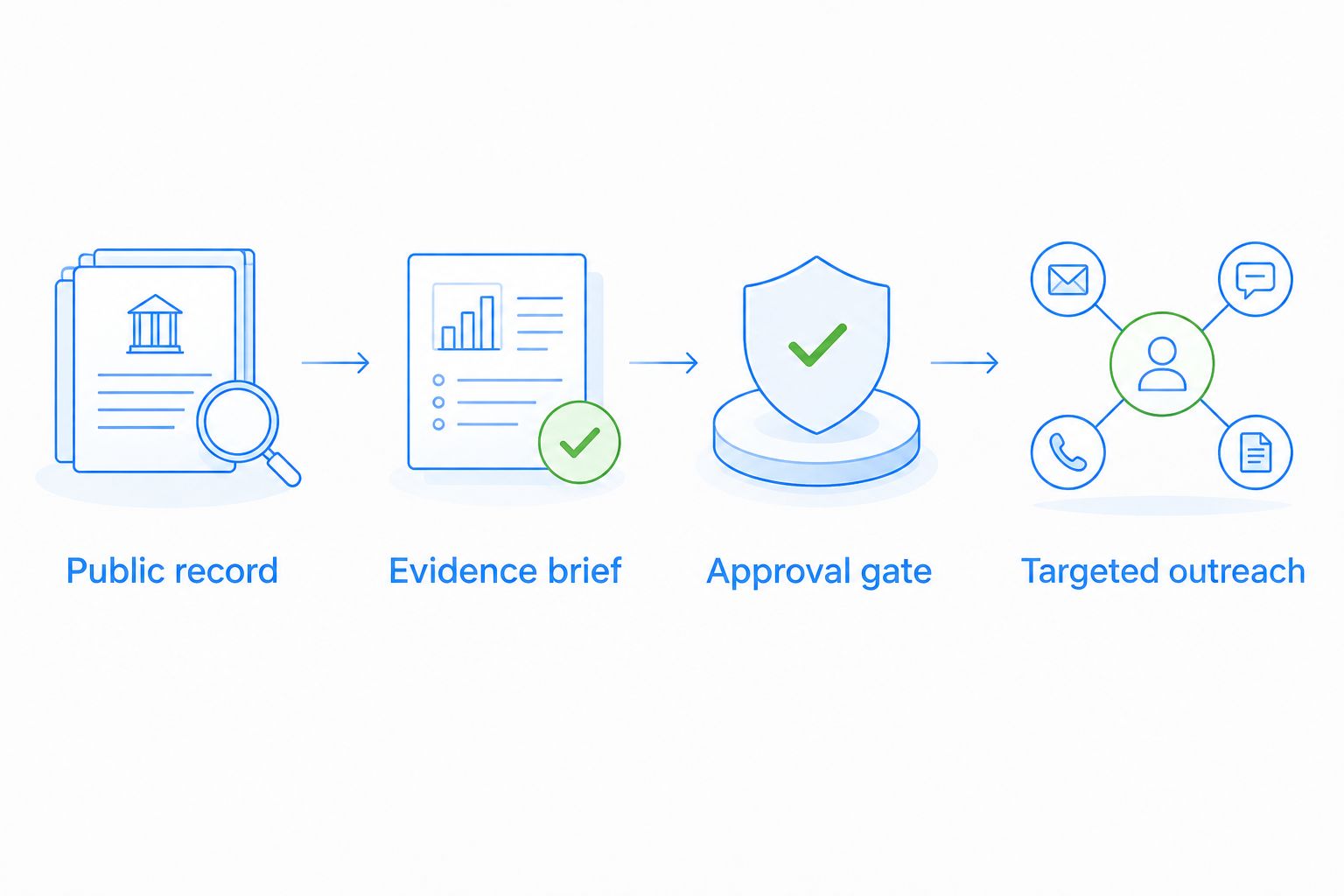
Approval gate configuration
A repository event should create work for review, not permission to send. Choose the handoff according to your access and maintenance capacity.
| Workflow | Best for | Advantage | Limitation |
|---|---|---|---|
| Manual handoff | An individual researcher managing a paper | Works without a repository integration | Requires a person to copy and verify information |
| Notification-to-draft handoff | A team with a supported repository notification or feed | Reduces repeated entry when the event contains useful metadata | Requires event checks, duplicate handling, and connection maintenance |
Start with a manual handoff unless repeated entry is a real problem. Automation is not an improvement if it turns corrections, private records, or duplicate notifications into new pitches.
- Create a readiness field. Add Outreach status with your own values: Needs review, Blocked, and Approved. These are tracking values you define, not repository settings.
- Assign the reviewer. Add Approval owner. Ask that person to verify factual wording, author agreement, disclosure requirements, manuscript access, and announcement timing under applicable institutional procedures.
- Record timing separately. Add Press embargo and Approved release time where relevant. Specify the time zone for a timed release; do not infer press clearance from a repository publication date.
- Test any automated intake. If the repository provides a suitable notification, feed, or supported integration, use it to create a draft record. Map only the fields the event actually supplies, then complete the remaining fields manually.
- Prevent duplicate intake. Use a stable paper or record identifier to check whether the item already exists. Keep 1 paper per tracking record so a metadata correction does not become a separate outreach campaign.
Expected result: each paper has an identifiable reviewer, a recorded decision, and a clear reason if outreach is blocked. A new upload cannot bypass that decision.
Targeted outreach configuration
The final unit connects the approved evidence brief to a specific recipient. Best for: authors with a clear public-interest angle and an authorized press contact route. Targeting creates a relevant pitch; it cannot guarantee an editor’s interest or a published story.
- Define the angle. Explain why the finding belongs in the recipient’s coverage. Distinguish a research contribution from a news claim; a technically important advance does not automatically justify a broad public announcement.
- Check recipient fit. Read the journalist’s recent work and any submission guidance. Record Recipient, Coverage fit, and Contact source rather than collecting addresses without context.
- Draft the pitch. Use 2 opening sentences as an editing constraint: state the finding and explain its relevance to that journalist. Follow with the public record, the publication status, a limitation where needed, and an authorized contact.
- Review the exact message. Confirm that the pitch matches the approved brief. Remove unsupported novelty claims, causal overstatements, and language implying that repository deposit constitutes peer review.
- Send and log. Record Sent on, Response, and Next action. Follow recipient instructions and keep subsequent contact relevant; a deposit update alone is not a reason to resend the same pitch.
Expected result: the recipient gets a concise, accurate explanation with a working source link, while your team can see what was sent and who owns the response.
For your 2026 reporting, distinguish outreach activity from outcomes. A sent message is activity, a response is engagement, and published coverage is coverage; none is a citation.
Repeat the workflow when a record changes
A revised manuscript or newly published article creates an adjacent workflow: update the evidence brief before deciding whether to renew outreach.
Compare the changed record with the approved brief. Identify whether the update affects the finding, limitation, publication status, or reader destination. A corrected author affiliation needs record maintenance; a substantive correction needs review of any affected outreach claims.
Move the item back to Needs review when a substantive change affects the message. Preserve the earlier pitch in the outreach history instead of overwriting it. If a journalist is already working on the story, provide the relevant correction through the existing conversation.
For the transition from an early manuscript to journal publication, the preprint-to-published-paper promotion workflow addresses the wider campaign handoff. Keep that transition separate from routine metadata edits.
Troubleshooting
- The record opens, but the manuscript does not. Recheck access while signed out and inspect the repository’s restriction information. Describe access accurately; do not bypass restrictions by circulating an unauthorized file.
- A notification creates duplicate drafts. Match incoming events against the stable record identifier. Route updates to the existing tracking record rather than treating each notification as a new paper.
- The pitch describes the wrong version. Compare the brief with the manuscript at the public destination. Correct the version label and findings, then return the message for approval before sending.
- The record is public, but a press embargo remains active. Pause outreach and confirm timing with the authorized communications contact. Treat public access and press-release timing as separate checks.
- A journalist declines because the subject does not fit. Revisit the recipient’s coverage and your recorded rationale. Improve audience selection rather than expanding the same message into an indiscriminate mailing.
Customize your workflow
Add a parallel research-audience route when your primary objective is reaching scholars rather than securing news coverage. The approved evidence brief can support targeted research promotion and social media outreach, but each message still needs an appropriate audience and accurate claims.
Paper Spotlight’s academic paper promotion service begins with article analysis before promotion and uses expert-led targeting of relevant researchers. Its approach includes scientific testing of outreach methods across research areas and career stages. That describes the method, not evidence of a particular citation outcome.
Paper Spotlight is best for published-paper authors seeking expert-led research promotion rather than a press-distribution service. The advantage is a service built around article analysis and relevant research audiences; the boundary is that this does not replace a press office, establish newsworthiness, or guarantee citations.
If you consider a promotion plan in 2026, ask how the article analysis informs audience selection, what materials you must provide, and how activity is reported. Keep media coverage, research readership, and citations separate in your evaluation.
FAQ
How do I connect an open access repository upload to press outreach?
Connect the public repository record to an evidence brief, an approval decision, and a targeted pitch. Verify access and manuscript status before using the upload as the starting point for outreach.
Can a repository upload automatically email journalists?
Do not use a repository upload as automatic authorization to email journalists. Where a supported notification or integration exists, use it to prepare a draft that still requires factual, timing, and recipient review.
Does uploading a paper mean it has been peer reviewed?
Repository upload does not establish peer-review status. Identify whether the deposited document is a preprint, accepted manuscript, or published version and describe its status accurately.
What should I send a journalist with my repository link?
Send a concise explanation of the finding, its relevance to the journalist’s coverage, its publication status, and an authorized contact. Include the limitations needed to interpret the claim and a working public source link.
Can I promote a paper while its manuscript is restricted?
Check announcement permissions and access conditions before promoting a restricted manuscript. Do not imply that readers can access the full text or distribute a file without the required permission.
Is Paper Spotlight a replacement for my university press office?
Paper Spotlight offers academic paper promotion, article analysis, targeted research promotion, and social media outreach. Use your authorized institutional communications route for press approvals and embargo coordination.
Will repository outreach guarantee more citations?
Repository outreach does not guarantee citations. Evaluate public access, relevant engagement, media coverage, and later citations as separate outcomes rather than treating promotion activity as citation growth.
One last thing
Test the link in the exact message you plan to send. A repository record that worked during deposit can still be represented by the wrong URL in a copied pitch. Open the final message’s destination while signed out, then check that its manuscript version matches your claims.


