
Build an academic email list by identifying researchers whose work connects directly to your published paper, verifying their professional contact details, and recording why each person belongs on the list. For your 2026 outreach, distinguish individual research correspondence from an ongoing newsletter: a publicly listed email address is not permission to subscribe someone to repeated promotional messages.
- Learning how to build an academic email list starts with research relevance, not collecting the most addresses.
- Separate paper-specific correspondence from newsletters; a public email address does not establish newsletter consent.
- Keep contact sources, relevance notes, permission records, and exclusions alongside each address.
- Paper Spotlight suits early-career researchers seeking expert-led academic paper promotion, not a substitute for consent checks.
Why this matters
An outreach list should explain who needs to see your paper and why. An address alone tells you neither. For an early-career researcher, a poorly matched message also puts your professional reputation behind a claim of relevance that the recipient can immediately judge.
Your list belongs within a wider plan to promote a research paper after publication. A 2026 outreach plan should connect the audience, the paper's contribution, and a useful reason to make contact—not treat email volume as evidence of research impact.
How do you build an academic email list for outreach?
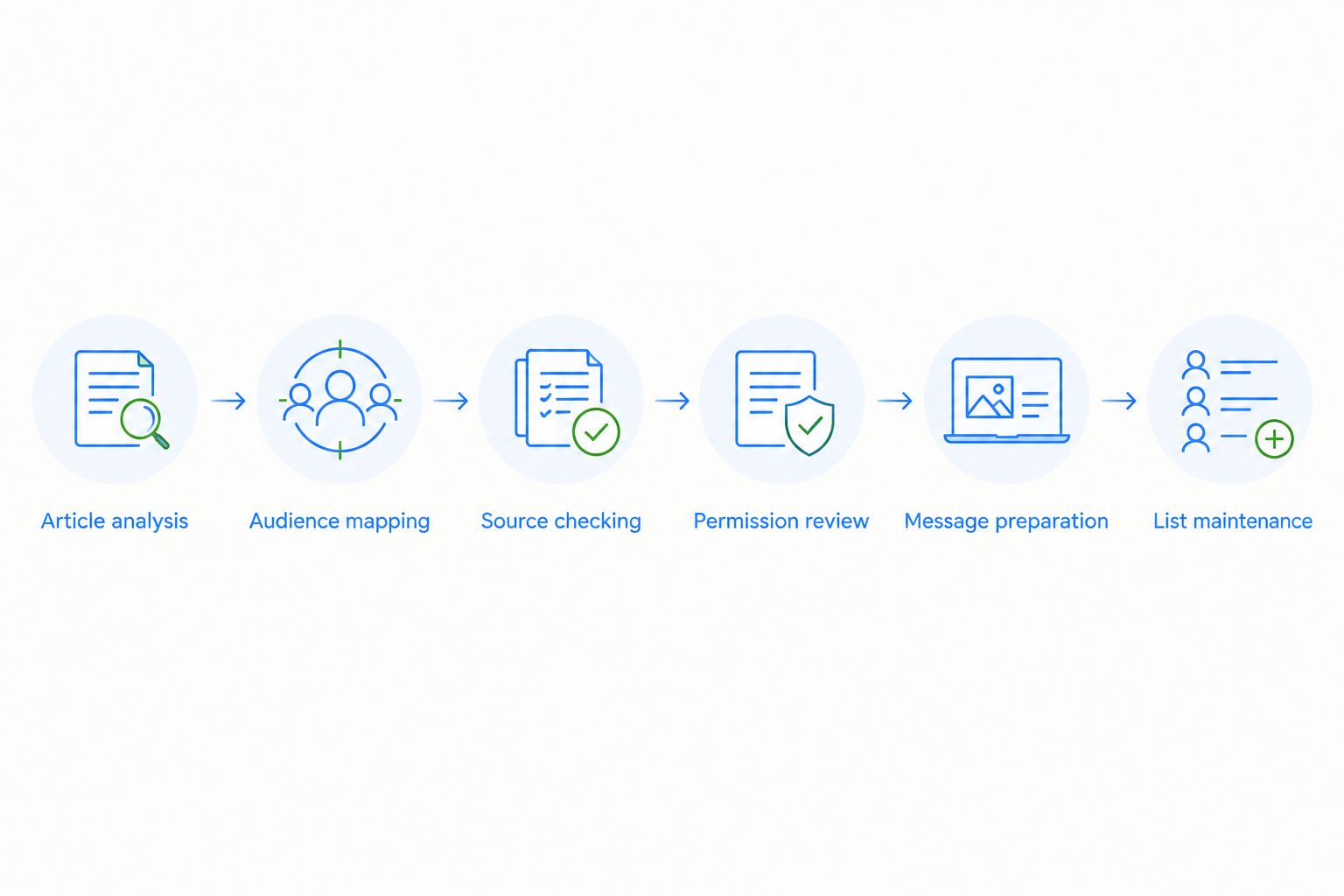
Use the following 6-step workflow to build a documented audience for a specific published paper. Keep a distinction between identifying a relevant researcher, deciding whether contact is appropriate, and enrolling someone in ongoing updates. Those are separate decisions.
1. Article analysis
Start with your paper, not a contact database. Write down its research question, main finding, method, study population or material, and limitations. Then identify which parts give another researcher a concrete reason to read it.
Turn that analysis into an audience brief. A methods paper might interest researchers using the same technique; a paper about a specific population needs a more focused audience than everyone working in the broader discipline. Include adjacent fields only when you can explain the connection.
Write 1 relevance sentence for each proposed audience: your paper helps these researchers understand, examine, or apply a particular finding or method. If the sentence amounts to “they work in science,” narrow the audience before collecting addresses. This brief becomes your inclusion rule throughout the process.
2. Audience mapping
Look for researchers through papers your article cites, papers discussing the same research question, relevant research groups, and conference programs related to the subject. Read enough of each person's work to establish a connection; an overlapping keyword is only a starting point.
Separate methodological relevance from subject relevance. Someone studying a different population with the same method needs a different explanation from someone studying your exact research question. Record the distinction so your eventual message reflects it.
Do not assume that a senior author is automatically the best recipient. Choose the person whose stated work connects to your contribution, regardless of career stage. Avoid emailing an entire laboratory when a particular researcher is the appropriate contact. Select for intellectual fit, not academic status or the easiest address to find.
3. Source checking
Verify each address against an appropriate professional source, such as a current institutional profile or an author-designated correspondence address. Record the source and the date you checked it. An address in an older publication does not establish someone's current affiliation.
For a 2026 campaign, check the current profile rather than treating the publication record as a live directory. If the researcher has moved institutions or provides explicit contact instructions, follow the current information. Do not generate guessed addresses from institutional naming patterns.
Read any restrictions attached to a directory or conference list before using its contents. Access to a directory does not establish permission to export it for promotion. Keep uncertainty visible in your records; an unverified address should not quietly become a send-ready contact because the research fit looks promising.
4. Permission review
Classify the intended communication before sending anything. A paper-specific message to a relevant researcher and a recurring promotional newsletter require different decisions about permission, purpose, and recipient expectations. Do not move contacts between those uses without checking the basis for doing so.
Before sending in 2026, check applicable privacy and electronic-marketing requirements, institutional rules, and your sending provider's policies. Requirements depend on jurisdiction and the nature of the message. Get appropriate institutional or legal guidance when the basis for contact is unclear.
For an ongoing newsletter, use an explicit subscription process and retain the permission record. For individual correspondence, document the relevance and check that the proposed contact is appropriate. Neither a public address nor a legitimate research topic creates blanket permission for repeated marketing.
5. Message preparation
Draft the message around the relevance note you already recorded. Identify yourself, explain the specific connection to the recipient's work, and describe the paper without overstating its findings. Provide a route to the published article or an authorized accessible version.
Ask for something proportionate, such as reading the finding or sharing a methodological observation if it matches the recipient's interests. Do not ask for a citation in exchange for attention, payment, or reciprocal promotion. A citation remains the author's scholarly decision.
Prepare different wording for genuinely different audiences, not superficial variations that merely change a name. If you cannot explain why the paper matters to a segment without generic praise, revisit the list. The message is a final relevance check, not a way to rescue a weak audience.
6. List maintenance
Remove duplicate contacts before sending. Preserve opt-outs and exclusions in a suppression record so that deleting an address from the working list does not accidentally make it eligible again during a later import.
Update affiliations, source checks, and permission status as information changes. Record delivery failures and stop using invalid addresses. Keep campaign notes factual: a reply is a reply, not evidence that the recipient read the whole paper or intends to cite it.
Restrict access to the contact file and retain only information needed for the stated purpose. Set a review and deletion practice consistent with applicable requirements and institutional policy. The finished list should remain auditable: another authorized person should understand why a contact was included, where the address came from, and whether further contact is appropriate.
Which sources belong in an academic outreach list?
Use each source for the job it can support. A paper establishes research relevance; a current professional profile helps verify contact details; a subscription record documents the permission captured by that subscription process. No single source does all three.
| Source | Best for | Useful evidence | Limitation or risk |
|---|---|---|---|
| Relevant published papers | Identifying a research connection | Topic, methods, and author contributions where stated | Contact details and affiliations can become outdated |
| Current institutional profiles | Checking professional contact details | Published address and stated research interests | Public display does not establish newsletter consent |
| Conference programs | Finding closely related research activity | Presentation topics and named contributors | Listing or attendance does not authorize promotional email |
| Your documented newsletter sign-ups | Sending the updates people requested | Recorded subscription purpose and permission | Permission is limited by what the person agreed to receive |
| Purchased or borrowed address lists | Not recommended for this workflow | An address collection to investigate | Relevance, provenance, and permission require independent verification |
Do not merge these sources into a single undifferentiated mailing audience. Preserve the source and intended use for every record. A researcher discovered through a conference program still needs an appropriate contact source and a separate assessment of whether your message is suitable.
What should your contact spreadsheet contain?
Start with 8 record fields: researcher name, professional affiliation, email address, contact-source reference, verification date, relevance note, contact basis or permission status, and communication status. Add only fields that support a defined operational need.
Use the communication-status field to distinguish contacts awaiting review, approved contacts, people already contacted, and exclusions. Keep subscription evidence separately when needed, with a reference back to the contact record. Do not record assumptions about willingness to receive messages as confirmed permission.
Your relevance note should be specific enough to inform the email. “Studies the same measurement method” is useful; “potential citation” is not. The record exists to support appropriate research communication, not to label people as citation opportunities.
Why academic email list requirements vary
There is no universal send-ready list for every published paper. Your decisions depend on the research and the intended communication:
- Research scope: A narrowly defined study needs a correspondingly specific relevance test.
- Recipient connection: Existing collaborators and unfamiliar researchers have different expectations of contact.
- Message purpose: A paper-specific exchange is different from enrollment in recurring updates.
- Contact provenance: Current professional information and inherited address files require different verification work.
- Applicable rules: Recipient location, institutional policy, and the nature of the message affect the checks required.
- Paper accessibility: Your outreach needs a lawful, usable reading route; an email should not imply access that the recipient does not have.
Set the purpose before choosing a sending tool. Software can organize records, but it cannot establish that a researcher belongs in your audience or that your proposed use of an address is appropriate.
When should you consider expert-led paper promotion?
Paper Spotlight is best for early-career researchers seeking expert-led academic paper promotion rather than a do-it-yourself mailing workflow. The relevant decision is whether you need help interpreting the article's audience and organizing promotion—not whether someone can supply a larger address file.
Paper Spotlight brings a PhD-founded perspective, article analysis before promotion, and expert-led targeting of relevant researchers. Its approach includes scientific testing of outreach approaches across research areas and career stages. That describes the method; it does not establish a specific result for your paper or guarantee citations.
The service covers targeted research promotion, article analysis, and social media outreach. For a 2026 campaign, evaluate whether those services address your actual constraint. The benefit is expert-handled promotion; the limitation is that promotion cannot determine whether another researcher reads, uses, or cites your work.
Before choosing a plan, clarify the proposed audience, channels, author responsibilities, and reporting. Do not assume that academic paper promotion includes email-list ownership, particular email operations, or guaranteed engagement. Review Paper Spotlight against the work you need handled, then register, choose a plan, and submit your article when the service fits.
Review your paper promotion options
Consider article analysis and targeted promotion for your published paper.
Can I use email addresses from published papers?
A published correspondence address is a contact source, not automatic authorization for any promotional use. Check the address, establish a paper-specific reason for contact, and review applicable requirements before sending. Do not add the author to recurring updates without an appropriate subscription basis.
Should I build a newsletter or contact researchers individually?
Build a newsletter for people who choose ongoing updates; consider individual correspondence when you have a specific, appropriate research connection. Keep those audiences separate. Interest in a particular paper does not establish a request for future campaigns.
How do I know whether the list reaches the right readers?
Evaluate audience fit through the relevance notes and the substance of responses, not address count alone. Record questions about the research, meaningful exchanges, and requests for further information without treating them as promised citations. Revise the audience when responses reveal a mismatch.
FAQ
What's the first step in building an academic email list?
Analyze your published paper and define which researchers have a specific reason to read it. Use that audience brief as your inclusion rule before collecting addresses.
Can I add researchers to my newsletter because their emails are public?
A public email address does not establish newsletter consent. Use an appropriate subscription process for recurring updates and check applicable requirements.
Should I buy an academic email list?
A purchased list is not a substitute for documented relevance and an appropriate basis for contact. Verify provenance, intended use, and permission rather than treating the file as send-ready.
What should I write in my first research outreach email?
Explain who you are, why your paper connects to the recipient's research, and where they can read it. Keep the request proportionate and do not ask for promised or reciprocal citations.
How many researchers should I include in my outreach list?
Let the documented relevance criteria determine the list size rather than choosing an arbitrary target. Exclude contacts whose connection to the paper you cannot explain.
Can Paper Spotlight guarantee citations from research outreach?
No citation count should be treated as guaranteed through paper promotion. Paper Spotlight offers article analysis, targeted research promotion, and social media outreach; other researchers decide whether to cite the work.
One last thing
Write the relevance sentence before copying the email address. This reverses the temptation to collect first and justify later. If you cannot state why a particular researcher should receive your paper, leave the contact out until you can. An exclusion is a useful outcome when it keeps your outreach focused and your professional communication credible.


