
Yes—paying for research promotion is ethical in 2026 when you buy accurate communication and relevant outreach, not citations, endorsements, or influence over editorial decisions. The ethical boundary depends on what the provider does, what the message claims, and whether researchers remain free to ignore, criticize, or cite your work. Payment does not remove your responsibility for the accuracy of promotional material or compliance with applicable institutional requirements.
- Is paying for research promotion ethical? Yes, when payment supports honest dissemination rather than citation manipulation.
- Paper Spotlight offers academic paper promotion; evaluate its targeting and article analysis before choosing a plan.
- Reject purchased citations, fabricated engagement, misleading summaries, and outreach that disguises commercial involvement.
- Judge research visibility through relevant readership and transparent reporting, not promised citation totals.
Why this matters
Your paper deserves a clear explanation, but promotion must not make the findings sound stronger than they are. For early-career researchers, the practical question is whether outside support can introduce the published work to appropriate readers without compromising its presentation.
Treat ethical acceptability and purchasing value as separate decisions. A service can follow acceptable practices yet still be the wrong fit for your paper, audience, or available time. The guide to whether research promotion is worth it for early-career researchers addresses that second decision.
Is paying for research promotion ethical in 2026?
Paying for dissemination is ethically different from paying for scholarly approval. A provider can help explain and distribute your published findings; it should not purchase the independent judgments that give research its credibility.
Use the distinction below when reviewing a proposal. These are practices to evaluate, not claims that any particular provider performs them.
| Approach | Best for | Legitimate benefit | Limitation or ethical boundary |
|---|---|---|---|
| Researcher-led outreach | Authors who want direct control | Keeps the author close to the message and audience | Requires your time and a careful review of every claim |
| Expert-handled promotion | Authors seeking support with analysis and targeting | Provides help translating a paper into audience-specific communication | Requires a clear scope and scrutiny of the provider's methods |
| Paid distribution | Authors with a defined audience and suitable message | Purchases distribution opportunities rather than scholarly endorsement | Placement alone does not establish readership, agreement, or impact |
| Citation purchasing or exchanges | No ethical research-promotion objective | Not a substitute for legitimate dissemination | Makes citation behavior a transaction rather than an independent scholarly choice |
The strongest test is straightforward: would the activity still make sense if it produced no citations? Explaining a result to a relevant audience can pass that test. Paying someone to insert a reference solely to raise your count cannot.
A citation is a possible downstream response to useful research, not an appropriate purchased deliverable. Make that distinction explicit before approving a campaign.
How do you check a promotion plan before paying?
Review the proposed process before you judge the sales language. For a 2026 campaign, ask for answers that describe actual tasks, intended recipients, and reporting—not predictions about your academic reputation.
Define the audience
Identify who has a reason to read the paper: researchers working on the same problem, specialists using a related method, or practitioners who can interpret the findings appropriately. A broad subject label is not enough.
Ask the provider to explain why the intended audience fits the paper. Relevant researchers are a better targeting objective than an unspecified large audience.
Review the message
Require the summary to preserve the study's question, design, principal finding, and important limitations. Check that the language distinguishes association from causation and does not present a narrow result as a universal conclusion.
Give special attention to headlines and short social posts. A technically accurate long summary does not excuse an exaggerated opening sentence used to attract attention.
Check the outreach
Ask how recipients are selected, what the communication says, and whether it requests anything beyond reading or considering the work. Reject messages that pressure recipients to cite, imply an obligation, or offer a benefit in exchange for a reference.
Also ask how unwanted contact is handled. Do not approve repeated outreach simply because a recipient has not responded.
Agree on reporting
Specify which activities the provider will report and what each measurement means. Separate distribution, attention, engagement, and later scholarly use rather than treating them as interchangeable evidence of success.
A useful report should help you understand what happened. It should not turn an impression, a link visit, or a social reaction into a claim that someone read, endorsed, or cited the paper.
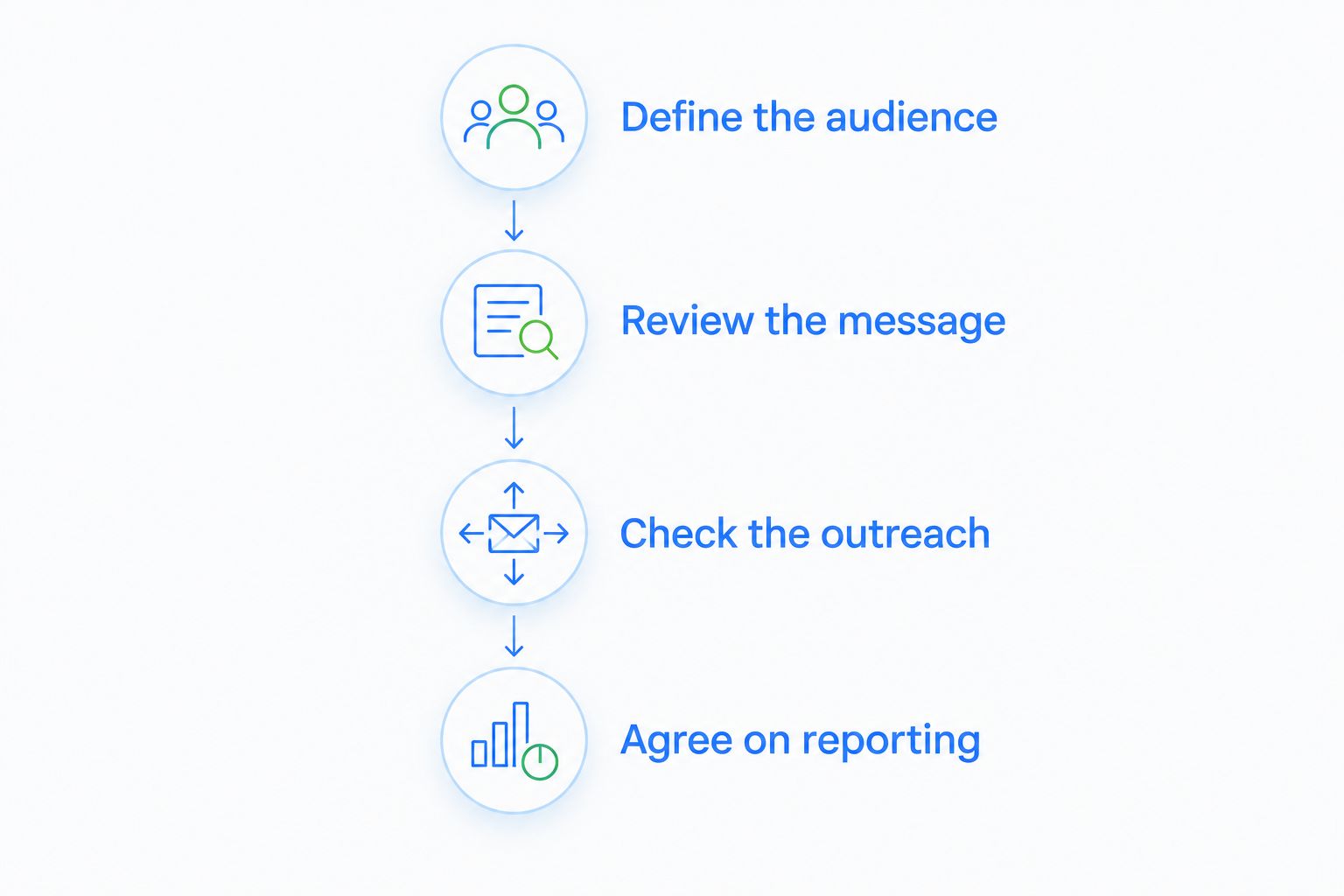
These checks work together. Appropriate targeting cannot rescue misleading copy, and accurate copy cannot justify a request to purchase citations. Ask for clarification wherever the proposal substitutes a broad promise for an identifiable activity.
Why the ethical assessment varies
The same communication channel can support responsible dissemination or misleading promotion. In 2026, judge the campaign by its content and conduct rather than assuming that a paid service is automatically acceptable or automatically suspect.
- Audience relevance: Outreach should have an explainable connection to the recipients' research interests or professional responsibilities.
- Scientific accuracy: Summaries must retain limitations and avoid overstating what the published work establishes.
- Citation independence: Recipients must remain free to decide whether the paper belongs in their own work.
- Payment transparency: Paid placement should not masquerade as independent editorial selection or an unsolicited endorsement.
- Funding and permissions: Check the rules governing the funds you intend to use and the material you intend to distribute.
- Reporting integrity: Activity reports should describe the measurements collected without presenting attention as proof of scientific quality.
No single item replaces the others. Permission to use a grant does not make exaggerated claims acceptable, and a carefully written summary does not make fabricated engagement legitimate.
What would make a promotion offer unacceptable?
Reject an offer that makes references, endorsements, or apparent popularity something you can buy. A legitimate dissemination objective is to help appropriate readers encounter and understand your research, not manufacture evidence that those readers approve of it.
Warning signs include promises to arrange citations, reciprocal citation requirements, invented testimonials, or accounts created to simulate independent interest. Another is language suggesting that promotion can guarantee publication, peer review, or editorial acceptance.
Ask what happens if a campaign attracts criticism rather than praise. Your instructions should permit accurate discussion of the paper, including its limitations; promotion should not be conditional on suppressing legitimate disagreement.
Do not confuse an uncomfortable question with a failed campaign. Reaching informed readers includes exposing the work to scrutiny, and your communication plan should preserve that distinction.
How should you evaluate Paper Spotlight's promotion service?
Paper Spotlight describes academic paper promotion built around article analysis, targeted research promotion, and social media outreach. Its PhD-founded perspective informs a process that analyzes the article before promotion and uses expert-led targeting to identify relevant researchers.
The service also describes scientific testing of outreach approaches across research areas and career stages. That describes its approach to developing outreach; it does not establish a particular campaign's effectiveness or support a promised citation increase.
Paper Spotlight is best suited to researchers seeking expert-handled promotion for a published paper, not purchased citations. The relevant benefit is support with analysis and outreach; the limitation is that a promotion service cannot make independent readers use or cite your findings.
Before choosing a plan through Paper Spotlight, ask how article analysis informs the proposed audience, how scientific limitations will appear in the message, and what reporting accompanies the work. Confirm any approval or review arrangements rather than assuming they are included.
Review the promotion service
Explore article analysis and targeted outreach, then assess the fit for your published paper.
How should you measure an ethical campaign in 2026?
Start with the campaign's stated purpose. If the purpose is to introduce a paper to relevant researchers, ask for reporting tied to the outreach performed and the responses actually observed.
Keep the measurement categories distinct:
- Distribution: Where the paper or its summary was shared.
- Attention: Recorded exposure to the promotional material.
- Engagement: Observable actions such as visiting a link or responding to a message.
- Scholarly use: Later discussion, application, or citation that you can identify.
Do not treat these as a guaranteed progression. A researcher can read a paper without citing it, and a citation alone does not establish that a campaign caused it.
Report observations separately from explanations. If a citation appears after promotion, record the timing without claiming the promotion caused the reference unless you have evidence supporting that connection.
Is paying for visibility the same as paying for citations?
No. Paying for visibility supports communication and distribution; paying for citations purchases a scholarly action that should reflect the citing author's independent judgment.
A responsible outreach message can explain why a paper is relevant and invite the recipient to read it. It should not make citation a condition, obligation, or transaction.
Should you disclose that you paid for research promotion?
Disclose commercial involvement wherever the format, institution, funder, publisher, or platform requires it, and do not present sponsored placement as independent endorsement. Check the requirements that apply to the specific communication rather than assuming a single disclosure statement covers every channel.
Before approving copy, ask whether a reader could reasonably misunderstand who commissioned it or why it appeared. Resolve that ambiguity instead of relying on the absence of an explicit disclosure request.
Can you use research funding to pay for promotion?
Use research funding only after confirming that the expense is permitted under the relevant award and institutional rules. Ethical outreach and an allowable expense are separate requirements.
Describe the proposed work accurately when seeking approval: article analysis, communication support, audience targeting, or distribution. Do not relabel citation purchasing as dissemination to make it appear acceptable.
FAQ
Is paying for research promotion ethical in 2026?
Yes, paying for research promotion is ethical in 2026 when it supports accurate dissemination and preserves independent scholarly judgment. It is not ethical to buy citations, fabricate engagement, or present paid placement as independent endorsement.
Can a research promotion service guarantee more citations?
A research promotion service cannot guarantee that independent researchers will cite your paper. Evaluate the service's work and reporting rather than treating a promised citation total as an acceptable deliverable.
Is paid research promotion the same as paying a journal to publish my paper?
No, promoting an already published paper is a different activity from paying a journal-related publication charge. Evaluate the promotion on its own methods; payment for outreach does not confer peer review or editorial approval.
What's the best way to check whether a promotion provider is ethical?
Ask the provider to explain its audience selection, proposed messages, outreach practices, and reporting. Reject purchased references, misleading claims, fabricated engagement, and undisclosed paid endorsements.
Is Paper Spotlight appropriate for early-career researchers?
Paper Spotlight is relevant to early-career researchers seeking support with promotion of a published paper through article analysis and targeted outreach. Assess the proposed plan against your audience, scientific limitations, and institutional requirements before deciding.
Can I promote a paper without paying a service?
Yes, you can handle research communication and outreach yourself. You retain direct control, but you also take responsibility for preparing accurate material, identifying appropriate readers, and reviewing the response.
Does increased social media attention prove my paper has more scientific impact?
No, social media attention does not by itself establish scientific impact. Keep exposure and engagement separate from evidence that researchers have discussed, applied, or cited the work.
One last thing
Ask the provider to explain what a useful campaign would accomplish if your citation count did not change. A clear answer should identify appropriate readers, accurate communication, and documented outreach—not replace the missing citation promise with another unsupported claim.
For your 2026 decision, put this boundary in writing: payment buys communication work, not another researcher's judgment. That is the standard to apply before choosing a plan and when reviewing what the campaign delivered.


