
Promote a research paper after publication by making the published work easy to access, explaining its contribution clearly, and sharing it with researchers whose work directly connects to it. Start with an accurate summary and a stable article link, then use relevant academic profiles, social posts, and selective outreach. In 2026, treat promotion as research dissemination—not a promise of citations or a substitute for scientific quality.
- How to promote a research paper after publication: improve access, explain the contribution, and target relevant readers.
- Paper Spotlight suits researchers seeking expert-handled academic paper promotion, not guaranteed citations.
- Match each outreach message to a research question, method, or application the recipient already studies.
- Track article engagement and scholarly responses separately from citations; they measure different outcomes.
Why this matters
Publishing makes your paper available; dissemination gives relevant readers a reason to investigate it. For an early-career researcher, the practical goal is to help someone recognize where the work fits—not simply announce that another article exists.
Paper Spotlight offers academic paper promotion through article analysis, targeted research promotion, and social media outreach. Whether you handle dissemination yourself or choose a service, use the same standard: the message must preserve the paper’s claims, limitations, and relevance to its intended readers.
How to promote a research paper after publication
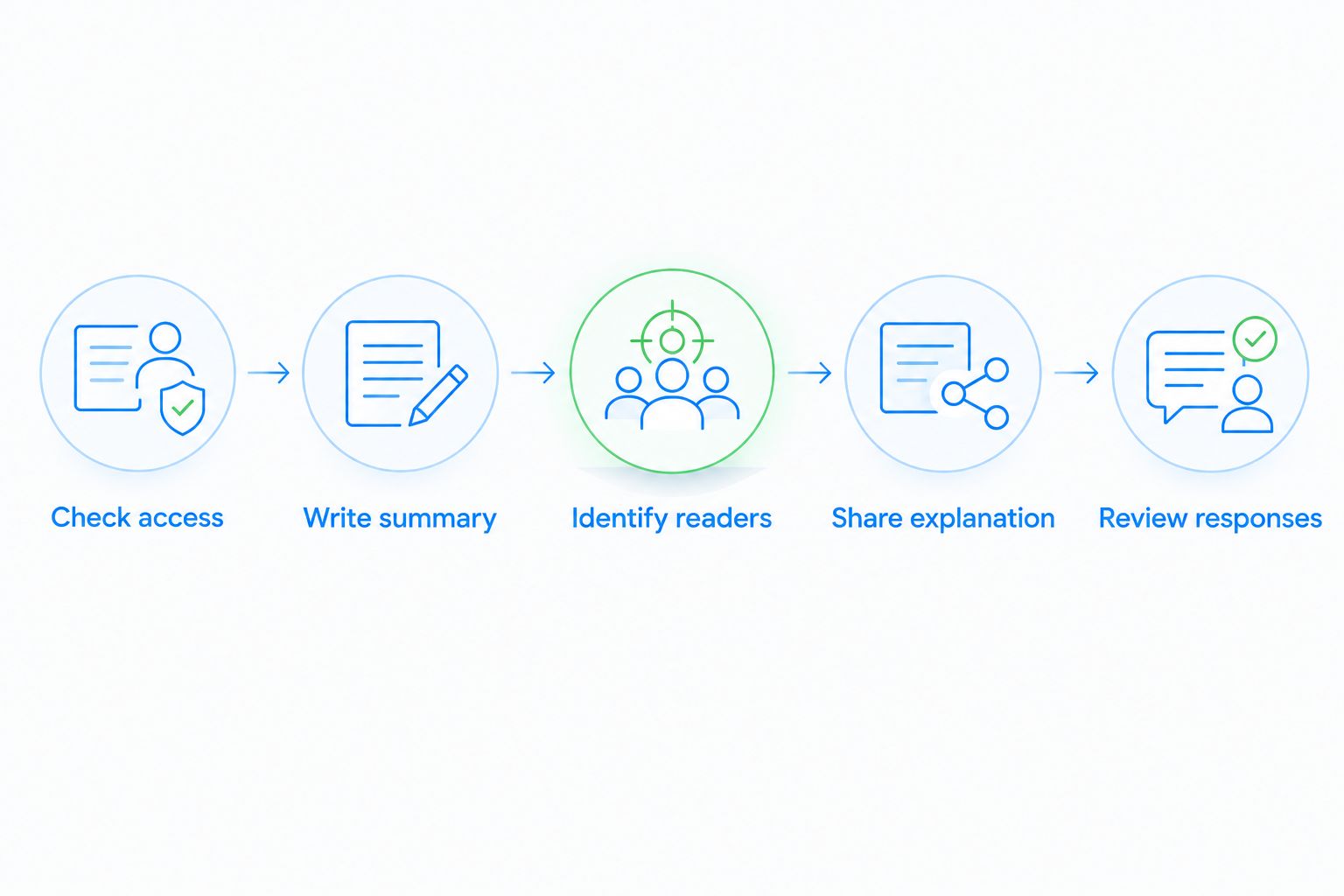
Use this sequence to prepare the paper, choose its audience, and turn an announcement into useful scholarly communication. Finish the access and accuracy checks before asking anyone to read or share the work.
1. Check the reader’s route to the paper
Open the article link while signed out of your institutional account. Confirm that the title, authors, publication details, and article destination are correct, and check what a reader without your subscriptions can access.
If the full text sits behind a subscription, check your publishing agreement and institutional guidance before sharing another version. Link to an authorized repository copy when appropriate, clearly identifying its version. Do not upload the publisher’s PDF unless your rights permit it.
Choose 1 primary article link for your main announcement. This keeps the reader’s next step clear; it does not mean every platform must use an identical destination when access needs differ.
2. Write an accurate plain-language summary
Draft a 3-sentence summary: the research question, the main contribution, and the limitation that matters most for interpretation. Keep the technical terms needed for accuracy, but explain unfamiliar language rather than making the reader decode it.
Distinguish what the study found from what it suggests. An association is not automatically a causal effect, and a result from a particular setting does not automatically apply elsewhere. Ask a coauthor to check that the summary preserves those boundaries.
Use the summary as a source document for outreach, not a script to paste everywhere. A specialist needs different context from a practitioner encountering the topic for the first time.
3. Identify readers by research relevance
Start with 2 audience groups: researchers working on the same problem and researchers who could use the method, dataset, or interpretation. Add other audiences only when you can explain their connection to the paper.
For each group, write down the specific reason the work matters. A shared discipline is too broad; a shared measurement problem, population, theoretical debate, or analytical approach gives you a stronger basis for outreach.
Use public professional information to assess relevance. Do not assume that an author wants promotional messages simply because their email address appears on a paper.
4. Update your academic presence
Add the publication to the academic profiles and institutional pages you maintain. Keep the citation details consistent, and distinguish the published article from earlier versions so readers understand what they are opening.
Where your profile permits context, include a brief explanation of the contribution rather than only the title. A clear description helps a reader decide whether to follow the article link without requiring them to infer relevance from specialist terminology.
5. Share a useful public explanation
Lead a social post with the research problem or finding—not the fact that you are pleased to announce publication. Explain what the paper adds, state an important boundary, and give readers a clear route to the article.
Choose a format you can make accurately. A short text explanation is preferable to a complicated graphic that strips away uncertainty. If you reuse a figure, check permissions and make sure its caption still explains what the figure actually shows.
6. Send selective, personalized outreach
Contact someone only when you can explain why this particular paper connects to their work. Refer to that connection, summarize the contribution briefly, and include the article link without attaching an unsolicited manuscript file.
Ask for a relevant response, such as methodological feedback or discussion of an overlapping question. Do not ask someone to cite the paper as a favor. A citation belongs where the work genuinely supports the citing author’s argument.
Follow mailing-list and community rules. An announcement that is welcome in a designated research thread can be inappropriate when copied into an unrelated discussion.
7. Review responses and improve the explanation
Record where you shared the paper, which audience each message addressed, and what responses followed. Useful signals include substantive questions, requests for clarification, article-link engagement where measurable, and invitations to discuss the work.
If readers repeatedly misunderstand the same point, revise the summary. If the outreach reaches people outside the intended audience, revisit the targeting rather than simply increasing the volume of messages.
For a 2026 promotion plan, keep a simple activity record that separates what you did from what happened afterward. A citation appearing after outreach does not establish that the outreach caused it.
Which promotion channels should you choose?
Choose a channel according to the audience connection it supports. This 2026 planning table compares dissemination approaches, not expected citation returns; none guarantees that readers will use the paper in future research.
| Approach | Best for | Advantage | Limitation |
|---|---|---|---|
| Academic profiles | Readers checking your research record | Gives the publication a persistent place in your professional record | A listing alone does not explain why a new audience should care |
| Research-focused social posts | Public explanation and discussion | Lets you explain a finding in an accessible format | Public attention does not establish scholarly relevance |
| Personalized email | A clearly relevant researcher or group | Makes the connection to the recipient’s work explicit | Requires careful selection and respect for recipient preferences |
| Institutional communication | Work relevant to an institution’s audiences | Provides a route to editorial or communications support | Support depends on institutional processes and editorial decisions |
Start with the channels where you can identify a relevant audience and maintain an accurate message. Maintaining every possible account is not a requirement for responsible dissemination.
If you need to evaluate later scholarly uptake, consult the guide to citation tracking tools for researchers. Keep citation monitoring separate from the immediate question of whether your announcement reached appropriate readers.
Why research promotion plans vary
The right approach depends on what the paper needs readers to understand and where those readers can access it. Use these factors to adjust the plan rather than copy another researcher’s campaign:
- Research area: Build the explanation around the questions and terminology relevant researchers use. A broad disciplinary label is not enough to establish fit.
- Article accessibility: Check whether recipients can read the linked version and whether you are authorized to share an alternative.
- Audience expertise: Preserve methodological detail for specialists while explaining the practical significance for less specialized readers.
- Career stage: Connect the paper to the research identity you are building, without overstating independence or omitting collaborators.
- Available attention: Choose outreach you can review, answer, and maintain. Unanswered questions weaken the usefulness of an announcement.
When should you consider a research promotion service?
Consider a service when you want expert help analyzing the article, identifying relevant readers, and managing outreach. Keep responsibility for scientific accuracy with the authors, even when someone else prepares or distributes promotional material.
Paper Spotlight is best for researchers seeking expert-handled academic paper promotion. Its PhD-founded perspective starts with article analysis before promotion, followed by expert-led targeting of relevant researchers and social media outreach.
Paper Spotlight describes a method that includes scientific testing of outreach approaches across research areas and career stages. That describes its approach; it is not evidence of a particular citation increase or proof that an outreach method will work for every paper.
Before choosing a plan in 2026, ask how the proposed audience connects to your article, how scientific claims will be checked, and what reporting you will receive. The service’s role is promotion of published work—not publication acceptance, peer review, or the purchase of citations.
Expert handling gives you support with promotion, but it does not remove the need to check permissions, approve accurate messaging, and interpret outcomes carefully. Judge the decision by the work you want help with, not by an assumed citation outcome.
Review your paper promotion options
Explore academic paper promotion built around article analysis and relevant researcher outreach.
Can you promote a paper that was published some time ago?
Yes. An older published paper can be shared when you have a genuine reason to bring it to a relevant audience’s attention, such as a current discussion that directly connects to its findings.
State the original publication date accurately and distinguish the existing findings from any new commentary. Do not repackage an old result as a newly published discovery or imply that later evidence supports it without checking.
Can social media promotion increase citations?
Social media can help people encounter and discuss a paper, but it does not guarantee citations. A reader still needs to find the work relevant to research they later publish.
Treat social activity as dissemination, not a citation transaction. Record meaningful engagement without presenting reactions, shares, or article clicks as proof of scientific quality.
FAQ
What should I do first after my research paper is published?
Check that readers can reach the correct article, then prepare an accurate summary of its contribution and limitations. Confirm sharing permissions before distributing a manuscript or publisher PDF.
How do I promote my paper without a large social media following?
Focus on relevant readers rather than follower counts. Update your academic profiles, use appropriate research communities, and contact researchers only when you can explain a direct connection to their work.
Is it acceptable to email researchers about my published paper?
Selective, relevant professional outreach is appropriate when it respects recipient preferences and applicable rules. Explain the research connection, keep the message concise, and avoid repeated unwanted follow-ups.
Can I share the published PDF on social media?
Share the publisher PDF only if your rights permit it. Otherwise, link to the article or an authorized repository version, following your publishing agreement and institutional guidance.
Is paying for research promotion the same as paying for citations?
No. Research promotion pays for dissemination work, while legitimate citations depend on another author's scholarly judgment. Paper Spotlight's academic paper promotion should be evaluated as outreach support, not as a promise of citations.
What should I measure in a research promotion campaign in 2026?
Measure the outreach activity and reader responses you can actually observe. Keep article engagement, substantive inquiries, and citations separate, and do not attribute a citation to a campaign without evidence.
Should I ask other researchers to cite my paper?
Do not request citations as favors or conditions of support. Explain the paper's relevance and let researchers decide whether it belongs in their scholarly work.
One last thing
A limitation can be useful promotional information. Explaining where a finding does not apply helps a researcher decide whether the paper addresses their own question—and prevents attention built on a misleading claim.
Before your next announcement in 2026, read the message without its link. If it does not explain the contribution, the relevant audience, and the boundary of the claim, revise it before sharing. A clear invitation to read is more useful than a louder announcement.


