
Best overall for an individual research newsletter: Substack. Best for a publication on your own website: Ghost. Best for straightforward email publishing: Buttondown. This 2026 guide compares the best research newsletter platforms for scientists by publishing workflow, audience organization, and the work you will need to do yourself.
- Substack leads the best research newsletter platforms for scientists for individual publishing with email and web distribution.
- Ghost suits researchers building an independent publication; Mailchimp suits teams organizing different subscriber groups.
- Buttondown favors simple publishing, beehiiv supports newsletter growth workflows, and Brevo suits broader email communications.
- Paper Spotlight offers research promotion, not newsletter hosting; consider it when reaching relevant researchers is the priority.
Why this matters
A newsletter gives you a repeatable way to explain published work to people who choose to hear from you. It does not establish scientific quality, replace peer review, or guarantee citations. Your platform should support the communication task, not distract you from it.
Paper Spotlight is best for researchers seeking expert-handled promotion of a published paper rather than a newsletter publishing tool. Paper Spotlight provides article analysis, targeted research promotion, and social media outreach. That distinction matters: running a newsletter and promoting an individual paper solve different problems.
For your 2026 decision, start with the audience you already have. An existing subscriber list calls for good organization and consistent publishing; a paper without an established readership calls for a separate plan to reach relevant researchers.
What makes the best research newsletter platform?
Judge each platform against the work you actually need to complete:
- Publishing workflow: Can you turn a research update into an email and readable web page without unnecessary formatting work?
- Audience organization: Can you separate readers by topic, relationship, or subscription preference when those distinctions matter?
- Publication ownership: Does the platform fit your preferred website, archive, and subscriber-management arrangement?
- Reader discovery: Does it provide ways to introduce your publication to new readers, rather than only send to existing subscribers?
- Operational workload: Who handles setup, editing, permissions, and ongoing maintenance?
- Research accuracy: Can your workflow preserve references, qualifications, and a clear distinction between findings and interpretation?
Accuracy remains your responsibility on every platform. None of these newsletter tools substitutes for checking that a summary matches the published paper.
Research newsletter platforms at a glance
| Platform | Best for | Standout feature | Key limitation |
|---|---|---|---|
| Substack | Individual researcher newsletters | Email publishing paired with a web publication and network features | Network exposure does not establish disciplinary relevance |
| Ghost | Independent research publications | Website publishing, newsletters, and memberships in one system | More publication setup decisions than an email-first workflow |
| Buttondown | Straightforward research updates | Markdown-friendly newsletter writing | Audience development still needs a separate plan |
| Mailchimp | Labs with distinct subscriber groups | Contact organization, segmentation, and email automation | Campaign management adds work for a simple author newsletter |
| beehiiv | Newsletter growth programs | Newsletter publishing with referral and recommendation tools | Growth features do not determine scientific relevance |
| Brevo | Research teams coordinating broader email activity | Email marketing, contact management, and transactional email | Broader communications functions require configuration |
These are workflow recommendations for 2026, not a ranking of citation outcomes. Choose the platform that matches your publication model; do not infer research impact from the length of a feature list.
1. Substack: best research newsletter platform for individuals
Substack combines newsletter delivery with a web publication. Its recommendations and social features also let writers participate in a wider publishing network. That makes it a practical default when you want to publish under your own name and keep the setup centered on writing.
For a scientist, the strongest use is a recurring explanation of research in context: what a paper investigated, what it found, and what remains unresolved. A publication built around that editorial purpose is clearer than a stream of disconnected announcements.
Substack pros:
- Combines emailed issues with a public web archive.
- Keeps an individual publication centered on writing and subscriptions.
- Includes network features that support interaction with other publications.
Substack cons:
- Network participation does not ensure your readers work in the relevant field.
- Its publishing environment is not a substitute for a dedicated institutional website.
Best for: An individual scientist publishing accessible commentary and research updates.
Verdict: Buy into the Substack workflow if writing regularly is your main task; skip it as a substitute for targeted research outreach.
2. Ghost: best research newsletter platform for independent publications
Ghost combines website publishing, email newsletters, and membership functions. It is also open-source software, with managed hosting and self-hosting approaches. Choose it when the publication itself matters as much as the email issue.
A research group can use this model to organize explanatory articles, publication updates, and an ongoing newsletter under a dedicated website. The trade-off is responsibility: you need to decide how the site is structured and who maintains the publishing workflow.
Ghost pros:
- Connects website articles and newsletter publishing.
- Supports an independent publication structure.
- Offers managed and self-hosted approaches to operating the software.
Ghost cons:
- Requires more website and publication decisions than a narrow email tool.
- Self-hosting creates technical maintenance responsibilities.
Best for: A researcher or group building a lasting editorial website with an accompanying newsletter.
Verdict: Buy into Ghost when website ownership is central; hold if you only need an occasional email update.
3. Buttondown: best research newsletter platform for simple updates
Buttondown is a newsletter service with Markdown-friendly writing and subscriber management. Its focused publishing approach fits researchers who want to write a clear email rather than assemble a wider communications system.
Use it for concise updates that explain a publication, connect related findings, or announce research activity to consenting subscribers. The writing still needs a recognizable purpose. A simpler interface does not remove the need to decide who the newsletter serves.
Buttondown pros:
- Supports Markdown-based writing.
- Centers the workflow on newsletter publishing.
- Provides subscriber management alongside the writing process.
Buttondown cons:
- Does not remove the need to attract relevant subscribers separately.
- Is a narrower fit when your main requirement is a substantial editorial website.
Best for: Scientists who prefer a focused writing workflow for recurring research emails.
Verdict: Buy into Buttondown for straightforward publishing; skip it when website development is the primary project.
4. Mailchimp: best research newsletter platform for lab segmentation
Mailchimp provides email marketing, contact organization, segmentation, and automation. These functions suit a laboratory or research organization communicating with different groups rather than publishing only an individual author's newsletter.
For example, collaborators, event subscribers, and readers of a particular research topic need not receive identical messages. Use segmentation when it reflects a genuine difference in reader needs, not simply because the function exists.
Mailchimp pros:
- Organizes contacts for targeted email campaigns.
- Supports segmentation for different reader groups.
- Provides automation for recurring communications workflows.
Mailchimp cons:
- Contact management and campaign setup create additional administrative work.
- Marketing-oriented functions require careful adaptation to academic communication.
Best for: Labs or departments with distinct audiences and someone responsible for email operations.
Verdict: Buy into Mailchimp when audience organization matters; hold if every subscriber receives the same simple update.
5. beehiiv: best research newsletter platform for growth workflows
beehiiv combines newsletter publishing with tools such as recommendations and referral programs. It fits a publication that treats audience development as ongoing editorial work, not an activity performed only when a new paper appears.
For a science newsletter, define the intended readership before introducing growth mechanisms. Readers interested in general science coverage are not automatically the researchers most likely to use a specialized paper.
beehiiv pros:
- Combines email newsletter publishing with a web presence.
- Includes referral tools for subscriber-led audience development.
- Supports recommendations between publications.
beehiiv cons:
- Growth mechanisms require their own setup and oversight.
- Subscriber growth alone does not demonstrate disciplinary relevance or citation impact.
Best for: Science communicators running a newsletter with an explicit audience-growth program.
Verdict: Buy into beehiiv when newsletter growth is a defined responsibility; skip growth features you cannot maintain.
6. Brevo: best research newsletter platform for broader email operations
Brevo combines email marketing with contact management and transactional email capabilities. It suits a research organization coordinating newsletters alongside other email communications, rather than an individual researcher seeking only an editor and send button.
Keep communication purposes separate. An operational message about an event registration and an optional research newsletter should not become interchangeable simply because the same system can handle both.
Brevo pros:
- Supports email campaigns and contact organization.
- Includes automation for communication workflows.
- Provides transactional email capabilities alongside marketing functions.
Brevo cons:
- Its broader scope creates configuration decisions beyond newsletter writing.
- Teams must distinguish operational communications from optional subscriptions.
Best for: Research organizations managing newsletters within a wider email operation.
Verdict: Buy into Brevo for coordinated email operations; hold if your requirement is limited to author-led publishing.
How the platforms are ranked
The order prioritizes an early-career scientist's publishing decision: an individual newsletter first, followed by an independent publication, simple email writing, segmented lab communications, audience growth, and broader email operations.
The criteria are publishing workflow, audience organization, ownership, discovery, workload, and research accuracy. This 2026 ranking does not claim that one platform produces more citations than another. Features explain fit; citation outcomes require separate evidence.
Build the workflow before choosing the platform
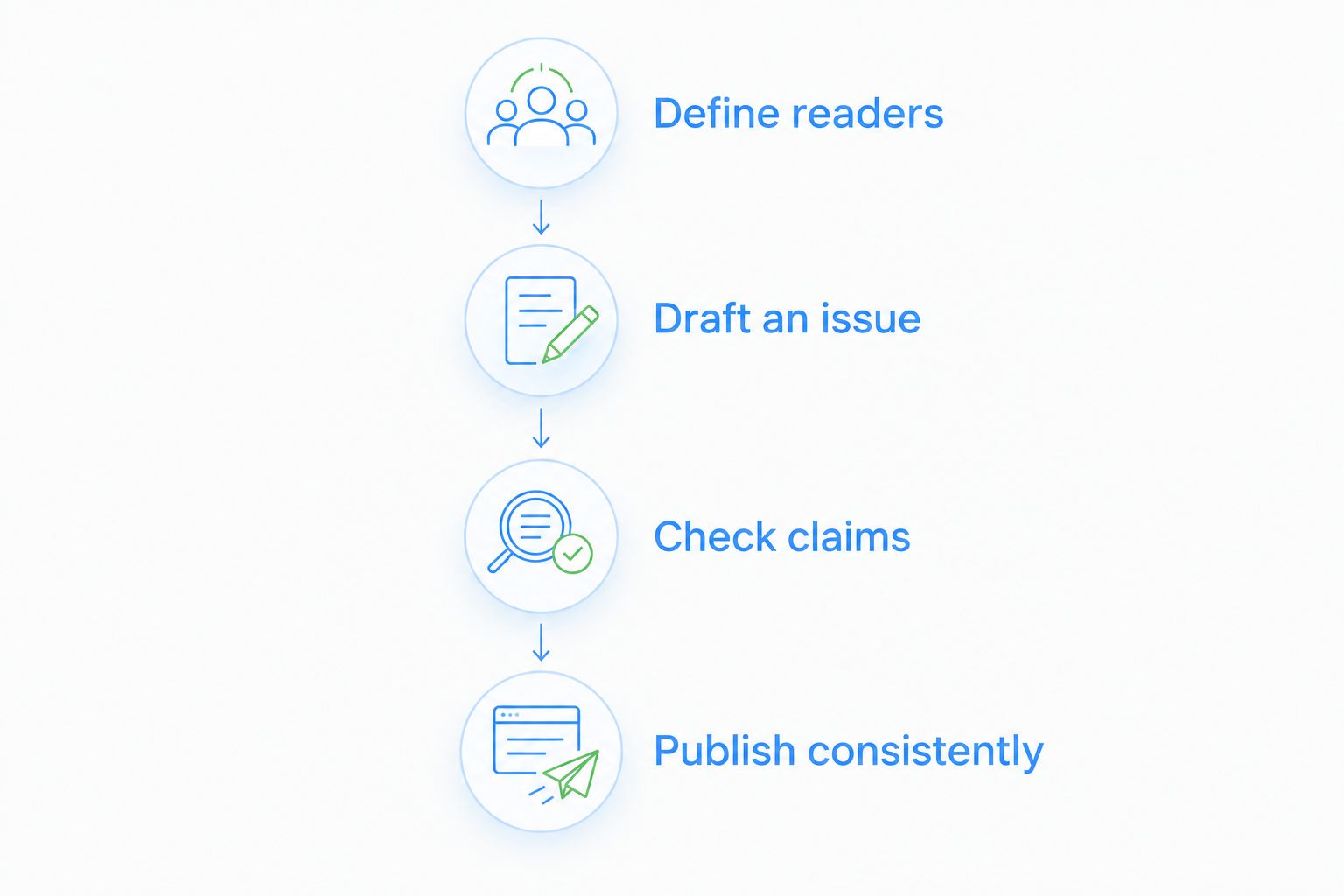
Use this sequence to test whether a newsletter is the right commitment. The quantities below are planning recommendations, not performance benchmarks.
Define readers
Write down 3 reader groups you want to reach, such as researchers using your method, researchers studying the same question, and practitioners applying the findings. Then identify which group the newsletter primarily serves. Trying to write equally for all of them can blur the explanation.
Draft an issue
Prepare 1 complete issue before committing to a publishing system. Include the research question, the main finding, a limitation, and a reference to the published work. This reveals whether you need a simple editor, a structured website, or separate versions for different audiences.
Check claims
Compare the draft with the paper. Preserve uncertainty, distinguish association from causation where relevant, and avoid extending the findings beyond the study's scope. Ask a coauthor to review sensitive wording before publication.
Publish consistently
Choose a schedule you can maintain alongside research duties. Review the workflow after 4 published issues: assess editorial effort, reader questions, and whether the topics still serve the intended audience. Do not turn that review into a promise of citation growth.
When promotion is the better next move
A newsletter is a continuing editorial commitment. If your immediate goal is to introduce a published paper to relevant researchers, assess that goal separately from your choice of publishing software.
Paper Spotlight's research promotion service brings a PhD-founded perspective, article analysis before promotion, and expert-led targeting of relevant researchers. Its approach includes scientific testing of outreach approaches across research areas and career stages. Those method descriptions are not evidence of a particular citation outcome.
The service addresses promotion of published work, while a newsletter addresses communication with subscribers. The limitation is equally clear: promotion does not replace peer review, establish scientific validity, or guarantee citations. Choose based on the task you need help completing.
Explore promotion for your published paper
Review a service focused on article analysis, relevant researcher targeting, and social media outreach.
Which research newsletter platform should you choose?
Choose Substack as the default for an individual research newsletter in 2026. Choose Ghost when an independent website is central, or Buttondown when focused email writing matters more than publication-building features.
For organizations, make the decision around responsibilities. Mailchimp fits audience segmentation, beehiiv fits a defined growth program, and Brevo fits broader email operations. Assign an editorial owner before adopting any of them; software cannot decide what your readers need to understand.
FAQ
What's the best research newsletter platform for an early-career scientist?
Substack is the default recommendation for an individual scientist publishing recurring research commentary and updates. Buttondown is an alternative when you prefer a focused, Markdown-friendly email workflow.
Is Ghost better than Substack for a research newsletter?
Ghost is the better fit when an independent editorial website is central to your publication. Substack is the stronger default when your priority is individual writing within an existing publishing network.
Can a research newsletter increase citations?
A research newsletter can introduce published work to readers, but it does not guarantee citations. A citation requires another author to find the research relevant and use it in scholarly work.
Which newsletter platform should a research lab choose?
Mailchimp is the recommended option here for a lab with distinct subscriber groups. Brevo is an alternative when newsletters sit within broader email operations, including transactional messages.
Do I need a newsletter to promote a single research paper?
No, promoting a single paper does not require maintaining a newsletter. Paper Spotlight offers research promotion through article analysis, targeted outreach, and social media activity rather than newsletter hosting.
Should I move my collaborator contacts into a newsletter list?
Do not treat a collaborator contact list as automatic permission for newsletter subscriptions. Invite people to subscribe and follow applicable consent requirements and institutional policies.
What should a scientist include in a newsletter issue?
Include the research question, the main finding, a meaningful limitation, and a reference to the published work. Explain why the finding matters to the intended reader without overstating what the study establishes.
One last thing
Before you choose a platform in 2026, remove the platform name from your draft and read it again. If the issue does not explain why the paper matters to a specific reader, a different publishing tool will not fix it. Improve that explanation first; then choose the workflow that makes it repeatable.


