
Instead of manually rewriting your research pitch for every contact, build a Google Scholar profile to press coverage workflow: verify your published paper, prepare a reusable evidence brief, and adapt it for relevant journalists. This 2026 guide connects those steps without treating a public profile, research promotion, or media outreach as a guarantee of coverage.
- Google Scholar profile to press coverage requires a verified paper, a plain-language summary, and a relevant journalist pitch.
- Paper Spotlight suits early-career researchers seeking expert-led academic paper promotion, not guaranteed press coverage.
- Keep research promotion and media outreach separate: relevant researchers and journalists need different reasons to read.
- Track outreach, press mentions, and scholarly citations separately; none is a substitute for another.
Why this matters
A Google Scholar profile helps someone check your research identity and publication record. It does not explain why a particular finding deserves a news story. Your workflow must bridge that gap with an accurate summary, a clear public-interest angle, and evidence a journalist can inspect.
Paper Spotlight provides academic paper promotion through article analysis, targeted research promotion, and social media outreach. Those activities address research visibility; journalist outreach requires a separate editorial pitch.
Paper Spotlight is best for early-career researchers seeking expert-led academic paper promotion rather than guaranteed press coverage. For your 2026 outreach, decide whether you want relevant scholarly readers, public reporting, or both before choosing the next step.
Before you start
- Account and access: Have access to the Google account associated with your Scholar profile, your published paper, and its publisher record or DOI. You also need a working professional contact address for replies.
- Materials: Start with 1 published paper. Gather its citation, abstract, main finding, limitations, and an author-approved description of your contribution. Prepare a lawful reading route rather than assuming you can redistribute the publisher’s PDF.
- The easily missed gate: Check embargoes, institutional communications requirements, coauthor agreement, and figure permissions before contacting journalists. A publicly visible Scholar entry does not establish permission to distribute every associated file or announce every result.
This is a repeatable handoff workflow, not an automatic connection between Google Scholar and news outlets. Keep the profile, evidence brief, and outreach record aligned; do not expect a profile update to send a pitch.
Profile configuration
Verify your identity and paper
- Sign in to Google Scholar and open My profile. Check that your name, affiliation, and research interests accurately identify you. Use your current professional details rather than adding promotional claims to academic identity fields.
- Review the target paper’s title, author list, publication venue, and bibliographic details against the publisher record. Remove publications that belong to another researcher. Do not let a similar name become evidence of work you did not author.
- If the paper is missing, use the + control and select Add articles. Inspect the search results before adding the matching record. Do not select a paper solely because its title contains your topic.
- Open the profile’s edit control and select Make my profile public if you want journalists to inspect it without your account access. Check the profile while signed out, then check that the target paper is represented correctly.
Expected result: A journalist can open your public profile and identify the correct researcher and paper. This verifies identity and bibliographic context, not the strength of the study’s conclusions.
Keep the paper’s reading link separate from the profile link in your outreach materials. The profile establishes who you are; the publisher or permitted repository record establishes which work you are discussing. Asking a journalist to search your entire publication list creates an unnecessary handoff.
Evidence brief configuration
Build an inspectable research summary
- Create a working document for the selected paper. Use these headings: Paper record, Main finding, Public relevance, Limitations, and Contact details. These are headings for your own document, not fields inside Google Scholar.
- Under Paper record, copy the verified citation and your public Scholar profile address. Add the DOI or publisher record, plus a permitted accessible version when one exists. Identify the publication status accurately; do not describe a preprint as a peer-reviewed journal article.
- Write Main finding in 2 sentences: first state what the study examined and found, then state the boundary of that finding. Preserve distinctions such as association versus causation, laboratory findings versus clinical outcomes, and study participants versus the wider population.
- Under Public relevance, explain who needs to understand the result and why. Under Limitations, include the constraints that would materially change a reader’s interpretation. Add your contribution and a reliable way to arrange an interview under Contact details.
Expected result: You have a reusable evidence brief whose claims can be checked against the paper. A reader can identify the finding, its relevance, and its limits without decoding the abstract.
Separate your audience from your evidence
Define 3 audience groups in the brief: researchers in the immediate field, researchers in adjacent fields, and journalists covering the relevant subject. Keep the underlying finding unchanged. Change the explanation of relevance for each audience.
For a specialist, explain the connection to a research question or method. For an adjacent-field researcher, explain the transferable idea without assuming shared terminology. For a journalist, explain the public question the finding informs and what remains unresolved.
Use the researcher media kit guide to organize supporting materials. Include only figures you have permission to share, and retain captions, units, and qualifications. A visually simpler figure must not become a scientifically different claim.
Outreach configuration
Choose the right outreach route
A Scholar profile supports every route below, but the routes do different jobs. Choose the recipient and purpose before drafting a message; do not send a researcher-facing promotion message to a journalist unchanged.
| Route | Best for | Advantage | Limitation |
|---|---|---|---|
| Researcher-led scholarly outreach | Authors with specific relevant colleagues in mind | Connects the paper to a recipient’s research interests | Requires your time and does not provide a press pitch |
| Institutional communications | Researchers seeking an institution-aligned media approach | Provides a route to discuss institutional requirements and story framing | You must confirm the office’s scope and approval process |
| Direct journalist outreach | Authors with a clear public-interest angle and relevant reporting contacts | Lets you tailor the pitch to the journalist’s coverage | Editorial decisions remain outside your control |
| Paper Spotlight academic paper promotion | Early-career researchers seeking expert-led targeting of relevant researchers | Combines article analysis with targeted promotion and social media outreach | Research promotion is not a guarantee of press coverage or citations |
Use scholarly promotion for research readership and an editorial pitch for press interest. Combining the routes is reasonable; treating them as interchangeable is not.
Prepare and send the pitch
- Read the journalist’s recent relevant reporting. Identify the subject they cover and the connection to your paper. A publication’s general reputation is not enough to establish that a particular journalist is the right recipient.
- Draft a subject line that names the finding or question in plain language. Avoid presenting a routine publication announcement as a breakthrough. The opening should explain the connection to the recipient’s reporting, not praise their work generically.
- Describe the finding, its public relevance, and its central limitation. Offer the evidence brief and an interview. Include the paper’s reading route and your Scholar profile as supporting references, rather than making the profile the story.
- Coordinate with your institution when required, then send the message through the journalist’s stated contact route. Record what you sent and to whom. Do not send an embargoed claim before its permitted release.
Expected result: Your 2026 pitch gives the recipient an inspectable research claim, a reason it fits their coverage, and a clear next action. Sending it is an outreach event, not a coverage result.
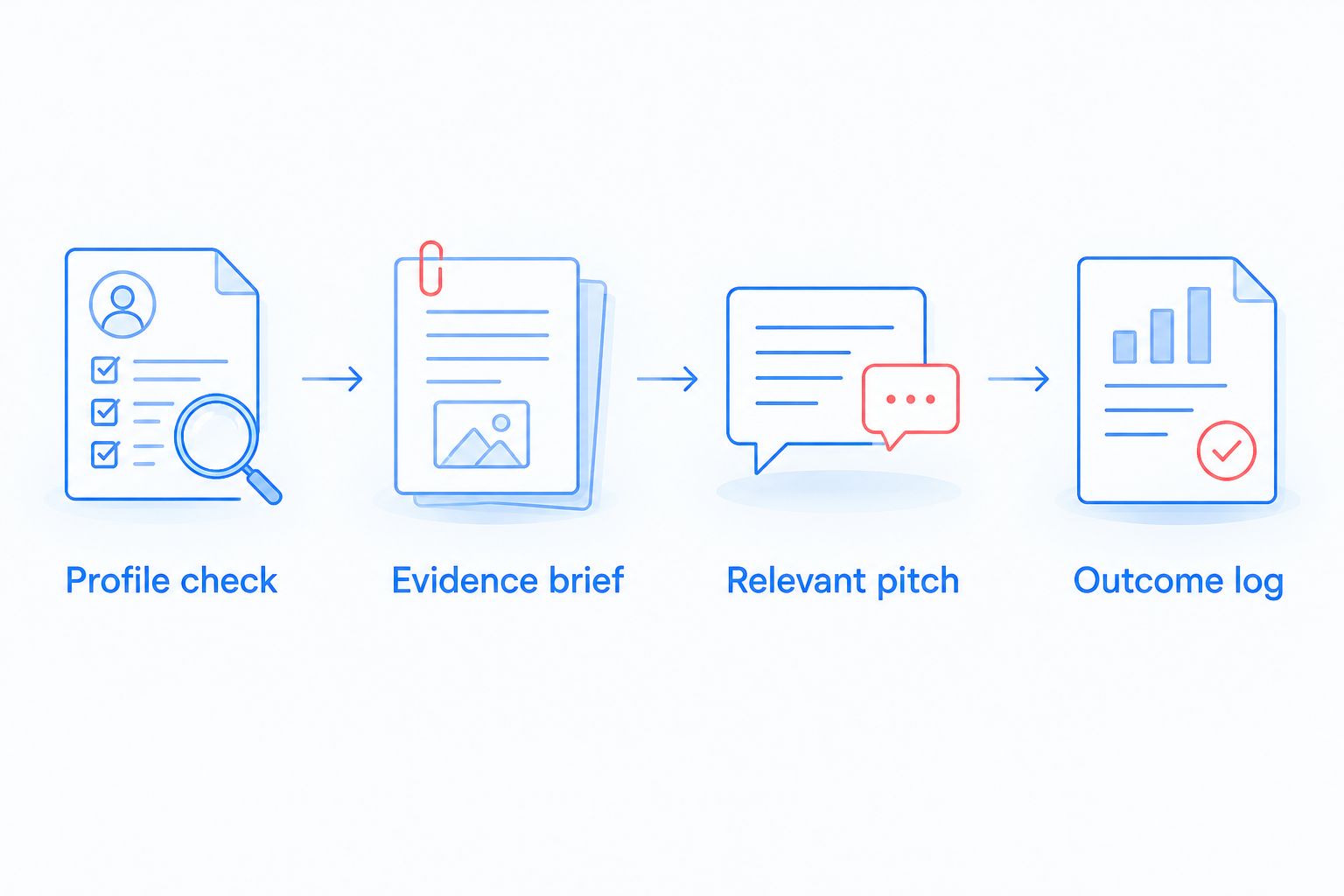
The workflow has four handoffs: Profile check, Evidence brief, Relevant pitch, and Outcome log. Finish each handoff before moving to the next so an inaccurate publication record does not become an inaccurate media claim.
Outcome log configuration
Keep activity separate from impact
- Create an outreach record with fields for recipient, audience, paper, message version, send date, response, and next action. These are your tracking fields, not Google Scholar settings. Give the record a clear 2026 campaign label.
- Record replies as replies. Record an interview request separately from a published story. When coverage appears, save its title, outlet, publication date, and location in your own record.
- Inspect the published story for the correct researcher, paper, and interpretation. If it contains a material error, send a concise correction request with the supporting passage from the paper.
- Track scholarly citations separately from press mentions and outreach activity. Note when you checked each measure. Do not report a press mention as a citation or attribute a citation increase to outreach without evidence connecting them.
Expected result: Your record shows what happened without mixing messages sent, reader responses, published coverage, and scholarly use. This lets you describe outcomes accurately to collaborators and assess your next action.
Keep an unanswered pitch in the log rather than repeatedly rewriting history as a new campaign. Before following up, check the journalist’s contact preferences and whether you have something useful to add. Repeated requests without new relevance do not strengthen the scientific case.
When your paper or profile is updated
An update workflow starts with the change, not with another mass announcement. In 2026, use the same evidence brief to distinguish an administrative correction from a finding that changes interpretation.
- Profile correction: Fix the affiliation, author attribution, or publication record. Update the brief, but do not manufacture a news angle from housekeeping.
- New publication version: Check what changed and update the citation and reading route. Explain the version difference to anyone already working on a story.
- Correction or changed conclusion: Revise the summary and limitations. Contact active media recipients with the corrected information before continuing promotion.
- New public-interest context: Explain why the existing result is relevant to the current question. Keep the original study’s scope intact.
Expected result: Every active recipient has the version and qualification needed to interpret the paper correctly. A new citation count alone is not a new finding.
Troubleshooting
Your profile is not visible while signed out
Check Make my profile public in the profile editor, then test the profile again without your signed-in session. Distinguish access from search visibility: being publicly accessible does not guarantee a particular search position.
Scholar shows another researcher’s paper
Remove the incorrect entry and verify the remaining records against their publisher details. Review additions before using the profile as an identity reference in outreach, especially when authors share your name.
The journalist cannot read the paper
Provide the publisher record and a repository version you are permitted to share, if one exists. Explain access restrictions clearly. Do not attach a restricted publisher PDF simply because you authored the study.
Your pitch receives no response
Check recipient relevance, the public-interest explanation, and whether the message makes an interview or evidence review straightforward. Revise those elements before expanding the recipient list. Silence does not establish that the research lacks value.
Coverage overstates the finding
Identify the exact sentence, supply the relevant evidence, and request a specific correction. Update your reusable summary if its wording contributed to the misunderstanding; do not redistribute an inaccurate headline as a promotion asset.
Customize your workflow
Paper Spotlight’s PhD-founded perspective connects article analysis before promotion with expert-led targeting of relevant researchers. Its approach includes scientific testing of outreach approaches across research areas and career stages; that describes the method, not proof of a particular result for your paper.
Before choosing a promotion plan, clarify your intended readers and prepare the evidence brief. Register, choose a plan, and submit the article with a clear objective. Keep any press objective distinct from scholarly promotion, and preserve author review of scientific claims.
For a researcher-facing version of the workflow, use the academic email outreach guide. Replace the journalist’s public-interest angle with a specific connection to the recipient’s research. Keep the same verified citation and limitations.
Explore targeted paper promotion
Review the service with your published paper and intended research audience in mind.
FAQ
How do I go from a Google Scholar profile to press coverage?
Verify your public profile and paper, prepare a plain-language evidence brief, and pitch journalists whose reporting matches the finding. Google Scholar supplies identity and publication context; it does not send pitches or guarantee coverage.
Does making my Google Scholar profile public get journalists to contact me?
A public profile makes your research identity accessible, but it does not guarantee journalist contact. A relevant pitch must still explain the finding’s public significance and limitations.
What should I send a journalist about my research?
Send a concise explanation of the finding, its relevance, its main limitation, and a lawful reading route. Include your professional contact details and offer an interview or supporting evidence brief.
Can Paper Spotlight guarantee press coverage or citations?
No guarantee of press coverage or a specific citation count belongs in your promotion decision. Paper Spotlight offers academic paper promotion through article analysis, targeted research promotion, and social media outreach; those services are distinct from editorial acceptance.
Should I contact my university communications office first?
Contact the office first when institutional requirements, embargoes, or coordinated announcements apply. Confirm its process before promising a journalist access, timing, or institutional participation.
Can I promote a paper if the full text is behind a paywall?
You can explain the published finding and provide its publisher record without distributing a restricted PDF. Supply a permitted repository version when available, and make access restrictions clear.
How should I measure this workflow in 2026?
Track messages, replies, interviews, published coverage, and scholarly citations as separate outcomes. Do not treat coverage as a citation or claim that outreach caused a citation increase without supporting evidence.
One last thing
Put the most important limitation next to the finding, not at the bottom of the media kit. A journalist who sees the claim and its boundary together has a better starting point for an accurate explanation. Your aim is credible visibility for the research you actually published, not a larger claim than the paper supports.


