
Altmetrics can signal attention that precedes citations, but they do not reliably predict an individual paper’s future citations on their own. A mention, share, or news story is not evidence that another researcher will cite the paper; use these signals to assess visibility and audience relevance, then track citations separately.
- Do altmetrics predict future citations? Not reliably for individual papers; attention and scholarly use are different outcomes.
- Assess who mentions your paper and why, not just the total attention score.
- Compare papers within similar fields, publication ages, and tracking sources.
- Paper Spotlight offers research promotion, not guaranteed citations; judge outreach by relevance and transparent reporting.
Why this matters
Your first published paper needs readers, but a rising attention score does not establish that those readers will use it in their research. Treating visibility as a citation forecast can lead you to choose the wrong promotion activities or overstate results in a funding application.
For your 2026 reporting, separate attention, engagement, and scholarly use. The guide to altmetrics tracking tools addresses monitoring; the more important decision is what each recorded event actually tells you.
Use altmetrics to improve dissemination, not to promise future citations. That distinction gives you a practical way to evaluate both your own outreach and a paid promotion service.
Do altmetrics predict future paper citations?
Altmetrics provide information about attention surrounding research, not a dependable paper-level citation forecast. Some indicators can be associated with later citations across groups of papers, but an association does not establish what will happen to your article.
The central distinction is between observing attention and demonstrating predictive accuracy. A credible prediction requires a defined outcome, a future observation period, and evaluation on papers outside the data used to develop the prediction.
| Signal | What it supports | What it does not establish | Best use |
|---|---|---|---|
| Social media mentions | Your paper entered a tracked public conversation | Readers understood, endorsed, or will cite it | Finding relevant conversations |
| News coverage | Your research attracted editorial attention | Academic adoption or methodological quality | Assessing public visibility |
| Reference-manager saves | Users saved a reference for possible use | Users read it or will cite it | Monitoring research-related interest |
| Policy-document mentions | A tracked document referenced your work | Future journal citations or a demonstrated policy effect | Documenting a specific form of use |
| Journal-article citations | Later scholarly documents referenced the paper | Agreement with its findings or proof of quality | Tracking scholarly use in context |
These signals serve different purposes. A policy mention can matter to your dissemination goals even if it produces no journal citations, while a widely shared post can generate attention unrelated to the paper’s academic contribution.
There is no valid conversion rule from an attention score to a future citation count. Do not turn a score increase into a citation forecast without a separately evaluated prediction method.
What would convincing prediction evidence look like?
A study claiming predictive value should identify the papers studied, their disciplines, the attention sources, and the period during which citations were counted. It should also distinguish information available early from information collected after citations had already accumulated.
Ask whether the prediction improves on a simpler baseline using publication age and research field. A complex score is not useful merely because it correlates with something that time and discipline already help explain.
Finally, look for uncertainty and testing on separate papers. A relationship measured across a collection of publications does not justify telling an early-career researcher how many citations a particular paper will receive.
Why the relationship between attention and citations varies
Altmetrics and citations capture different activities. Their relationship depends on what was measured, who encountered the research, and whether the observation periods make sense.
- Research field: Compare papers addressing similar scholarly communities rather than treating attention across unrelated disciplines as equivalent.
- Publication age: A newly published paper and an older article have had different opportunities to attract attention and citations.
- Attention source: A reference-manager save, a news report, and a social post represent different actions, not interchangeable units of interest.
- Audience relevance: Attention from researchers working on a related problem answers a different question from attention among general readers.
- Tracking coverage: An unrecorded mention is absent from the dataset, not necessarily absent from the world.
- Reason for attention: Praise, criticism, controversy, and correction can all produce mentions; inspect the context before interpreting a total.
For a 2026 campaign, keep these factors beside the headline metric. Otherwise, you risk comparing differences in measurement or audience with differences in research uptake.
Why a composite score needs context
A composite attention score summarizes selected events according to a provider’s rules. It is not a direct count of readers, and its numerical scale should not be treated as a scale of scientific quality.
Read the underlying mentions before drawing conclusions. Several relevant researchers discussing your methods tell you something different from repeated distribution of the same promotional message, even when both create visible activity.
How should you track attention without overstating impact?
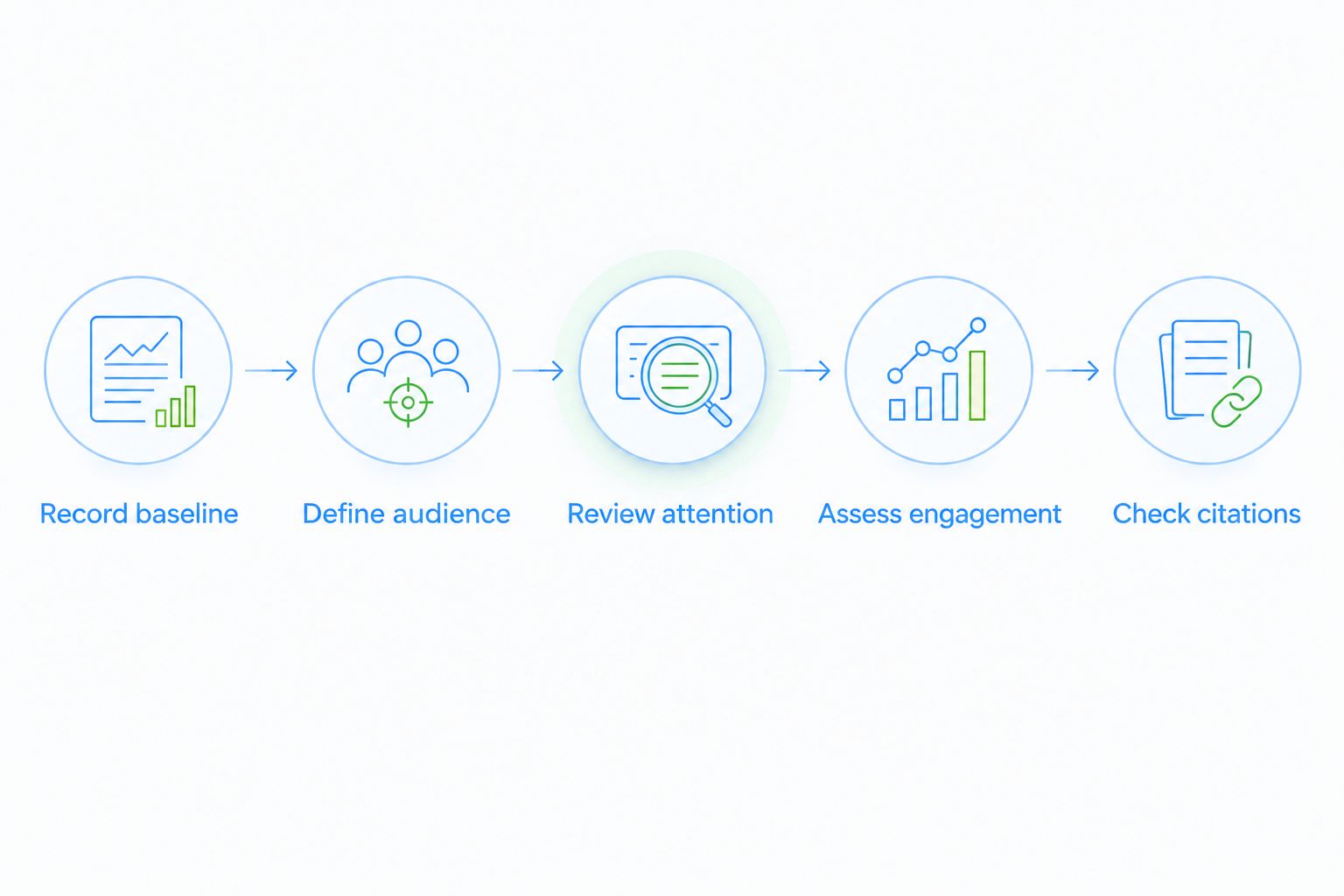
Build a reporting process that keeps distribution, audience response, and scholarly use separate. The following checkpoints are suggested reporting intervals, not estimates of how quickly citations should arrive.
- Record baseline. Before outreach, save the paper identifier, publication date, existing attention, and citation counts. Record the source and date for each metric so later comparisons use the same basis.
- Define audience. Name the research questions, methods, or applications that make someone a relevant reader. Avoid defining success as reaching everyone interested in a broad subject.
- Review attention. At a suggested checkpoint of 30 days, inspect the actual mentions and conversations. Separate your own distribution from independent responses and distinguish researchers from other audiences where the evidence permits.
- Assess engagement. At a suggested checkpoint of 90 days, review substantive questions, discussions, and accessible engagement data. Record which responses demonstrate interest in the paper rather than interest in a headline alone.
- Check citations. At a suggested checkpoint of 12 months, review citations separately and read their context. Keep tracking beyond that checkpoint when appropriate; it is not a deadline for judging the paper’s contribution.
Keep the reporting source consistent. If you switch citation databases or attention providers during a campaign, label the change rather than presenting the resulting difference as growth.
Your 2026 report should also distinguish observations from interpretations. Write that a researcher discussed your method when that happened; do not rewrite that event as evidence that the researcher will cite it.
What belongs in your campaign record?
Use a simple record with the event date, source, paper identifier, audience context, and a short description of what happened. Preserve enough information to revisit the original mention rather than relying entirely on a dashboard total.
Include limitations alongside results. If you cannot identify who read a post or whether someone opened the full paper, leave that question unresolved instead of substituting impressions for readers.
For team reporting, agree on the meaning of each category before promotion starts. This prevents a later discussion in which one person calls all attention “impact” while another reserves that word for documented use.
Which metric should guide your next promotion decision?
Choose the metric that matches the decision you need to make. Attention indicators help you inspect distribution; citation records help you inspect later scholarly referencing. Neither replaces reading the underlying evidence.
| Approach | Best for | Strength | Limitation |
|---|---|---|---|
| Attention monitoring | Researchers checking whether outreach reached visible conversations | Provides detail about tracked mentions and their context | Coverage is incomplete and attention is not scholarly use |
| Citation tracking | Researchers documenting subsequent scholarly references | Identifies recorded references to the paper | Does not explain all readership or establish endorsement |
| Combined reporting | Researchers evaluating dissemination without confusing outcomes | Keeps early attention and later referencing visible together | Requires interpretation rather than a single success score |
Combined reporting is the best fit when your goal is credible visibility. It lets you recognize useful dissemination without claiming that every positive response will become a citation.
In your 2026 outreach plan, specify what action each signal would change. Relevant questions about a method might justify a clearer explanatory post; unrelated sharing is not a reason to repeat the same campaign unchanged.
Should you buy promotion to improve altmetrics?
Buy promotion for a defined dissemination task, not for an attention score alone. Ask what the service will analyze, which researchers it will target, what outreach it will perform, and how it will distinguish activity from outcomes.
Paper Spotlight is best for researchers seeking expert-handled promotion of a published paper, not a guaranteed citation count. Its PhD-founded perspective connects article analysis before promotion with expert-led targeting of relevant researchers and social media outreach.
Paper Spotlight’s research promotion approach also includes scientific testing of outreach approaches across research areas and career stages. That describes a method of evaluating outreach, not evidence of a particular result or proof that a campaign will increase citations.
The benefit is expert handling of the promotion process; the limitation is that promotion does not control readers’ research needs or citation decisions. You can review Paper Spotlight with a concrete brief: the paper’s contribution, its intended research audience, and the visibility outcome you want to assess.
Review your paper promotion options
Consider article analysis and relevant-researcher targeting before choosing a promotion plan.
Before choosing a plan, ask how reporting will separate outreach delivered, attention observed, and citations recorded. Reject any promise that payment secures citations, publication, or peer review.
Can a paper with little online attention still receive citations?
Yes, limited recorded online attention does not mean a paper will receive no citations. Researchers also discover literature through scholarly searching, reference lists, teaching, and professional exchanges that an attention tracker does not fully capture.
Use a low score as a prompt to inspect discoverability and audience fit, not as a verdict on the paper. Check whether your title, abstract, and accessible sharing materials clearly explain the contribution.
Does a high attention score mean a paper is high quality?
No, a high attention score does not establish research quality. Assess the study’s methods, evidence, limitations, and relevance separately from its visibility.
A critical discussion can attract attention just as a favorable discussion can. Read what people are saying before using a score in a research statement or promotion report.
FAQ
Do altmetrics predict future citations for my paper?
Altmetrics do not reliably predict an individual paper’s future citations on their own. They describe tracked attention that you should interpret alongside audience relevance, publication age, and later citation records.
Which altmetric is best for predicting citations?
There is no universally best altmetric for predicting citations across papers and research fields. Evaluate the specific indicator, the population studied, and whether a prediction was tested on separate papers.
Does sharing my paper on social media guarantee more citations?
Sharing your paper on social media does not guarantee more citations. It creates an opportunity for discovery, but citation depends on whether other researchers use and reference the work.
Should I report an attention score in my academic CV?
Report an attention score only with clear context about the source, measurement date, and what it represents. Do not present it as a substitute for research quality or a prediction of citations.
How long should I track citations after promoting a paper?
Use an ongoing tracking period suited to your research field rather than treating a campaign’s end as a citation deadline. The suggested 12 months checkpoint is a reporting choice, not a promised time to results.
Is paid paper promotion the same as paying for citations?
Paid paper promotion purchases dissemination work, not scholarly references. Ethical promotion leaves researchers free to read, assess, ignore, or cite the paper on its merits.
Can Paper Spotlight guarantee a higher citation count?
Paper Spotlight’s promotion service should not be treated as a citation guarantee. Evaluate its article analysis, audience targeting, and outreach process separately from any later citation changes.
One last thing
A citation is not automatically an endorsement: the citing paper can disagree with your findings or identify a limitation. Read citation context just as carefully as you read the context of an online mention.
For your next 2026 reporting update, add a short explanation beside each headline metric: what happened, who was involved, and what remains unknown. That makes your visibility report more defensible than a score presented without context.


