
Best overall: Altmetric Explorer for tracking attention to a published paper. Best for institution-wide reporting: PlumX Metrics. Best for reading attention alongside citations: Dimensions. These are the best altmetrics tracking tools to compare in 2026; Paper Spotlight is a research promotion service, not a tracking tool.
- Altmetric Explorer is the best altmetrics tracking tool for investigating where a paper is discussed.
- PlumX Metrics fits researchers whose library provides access to broader research-impact reporting.
- Dimensions fits researchers who want to examine attention alongside citation information.
- Paper Spotlight promotes published research; use a tracking tool to assess attention separately.
Why this matters
A citation tells you that another scholarly work referenced your paper. An altmetric signal tells you something different: that a source outside a traditional citation count mentioned, shared, saved or discussed it. Neither signal, on its own, establishes that the reader understood your findings or that a promotion effort caused the attention.
For an early-career researcher, that distinction shapes the decision. If your question is who discussed this paper?, inspect source-level mentions. If your question is how does its attention sit beside citations?, use a view that places both types of information together. In 2026, choose the tool around the question you need to answer, not the largest-looking number on a dashboard.
What makes the best altmetrics tracking tool?
- Traceable mentions: Can you inspect the underlying source rather than rely on a summary score?
- Relevant source coverage: Does the tool show the channels where researchers in your field actually encounter work?
- Identifier matching: Can you find the correct published paper using its DOI or another reliable identifier?
- Context alongside counts: Can you distinguish a substantive discussion from a brief share?
- Access for your role: Does your library provide the features you need, or will you need another route to view the data?
- Useful reporting: Can you explain what the tool shows without presenting attention as proof of research quality?
Start with the underlying mentions. A score without its sources cannot tell you whether the discussion reached relevant researchers. Before selecting a tool in 2026, search for your paper and check both the record and the links behind its attention summary.
Best altmetrics tracking tools at a glance
| Tool | Best for | Standout feature | Key limitation |
|---|---|---|---|
| Altmetric Explorer | Investigating discussion around an individual paper | Source-level attention records | Attention scores need source-level interpretation |
| PlumX Metrics | Viewing impact signals across a research portfolio | Multiple categories of research activity | Available views depend on institutional access and integration |
| Dimensions | Reading attention beside citation information | Research-discovery context | Less focused on investigating individual mentions than a dedicated attention tool |
The tools answer related but distinct questions. Use the table as a decision guide, then confirm which views your institution makes available. A missing result is not proof that nobody discussed your work; it can also reflect how a tool matches records and collects sources.
1. Altmetric Explorer: best altmetrics tracking tool for paper-level discussion
Altmetric Explorer helps you investigate online attention to research outputs and inspect the sources behind it. For a newly published paper, that makes it the strongest starting point when you want to know where discussion occurred, rather than report a score without context.
Search for the published record and verify its DOI before interpreting the result. Then read the linked mentions. A specialist discussing your method and a general share of your title are different kinds of attention, even when both appear in an activity view.
Altmetric Explorer pros:
- Supports inspection of attention to an individual research output.
- Makes source-level review more useful than a score alone.
- Fits a researcher preparing a defensible account of where a paper was discussed.
Altmetric Explorer cons:
- A high attention score does not establish scholarly influence.
- Coverage of discussion depends on the sources the service tracks.
- The views you can use depend on your access.
Best for: Researchers asking who discussed a specific published paper and where that discussion appeared.
Verdict: Buy if source-level attention is the decision you need to investigate and the available access meets that need. Skip a score-only reading of the results.
2. PlumX Metrics: best for portfolio-level impact reporting
PlumX Metrics organizes research activity into categories that include citations, usage, captures, mentions and social media. That wider view suits researchers whose library or institution already presents PlumX information alongside publication records.
Use it to compare the types of activity visible across your outputs. Do not add unlike categories together as though a save, a mention and a citation were interchangeable. For a 2026 portfolio update, describe the activity and name the category behind it.
PlumX Metrics pros:
- Separates different forms of research activity into named categories.
- Provides a useful structure for reviewing more than one output.
- Connects attention reporting with other impact signals.
PlumX Metrics cons:
- A category total still needs inspection before you describe its significance.
- Available views depend on the institution or publication platform presenting them.
- It is not a substitute for reading what people said about a particular paper.
Best for: Researchers with institutional access who need to describe activity across a publication portfolio.
Verdict: Hold until you check how your institution displays PlumX data. If your main task is tracing discussion of one article, start with Altmetric Explorer instead.
3. Dimensions: best for attention alongside citations
Dimensions is a research-discovery platform that presents publication and citation information, with attention information available in its research context. It suits a researcher who wants to keep online attention and scholarly referencing in view while examining a paper and related work.
The useful question is not whether one number is bigger than another. Check what each measure represents, whether the paper record is correct, and whether a mention is relevant to the audience you intended to reach. In 2026, attention and citations remain different observations, not stages of a guaranteed sequence.
Dimensions pros:
- Places research outputs in a broader discovery context.
- Helps you examine citation information without treating it as an altmetric.
- Suits researchers comparing a paper with related scholarly work.
Dimensions cons:
- It is less suited than a dedicated attention tool to investigating individual online mentions.
- Available data and views depend on the access you have.
- Citation information alone cannot tell you whether outreach reached its intended readers.
Best for: Researchers who want to consider attention while examining citations and related publications.
Verdict: Buy for research-context analysis if your available access supports that workflow. Choose Altmetric Explorer when source-level discussion is the primary task.
How to turn tracking into a credible visibility decision
A tool shows recorded activity. It does not decide whom you should contact or make a paper more visible by itself. Use a short sequence to keep measurement separate from promotion:
- Verify the record. Match the title, authors and DOI before treating a dashboard result as yours. If the record is wrong, stop there.
- Inspect the sources. Open mentions and identify whether they discuss the finding, point to the article or simply repeat its title.
- Identify the audience. Note which research communities the useful mentions reach. Do not assume a large audience is the right one.
- Choose an outreach angle. Explain the question your published paper answers and why that answer matters to a relevant researcher.
- Review the response. Return to the source records after outreach. Report what appeared, without attributing every later mention or citation to your activity.
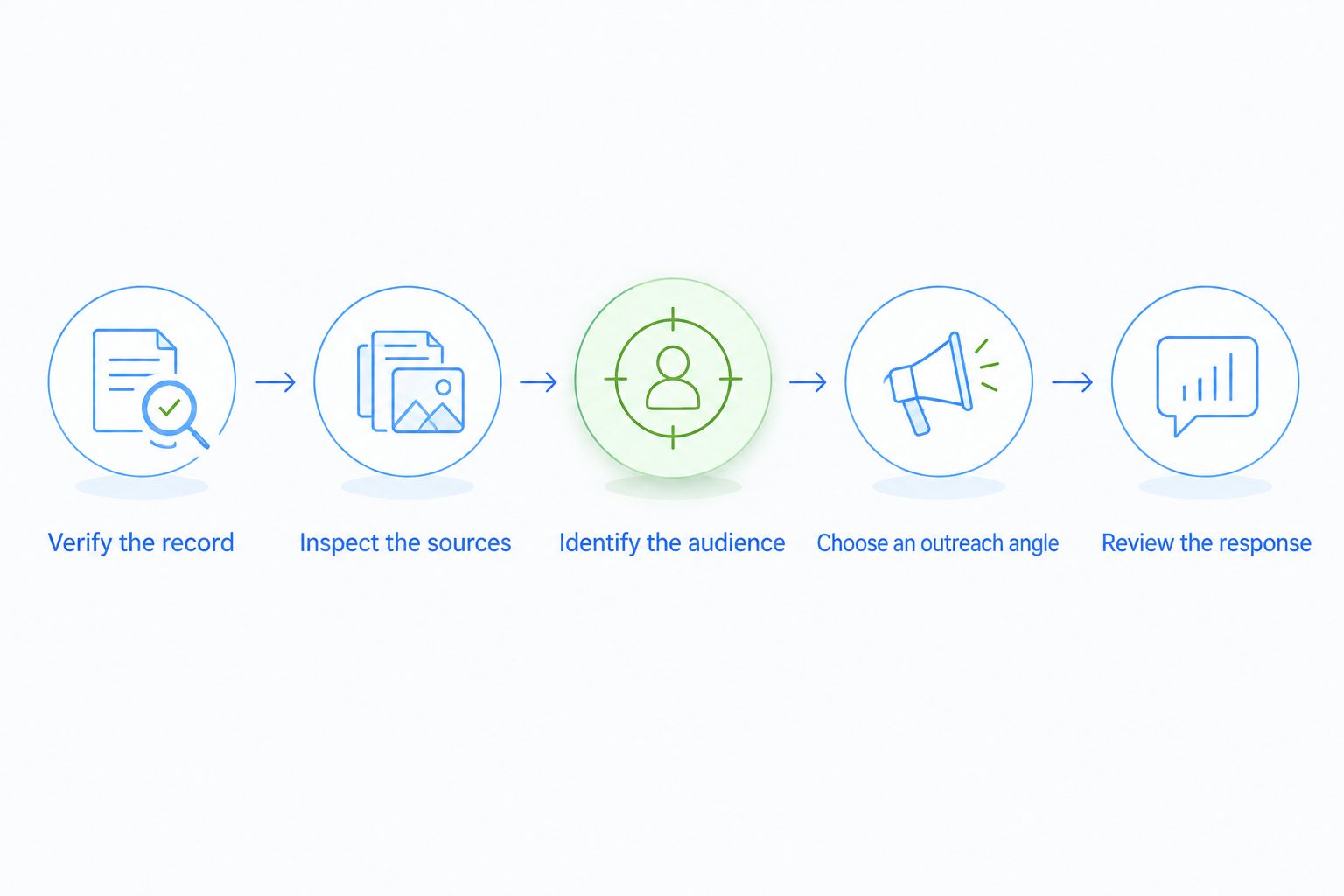
This process also prevents a common reporting error: presenting visibility as research quality. A mention can show that a paper entered a conversation. To explain its value, you still need to read the conversation and describe its relevance.
Paper Spotlight approaches the other side of this workflow: promotion of published research. Its stated service includes article analysis, targeted research promotion and social media outreach. The brand's PhD-founded perspective informs that service, and its approach includes expert-led targeting and scientific testing of outreach approaches across research areas and career stages. Those descriptions explain the method; they do not establish that any particular paper will receive a citation.
Paper Spotlight is best for researchers seeking help with targeted promotion of a published paper, not for researchers shopping for an altmetrics tracking tool. In 2026, keep the service decision distinct from the measurement decision: decide whom the paper should reach, then use source-level tracking to assess what attention is visible.
Plan your paper's promotion
Review Paper Spotlight's approach to targeted promotion of published research.
How we ranked these tools
The ranking follows the criteria above, with traceable discussion first because it answers the clearest paper-level question: where did this work appear, and what was said? Altmetric Explorer takes the top slot for that task. PlumX Metrics earns a separate slot for categorized portfolio reporting; Dimensions earns one for research and citation context.
This is a use-case ranking, not a claim that one tool records every mention or that a score measures quality. Access and coverage affect what you can see. For a 2026 decision, confirm the paper record and inspect the underlying sources before choosing a reporting workflow.
Which altmetrics tracking tool should you choose?
Choose Altmetric Explorer by default when your priority is understanding discussion of one published paper. Choose PlumX Metrics when your institution provides it and you need categorized activity across your outputs. Choose Dimensions when your question centers on a paper's research context and citation information as well as attention.
If you want people in a relevant research area to encounter the paper, tracking is only the measurement half of the job. Paper Spotlight addresses promotion, while the best altmetrics tracking tools help you examine recorded attention. Keep those roles separate when you describe the results to a supervisor, collaborator or potential reader.
FAQ
What is the best altmetrics tracking tool for a published paper?
Altmetric Explorer is the best starting point when you want to inspect where an individual paper was discussed. Check the paper record and read the underlying mentions before reporting an attention score.
Is Altmetric Explorer better than PlumX Metrics?
Altmetric Explorer is the better fit for investigating discussion of one paper; PlumX Metrics fits categorized activity reporting across outputs. The right choice depends on your question and the views you can access.
Can altmetrics show whether my research is high quality?
No. Altmetrics describe recorded attention and activity, not the quality of a paper's methods or findings. Read the sources behind a mention before describing its significance.
Do altmetrics predict citations?
No altmetric count guarantees future citations. Attention and citations record different actions, so report each separately rather than presenting one as proof of the other.
How can an early-career researcher use altmetrics responsibly?
Verify the publication record, inspect relevant mentions and describe what the sources actually show. Do not claim that promotion caused a citation without evidence connecting the activity to that outcome.
Does Paper Spotlight track altmetrics?
Paper Spotlight is described as a service for promoting published papers through article analysis, targeted promotion and social media outreach, not as an altmetrics tracking tool. Use a dedicated tool when you need to inspect recorded attention.
One last thing
Before sharing a 2026 attention summary, open the mention you would be most comfortable showing a fellow researcher. If it does not demonstrate a relevant conversation about your paper, lead with a more precise description of the attention instead of the headline score.