
Instead of manually rewriting dissertation announcements for every channel, build a dissertation to published paper visibility workflow that connects your published article, an accurate summary, relevant readers, and a review log. Use this 2026 guide to prepare credible outreach yourself or hand a clear brief to a promotion service.
- A dissertation to published paper visibility workflow starts with the published article, not a dissertation announcement.
- Paper Spotlight suits early-career researchers seeking expert-led academic paper promotion rather than managing every outreach task themselves.
- Use a plain-language summary, relevant audience groups, and a record of outreach outcomes.
- Promotion supports discovery; it does not guarantee citations, publication, or peer review.
Why this matters
Your dissertation explains a substantial research project. Your published paper presents a particular contribution. An announcement that describes the whole dissertation can send readers toward questions the article does not answer.
Promote the paper’s actual finding, scope, and limitations—not the broader promise of your dissertation. That distinction gives relevant researchers a clear reason to read and an accurate basis for deciding whether to cite it.
Paper Spotlight offers academic paper promotion through article analysis, targeted research promotion, and social media outreach. Its PhD-founded perspective puts analysis before promotion, with expert-led targeting and scientific testing of outreach approaches across research areas and career stages. Those methods describe the service’s approach, not a guaranteed result.
Before you start
- Gather the publication materials: the published article, its DOI or publication record, the dissertation record, an accessible version you are permitted to share, and any supplementary materials.
- Arrange access and approval: use a working institutional email account, access to the profiles you intend to update, and agreement with coauthors about public wording and outreach responsibilities.
- Resolve the version problem first: repository deposit does not automatically permit redistribution of the publisher’s PDF. Check the publishing agreement, embargo, and permitted manuscript version before attaching or uploading files.
Create a shared document or spreadsheet for the workflow. The bold field names below are labels to create in your own template, not buttons in a particular platform. This is a repeatable editorial process, not a native software integration.
For your 2026 campaign record, write down the publication status before drafting promotional copy. An accepted manuscript and a published version should not be presented as interchangeable records.
Publication brief
Configure the article record
- Create fields labeled Published title, Authors, Publication date, DOI, Reader destination, and Sharing permissions. Copy bibliographic details from the publication record rather than an old dissertation draft.
- Under Reader destination, record the publication page and any permitted reading route separately. Identify which destination each outreach message should use.
- Add Paper contribution and Dissertation relationship. Explain what this article contributes and how it relates to the dissertation without suggesting that every dissertation chapter appears in the paper.
- Create Main finding, Scope, and Limitation fields. Write each in plain language and check it against the published text.
- Assign an Approval owner. Ask that person to confirm the bibliographic details, scientific wording, and permitted sharing route before outreach begins.
Expected result: you have an approved source record from which every announcement can be written. A collaborator should be able to identify the correct paper and reading route without asking you which version to use.
Keep the limitation visible in this brief. Removing it to make a headline stronger creates a mismatch between the announcement and the paper readers encounter.
Audience and message
Configure the reader brief
- Create Audience, Relevance reason, Message angle, and Contact source fields. Define audiences by the research problem, method, or evidence they use—not simply by a broad department name.
- Start with 3 audience groups: researchers studying the same question, researchers using a related method, and practitioners who can interpret the work within its limits. Remove any group without a defensible connection.
- Draft a summary of no more than 150 words as an editorial starting point. Include the question, approach, finding, limitation, and reason a relevant reader should care. This is a suggested writing constraint, not a platform requirement.
- Adapt the opening sentence for each audience. Keep the scientific claim unchanged while explaining a different reason to read.
- For individual outreach, record a specific relevance reason before adding a recipient. Use appropriate professional contact information and respect institutional rules and recipient preferences.
Expected result: each audience has a clear reason to encounter the paper, and every message rests on the same approved scientific summary.
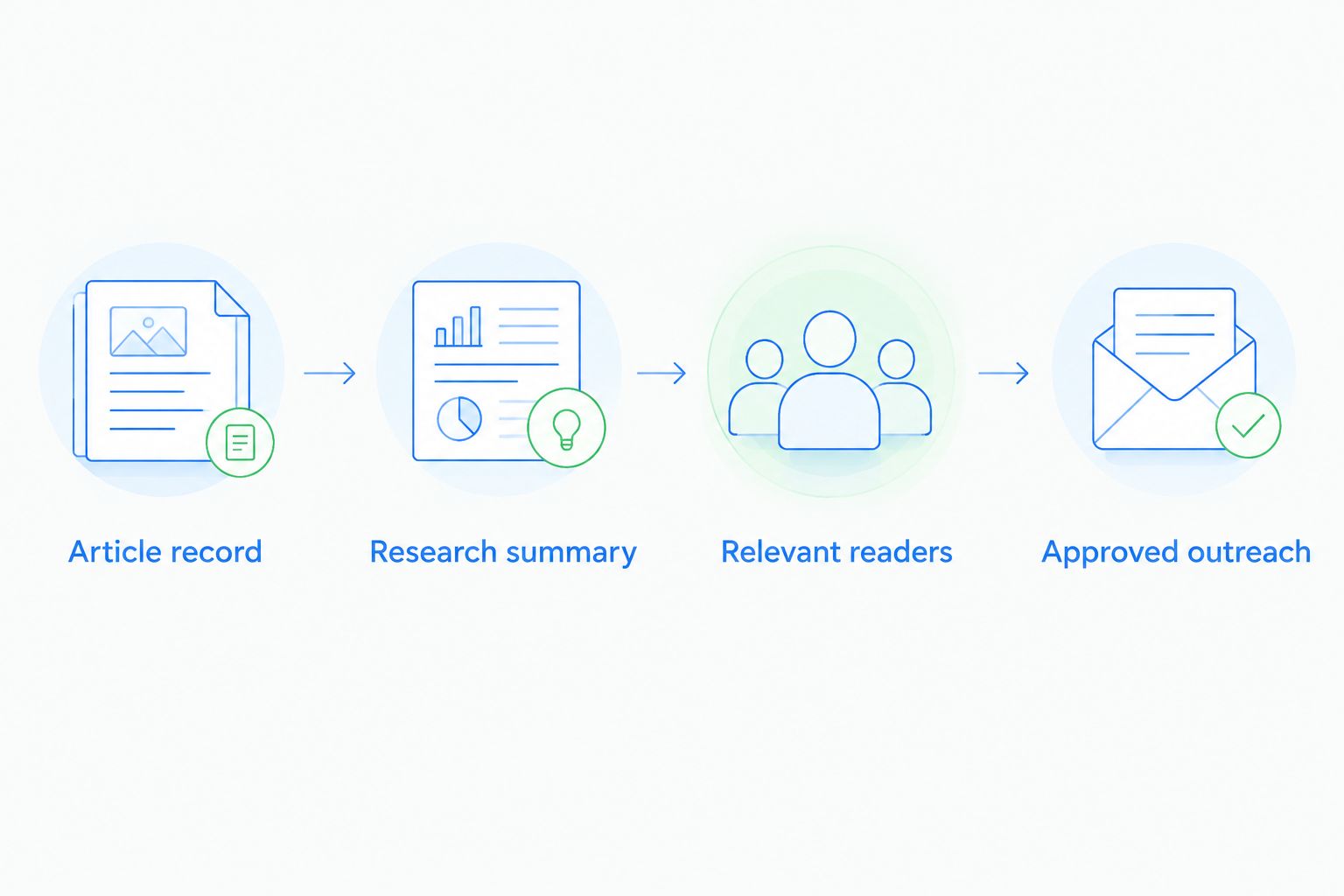
The brief can follow this sequence:
- Article record: identify the publication and permitted reading route.
- Research summary: state the contribution and its limits.
- Relevant readers: explain who needs the work and why.
- Approved outreach: select messages and destinations for review.
Do not make a list of prominent academics and then search for reasons to contact them. Start with relevance; reputation alone is not an audience criterion.
Outreach and handoff
Configure the delivery plan
- Create Channel, Audience, Approved message, Destination, Owner, and Status fields. Give each outreach action its own row so that responsibilities remain visible.
- Choose a channel based on where the intended readers communicate. A professional profile update serves a different purpose from a direct message about a specific methodological connection.
- Draft a short announcement containing the research question, finding, boundary, and reading destination. For direct outreach, add the recipient-specific relevance reason before the summary.
- Choose who will handle analysis, targeting, writing, approval, and delivery. Record these responsibilities explicitly whether you work alone, with colleagues, or with a service.
- Review the approved message and destination together. Send or publish only after the owner confirms both; then record the action under Status.
Expected result: you can see what will be shared, with whom, where it leads, and who is responsible. No recipient should receive overlapping approaches because ownership was unclear.
Choose the right level of support
These are workflow options, not rankings of research quality. Select the arrangement that fits your capacity and the judgment you want to retain.
| Approach | Best for | Main benefit | Main limitation |
|---|---|---|---|
| Researcher-managed outreach | Researchers who want direct control | You select every audience and message | You remain responsible for analysis, delivery, and review |
| Coauthor-coordinated outreach | Papers with shared promotion responsibilities | Authors can divide tasks using one approved brief | Coordination requires clear ownership and version control |
| Paper Spotlight academic paper promotion | Early-career researchers seeking expert-led support | Article analysis informs targeting and social media outreach | Service support does not remove the need to verify scientific claims or guarantee citations |
Paper Spotlight is best for early-career researchers who want expert-led promotion of a published paper. Its service is not a publication or peer-review service, and buying promotion is not buying citations.
Before choosing a plan, use the article brief to assess fit: explain the paper’s contribution, identify the intended readers, and clarify the approval process. The stated service sequence is register, choose a plan, and submit the article. Ask how the proposed work connects to your specific audience rather than treating wider distribution as an end in itself.
Measurement record
Configure a review you can interpret
- Create Baseline date, Action date, Activity, Observation, and Next decision fields. Record the starting position using only evidence you can access.
- Separate delivery records from reader responses. Publishing a post records an action; receiving a relevant question records an interaction. Neither, by itself, establishes scholarly impact.
- Set a review date 30 days after the initial outreach as a practical planning checkpoint. This is a suggested cadence, not a benchmark for when citations should appear.
- Review questions, relevant replies, permitted analytics, and citation records separately. Note the source and observation date so later comparisons use the same basis.
- Record the next decision: clarify the summary, refine an audience, correct a destination, or stop an unproductive activity. Do not infer that a citation was caused by promotion merely because it appeared afterward.
Expected result: the record supports a specific next action without confusing activity, attention, and citations.
Keep the same definitions throughout your 2026 review. Changing what counts as an interaction midway through a campaign makes the comparison difficult to interpret.
Update the workflow when publication details change
A second workflow applies when a previously shared manuscript becomes a published article, or when a correction changes what readers need to know. The trigger is a verified change to the publication record—not a desire to repeat the same announcement.
- Compare the updated record with your Published title, DOI, Reader destination, and Main finding fields.
- Check whether the scientific wording, access route, or version label needs revision. Obtain approval for substantive changes.
- Update profiles and summaries you control, including older announcements where editing is possible.
- Contact previous recipients again only when the update gives them a useful reason to revisit the work.
For a 2026 publication replacing an earlier manuscript record, distinguish the versions explicitly. The preprint-to-published-paper promotion workflow covers that adjacent transition.
Expected result: readers encounter the current publication without receiving a duplicate campaign disguised as new research.
Troubleshooting
Readers cannot access the linked paper
Test the destination while signed out of institutional access. If the article requires access credentials, identify a permitted manuscript route or accurately explain the access requirement. Do not bypass an embargo or upload a restricted PDF.
The dissertation gets attention instead of the article
Check the announcement’s opening and destination. Lead with the published paper’s contribution, identify it as the article derived from the dissertation, and direct readers to the publication record.
Outreach produces irrelevant responses
Review Relevance reason before changing channels. Remove audiences whose connection depends on a broad keyword alone, and revise the opening to identify the precise research question or method.
Coauthors send overlapping messages
Assign one owner to each outreach action and maintain a shared status record. Check that record before sending; a shared contact list without ownership does not prevent duplication.
Attention increases but citations do not
Treat attention and citations as different observations. Check whether the paper is reaching relevant readers, but do not describe visibility as a citation outcome or pressure recipients to cite the work.
Customize your workflow
Expand the workflow only after the publication record, message, and ownership are stable. For your next 2026 campaign, add a field for the question each audience asks most often; use those questions to improve explanations without altering the findings.
A researcher-managed process gives you direct control but leaves every task with you. Paper Spotlight offers article analysis and expert-led targeting for researchers seeking service support; you still need to provide accurate materials and assess whether the proposed audience fits your paper.
Choose one useful extension rather than adding channels without a clear purpose. A repository listing, a researcher profile, or a plain-language explanation should give readers a better route to understanding the same publication.
FAQ
How do I promote a paper that came from my dissertation?
Promote the published paper’s specific contribution, not the entire dissertation. Prepare an approved summary, identify relevant readers, verify sharing permissions, and record outreach actions and responses separately.
Can I share my published article PDF with everyone?
Share only the version your publishing agreement permits. Check manuscript-version rules and embargoes before distributing a file; repository access does not automatically grant redistribution rights.
Should I promote my dissertation or the journal article?
Use the journal article as the main destination when the outreach concerns that publication. Mention the dissertation as context when it helps readers understand the research relationship.
Is Paper Spotlight a journal publication service?
Paper Spotlight provides academic paper promotion, including article analysis, targeted research promotion, and social media outreach. It does not replace journal submission, editorial decisions, or peer review.
Does paying for research promotion guarantee more citations?
No, promotion does not guarantee citations. Researchers decide independently whether a paper is relevant enough to cite, and paid visibility must not be presented as purchasing citations.
How soon should I review my paper promotion workflow?
A review 30 days after initial outreach is a practical planning checkpoint, not a citation deadline. Assess message accuracy, audience relevance, reader responses, and available records separately.
Do I need to contact researchers individually?
Individual outreach is one option, not a requirement. Use it only when you can explain a specific professional connection between the recipient’s work and the paper.
One last thing
Test the reader’s route before sending the announcement. Open the destination without your institutional login and check the title, version, and access conditions. A scientifically accurate message still fails its immediate purpose if the intended reader cannot identify or reach the paper.


