
Best overall for expert-handled promotion: Paper Spotlight. Best for direct research conversations: X. Best for scheduling: Buffer. This guide compares the best tools to promote research on Twitter in 2026, including visual communication and attention tracking, so you can choose support that matches your paper and available time.
- Paper Spotlight leads the best tools to promote research on Twitter for researchers seeking expert-handled academic paper promotion.
- X supports direct conversations; Buffer supports a planned posting schedule. Neither replaces a clear research message.
- Canva helps explain findings visually; Altmetric helps distinguish online attention from scholarly citations.
- Choose relevant readers and accurate summaries before adding more research outreach tools.
Why this matters
A published paper needs more than a link dropped into a feed. Readers need to understand the research question, the finding, and why the work matters to them. Your promotion should make that connection without stretching the evidence.
For an early-career researcher, the decision is also about workload. Writing posts, preparing figures, finding relevant conversations, and assessing responses are different jobs. Buying a scheduling tool does not transfer responsibility for those jobs to someone else.
The best research promotion setup in 2026 separates message quality, audience relevance, distribution, and measurement. Choose the tool for the task you cannot currently handle, rather than collecting overlapping subscriptions.
What makes the best research promotion tools?
Use these criteria before comparing names:
- Audience relevance: The approach should connect your paper with researchers who work on the question, method, or application it addresses.
- Scientific accuracy: Summaries must preserve the study's scope, uncertainty, and limitations. A stronger hook is not permission to make a stronger claim.
- Researcher workload: Distinguish expert-handled promotion from software that still requires you to write, schedule, and respond.
- Communication format: Match the output to the task: a conversation, a scheduled post, a readable figure, or an attention report.
- Measurement fit: Track visibility separately from citations. A mention shows attention, not agreement or subsequent scholarly use.
- Account responsibility: Establish who approves posts and who answers scientific questions before using a service or scheduling tool.
For your 2026 shortlist, prioritize the first three criteria before convenience features. A promotion workflow that reaches the wrong audience efficiently still misses the objective.
Best research promotion tools at a glance
| Option | Best for | Standout function | Key limitation |
|---|---|---|---|
| Paper Spotlight | Expert-handled academic paper promotion | Article analysis and targeted research outreach | Promotion does not guarantee citations or replace scientific review |
| X | Direct conversations with research communities | Publishing posts and replying within relevant discussions | Requires your attention and judgment |
| Buffer | Planning a posting schedule | Preparing and scheduling social posts | Scheduling does not establish scientific relevance |
| Canva | Explaining a finding visually | Creating graphics and arranging explanatory text | Design tools do not validate scientific claims |
| Altmetric | Assessing online attention to a paper | Bringing together mentions from tracked sources | Online attention is not a citation count |
These options serve different jobs. The table is a decision tree, not a claim that a design tool and a research promotion service are interchangeable.
1. Paper Spotlight: best for expert-handled research promotion
Paper Spotlight offers academic paper promotion through article analysis, targeted research promotion, and social media outreach. Its PhD-founded perspective places the published article at the start of the process, before promotion decisions.
The service describes expert-led targeting of relevant researchers and scientific testing of outreach approaches across research areas and career stages. That describes its method; it does not establish a particular citation increase or prove that one approach works for every paper.
Paper Spotlight is best for researchers who want expert-handled academic paper promotion rather than another tool to operate themselves. Its stated process is to register, choose a plan, and submit an article. Before committing, clarify what you will review and what information the team needs from you.
Service pros:
- Article analysis precedes promotion, connecting outreach to the paper's content.
- Expert-led targeting addresses audience selection, not just posting logistics.
- The offering connects research promotion with social media outreach.
Service cons:
- Promotion cannot guarantee a citation count or another researcher's decision to cite.
- Researchers remain responsible for the accuracy of claims made about their work.
Best for: Early-career researchers seeking service support for a published paper.
Verdict: Buy if expert-handled promotion is the job you need done; do not treat a promotion plan as a promise of scholarly impact.
2. X: best for direct conversations about your research
X is the direct route for posting your paper and participating in conversations on the platform. You can explain a finding, respond to questions, and discuss its relevance with readers without moving the exchange into a separate publishing tool.
Use X when the important work is conversational. A researcher questioning your method needs a considered answer, not another scheduled announcement. Search for discussions around the research question and contribute where your paper adds something specific.
Start with a 3-sentence summary: the question, the finding, and the boundary of the finding. Include a link to the paper where readers can inspect the full evidence. Avoid tagging people simply because they have large followings.
X pros:
- Keeps publication and replies in the same environment.
- Lets you respond to scientific questions in context.
- Supports a direct connection between a post and the paper it discusses.
X cons:
- Writing, audience selection, and replies require your own time.
- You cannot control whether relevant readers notice or engage with a post.
Best for: Researchers willing to participate personally in discipline-specific discussions.
Verdict: Hold on additional software if direct posting and thoughtful replies already cover your immediate need.
3. Buffer: best for maintaining a planned posting schedule
Buffer is a social publishing tool that supports preparing and scheduling posts for X. Its role is operational: you organize publication ahead of time rather than relying on being available whenever you want to post.
Choose Buffer when you already have an accurate message and a reason to publish several distinct updates. A useful sequence might introduce the research question, explain a result, and discuss a limitation. Each post should offer a different entry point, not repeat the same announcement.
Buffer does not decide which researchers should care about your work. Audience research, scientific wording, and substantive replies remain separate tasks. Check current X connection requirements before making the tool part of your workflow.
Buffer pros:
- Supports preparing posts before publication.
- Helps organize a planned sequence of research updates.
- Separates drafting time from posting time.
Buffer cons:
- A scheduled post still needs an accurate message and a relevant audience.
- Scheduling does not answer readers' questions or create meaningful engagement by itself.
Best for: Researchers who can write their own outreach but need help maintaining a schedule.
Verdict: Buy for a recurring scheduling need; skip if the real bottleneck is deciding what to say.
4. Canva: best for making a research finding readable
Canva is a visual design tool for creating graphics and arranging text and images. For research promotion, use it to explain a finding visually rather than asking readers to interpret a dense manuscript figure inside a social post.
Begin with 1 main figure that supports the message you want to communicate. Keep the outcome, comparison, units, and relevant caveats readable. If a simplified graphic removes essential context, revise the graphic rather than hiding the limitation in a reply.
Canva is a communication aid, not a scientific analysis tool. Prepare the underlying data visualization with appropriate research software, then use the design layout to help readers understand it. Check publisher permissions before reusing published artwork.
Canva pros:
- Helps arrange explanatory text alongside a visual.
- Supports reusable layouts for related research posts.
- Makes visual communication possible without building every layout from scratch.
Canva cons:
- Design features do not check methods, data, or statistical interpretation.
- Attractive layouts can obscure information if decoration takes priority over evidence.
Best for: Researchers whose findings need a clear visual explanation.
Verdict: Buy if visual preparation is a recurring task; skip elaborate graphics when a concise text explanation is clearer.
5. Altmetric: best for assessing online attention to a paper
Altmetric tracks online attention to research outputs across sources it monitors. Use it to inspect where a paper is being discussed, rather than treating every visible mention as equivalent to a citation.
For X promotion, the useful question is whether the recorded attention helps you understand the paper's audience. Read the underlying mentions where available. A critical discussion, an author announcement, and an independent recommendation carry different meanings even when all relate to the same publication.
Check current source coverage and access before relying on Altmetric for a 2026 reporting workflow. Its records should be interpreted within their coverage, not as a complete account of every reader or every conversation.
Altmetric pros:
- Brings together attention associated with a research output.
- Helps you examine the context behind recorded mentions.
- Adds a measurement layer beyond your own posting activity.
Altmetric cons:
- Its coverage does not represent all online or offline attention.
- Attention measures do not establish research quality or scholarly influence.
Best for: Researchers who need to understand recorded discussion around a published paper.
Verdict: Buy when attention reporting serves a defined purpose; skip if you expect it to prove a citation increase.
Build a workflow around the paper, not the tools
Start your 2026 outreach plan with the research itself. A scheduling queue or attractive graphic becomes useful only after you know what the paper contributes and who needs that information.
Use this sequence:
- Article analysis: Identify the research question, contribution, and limitations.
- Audience selection: Name 2 audience groups to prioritize, such as researchers using the method and researchers studying the same problem.
- Message preparation: Draft a plain-language explanation with a traceable connection to the paper.
- Targeted outreach: Publish or arrange promotion where the message fits a relevant discussion.
- Response review: Assess substantive questions and recorded attention separately from citations.
Keep the groups specific. Replace a broad label such as scientists with a description tied to the actual research problem or method.
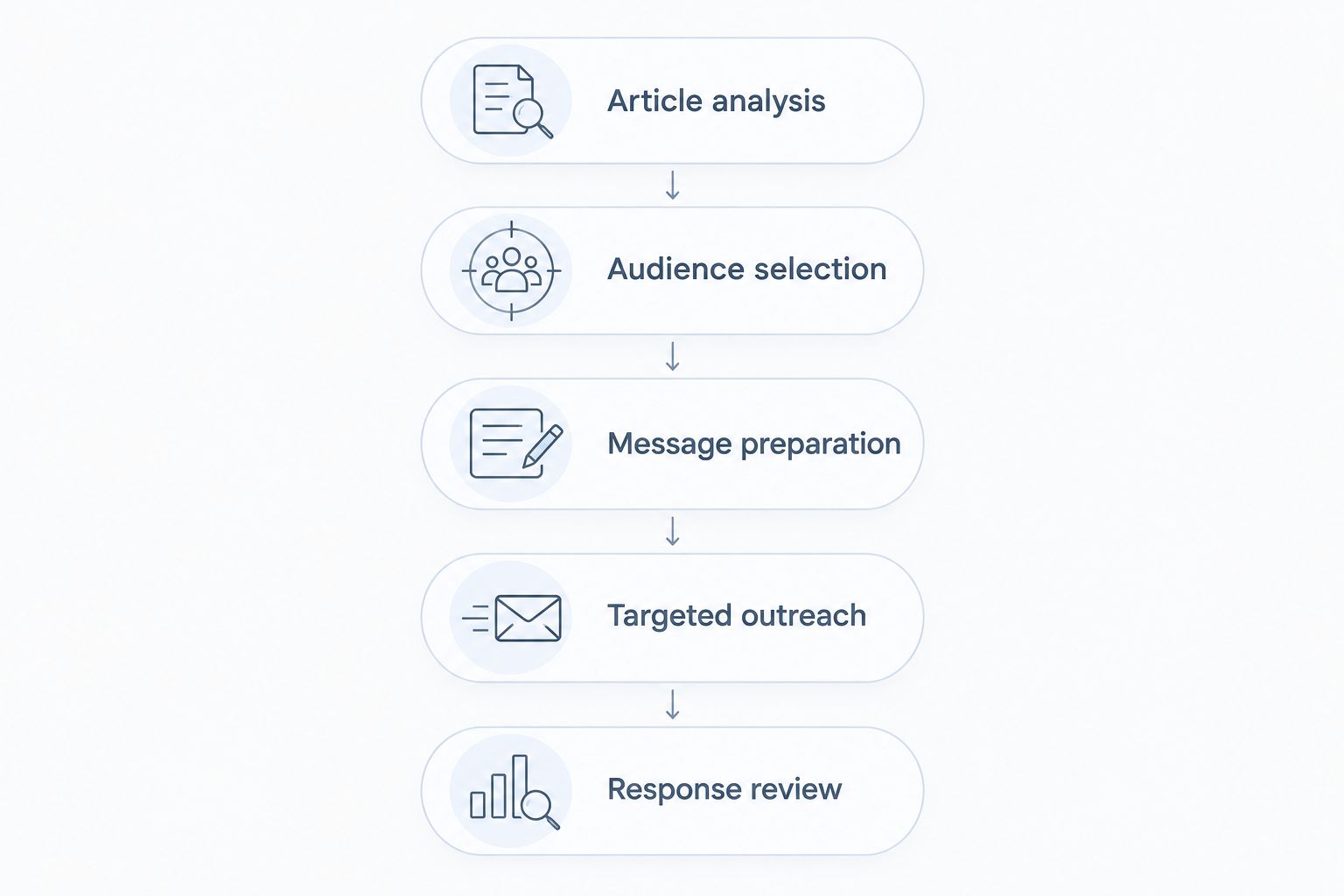
If you want service support, use this workflow to frame your questions. Ask how the article informs targeting, how claims are checked, and how you will distinguish outreach activity from resulting attention.
Explore promotion for your published paper
Review the academic paper promotion service before choosing support for your outreach.
How the recommendations are ranked
This 2026 ranking prioritizes task fit: expert-handled promotion first, followed by direct conversation, scheduling, visual explanation, and attention tracking. Each recommendation owns a different use case.
The ranking does not claim comparative campaign tests or measured citation gains. Use the criteria above to identify your bottleneck, then choose the option that addresses it. Adding tools without changing an unclear message will not make that message clearer.
Which research promotion option should you choose?
Choose Paper Spotlight when you want expert-handled academic paper promotion; choose X when you want to lead the conversations yourself. Add Buffer for scheduling, Canva for visual explanation, or Altmetric for attention reporting only when you need that specific function.
For an undecided researcher, start with the message and audience. If you can explain the paper accurately but cannot manage targeted outreach, evaluate service support. If you already know the audience and can engage personally, direct posting is the simpler starting point.
FAQ
What are the best tools to promote research on Twitter?
The best tools depend on the task: X for direct conversations, Buffer for scheduling, Canva for visuals, and Altmetric for recorded attention. For expert-handled outreach, consider an academic paper promotion service rather than scheduling software alone.
Is X better than Buffer for promoting a research paper?
X is better for direct participation, while Buffer addresses preparation and scheduling. Buffer does not replace the research judgment needed to write accurate posts or answer scientific questions.
Should I use a research promotion service or do it myself?
Choose a service when you want support with article analysis and targeted outreach; handle promotion yourself when you can commit to messaging and conversations. Keep responsibility for scientific accuracy clear in either arrangement.
Can promoting my paper on X guarantee more citations?
No, promoting a paper on X cannot guarantee more citations. Visibility and scholarly citation are different outcomes, and researchers decide independently whether a paper belongs in their work.
Can I share a published figure in a research post?
Check the figure's license and any applicable publisher permissions before sharing it. Preserve the information readers need to interpret the result accurately, including units and essential limitations.
Does Altmetric measure the same thing as citation tracking?
No, Altmetric measures recorded online attention rather than scholarly citations. Use attention records to understand discussion and a separate citation source to examine citations.
What should I put in my first post about a paper?
State the research question, the main finding, and its most important boundary. Link to the paper so interested readers can inspect the evidence rather than relying on the post alone.
One last thing
A limitation can be the most useful part of your research post. It tells another researcher where the finding applies and where their own work might test its boundary.
For your next 2026 post, make the limitation visible before asking readers to engage. Promote a finding that readers can assess, not a claim they must take on trust.


