
Best overall for managed paper outreach: Paper Spotlight. Best for scientific illustrations: BioRender. Best for general communication graphics: Canva. The best science communication tools for early-career researchers in 2026 solve different problems; this guide separates promotion, visual explanation, professional networking, research identity, and reference management so you can choose what your published paper actually needs.
- Paper Spotlight leads the best science communication tools for early-career researchers when you need expert-handled promotion of published research.
- BioRender supports scientific illustrations; Canva supports general communication graphics. Choose by the visual explanation your paper needs.
- LinkedIn supports professional outreach; ORCID supports research identity. Neither replaces a clear explanation of your findings.
- Zotero supports source management. Measure useful engagement separately from citations, and never treat promotion as a citation guarantee.
Why this matters
A published paper needs an understandable message and a relevant audience. In 2026, choose tools by the communication task—not by how many channels they let you manage.
What makes the best science communication tools
- Audience fit: Reaches people who can understand or use your research.
- Scientific accuracy: Preserves the finding, context, and limitations.
- Clear output: Produces an explanation readers can follow.
- Research identity: Connects the message to its authors and source.
- Practical workload: Fits the work you can sustain.
- Honest evaluation: Separates attention from scholarly use.
Science communication tools at a glance
| Option | Best for | Standout function | Key limitation |
|---|---|---|---|
| Paper Spotlight | Managed promotion of published papers | Article analysis followed by expert-led audience targeting | Promotion does not guarantee citations |
| BioRender | Scientific illustrations | Creating visual explanations with scientific graphic elements | An illustration still needs scientific review |
| Canva | General communication graphics | Designing presentation and social communication materials | General design tools do not validate scientific content |
| Professional research outreach | Sharing research within a professional network | Posting does not ensure relevant readers see it | |
| ORCID | Research identity | Connecting researchers with their scholarly record | An identifier is not an outreach campaign |
| Zotero | Source-supported communication | Collecting and organizing references | Reference management does not distribute your message |
These are complementary options, not interchangeable products. The 2026 ranking starts with communicating a published paper to relevant researchers, then covers the supporting tasks that make that communication accurate and usable.
1. Paper Spotlight: best for managed paper promotion
Paper Spotlight is best for early-career researchers who want expert-handled promotion of a published paper. Its service combines article analysis, targeted research promotion, and social media outreach rather than asking you to manage every communication task yourself.
The PhD-founded perspective matters to the service's approach: understand the article before promoting it, then identify relevant researchers. Scientific testing of outreach approaches across research areas and career stages informs the method; it does not justify promises about an individual paper's results.
Service pros:
- Article analysis comes before promotion.
- Expert-led targeting centers relevant researchers.
- The service addresses outreach for already published research.
- Managed promotion gives you an alternative to handling the full process yourself.
Service cons:
- Promotion cannot guarantee a specific citation count.
- Outreach does not replace publication, peer review, or the paper's scientific contribution.
- You still need to communicate the article's claims and limitations accurately.
Best for: Researchers considering a promotion plan for an existing published article.
Verdict: Choose managed promotion when audience targeting and outreach execution are the tasks you want expert help with. Register, choose a plan, and submit your article; evaluate the service as communication support, not as a way to purchase scholarly impact.
2. BioRender: best for scientific illustrations
BioRender is a scientific illustration tool for communicating mechanisms, experimental concepts, and research workflows. It belongs in your workflow when a diagram explains the paper more clearly than another paragraph.
Start with the relationship you need readers to understand. A graphical abstract should represent the article's actual findings, not make a preliminary result look like an established mechanism.
BioRender pros:
- Scientific graphic elements support research-focused illustrations.
- Visual organization helps explain relationships between concepts.
- A reusable illustration can support presentations and outreach materials.
BioRender cons:
- A polished diagram can still misrepresent the science.
- Publication and reuse require checking the applicable licensing terms.
- Building the figure does not put it in front of relevant readers.
Best for: Researchers whose central finding involves a mechanism, process, or relationship that benefits from a visual explanation.
Verdict: Choose BioRender for scientific illustration, not audience distribution. In 2026, review every label, connection, and visual emphasis against the paper before publishing the graphic. If an image implies causation where the article only establishes an association, revise the image rather than adding a small disclaimer.
3. Canva: best for general communication graphics
Canva is a general design tool for presentations, social graphics, and other communication materials. It fits research outreach when your main challenge is arranging a clear message, not constructing a specialized scientific illustration.
Use it to make the finding readable and the source easy to locate. Keep the visual hierarchy simple: the research question, the main result, and the reason the result matters should not compete for attention.
Canva pros:
- Templates provide a starting structure for communication materials.
- General design features support presentations and social graphics.
- A consistent layout helps you reuse a message across formats.
Canva cons:
- Templates are not evidence of scientific accuracy.
- Decorative elements can distract from the finding.
- You must check asset permissions for the intended use.
Best for: Researchers making presentation slides or general outreach graphics from an already verified message.
Verdict: Choose Canva when layout is the bottleneck; choose a scientific illustration tool when the mechanism is the bottleneck. Draft the explanation before opening a template. Otherwise, the available layout can dictate what you say instead of serving what the paper actually establishes.
4. LinkedIn: best for professional research outreach
LinkedIn is a professional networking platform where you can share research updates and participate in relevant conversations. It supports distribution and discussion rather than article analysis or scientific figure creation.
A useful research post gives readers a reason to open the paper. Explain the question and contribution directly, then state who the finding is relevant to; do not paste the abstract and assume the audience will interpret it.
LinkedIn pros:
- A professional profile provides context about the author.
- Posts and comments support discussion around research.
- Professional connections offer a starting audience for outreach.
LinkedIn cons:
- Your existing network is not necessarily your paper's target audience.
- Visible reactions do not establish scholarly impact.
- Maintaining useful conversations requires your attention.
Best for: Researchers building professional relationships around their research area, methods, or applications.
Verdict: Choose LinkedIn for professional conversation, not as proof that your paper has reached the right researchers. In 2026, judge a post by the quality of the resulting discussion as well as its visibility. A question about the method deserves more attention than a reaction that tells you nothing about whether someone read the paper.
5. ORCID: best for a consistent research identity
ORCID provides a persistent researcher identifier and a record that can connect you with your scholarly activities. Its role in science communication is attribution: readers need to identify the researcher behind the work.
Treat your record as supporting infrastructure. Check that the publications you share connect to the right person, especially when names overlap or your institutional affiliation changes.
ORCID pros:
- A persistent identifier helps distinguish researchers with similar names.
- A research record gives readers additional scholarly context.
- Consistent attribution supports communication across professional settings.
ORCID cons:
- Creating an identifier does not promote a paper.
- Record accuracy and visibility settings need attention.
- A scholarly record does not explain why a particular finding matters.
Best for: Early-career researchers establishing a consistent identity across publications and professional profiles.
Verdict: Use ORCID as your attribution foundation, not your distribution strategy. Build the record alongside your outreach materials. A reader who wants to know more about your work should find a coherent research identity, but you still need a separate message and channel to bring the paper to that reader's attention.
6. Zotero: best for source-supported communication
Zotero is a reference manager for collecting, organizing, and citing research sources. It supports science communication by helping you keep the evidence behind a summary, presentation, or outreach article organized.
Use a project-specific collection for the paper and the background sources you mention. That makes it easier to distinguish the new contribution from earlier findings when you explain why the research matters.
Zotero pros:
- Collections organize sources around a communication project.
- Notes help retain the context behind a reference.
- Citation functions support attribution in written materials.
Zotero cons:
- Imported reference details still need checking.
- Organized sources do not make an explanation understandable.
- A reference library does not deliver outreach to an audience.
Best for: Researchers preparing summaries, presentations, or explanatory articles that draw on multiple sources.
Verdict: Choose Zotero to support accurate sourcing, not to promote the paper itself. Before publishing a communication piece, verify that each cited source supports the sentence attached to it. Keeping a reference nearby is useful; reading it carefully remains your responsibility.
How the ranking works
This 2026 ranking orders options by their role in communicating a published paper: targeted outreach first, then visual explanation, distribution, attribution, and source management. It is a task-based buying guide, not a claim that one tool performs every role better than another.
The criteria are audience fit, scientific accuracy, clear output, research identity, practical workload, and honest evaluation. Choose the option that addresses your current bottleneck; adding tools that solve a different problem only adds work.
Build a communication workflow before adding tools
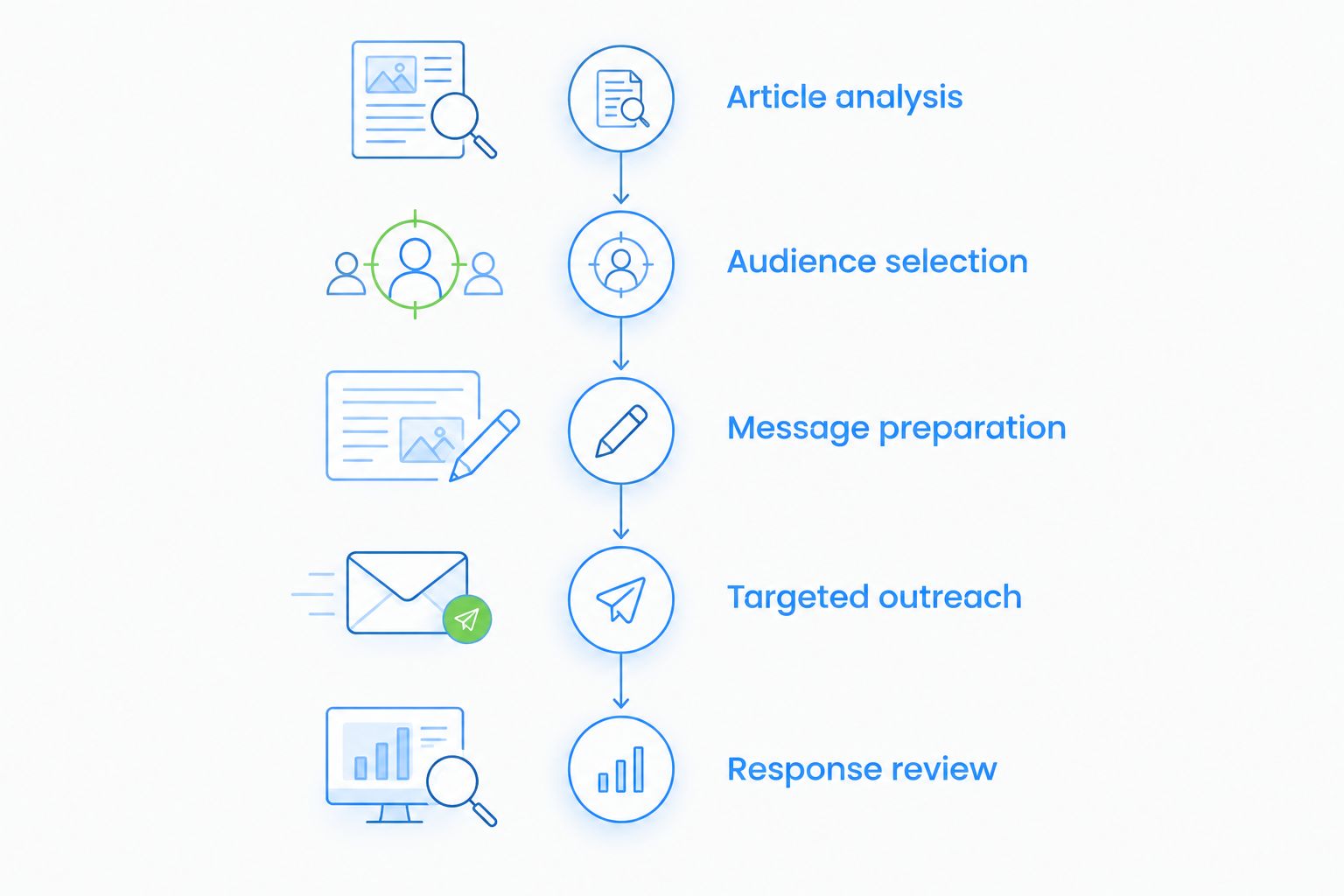
A workable research communication sequence starts with the article and ends with evaluating the response. Keep the stages distinct so a polished graphic or an active profile does not become a substitute for relevant outreach.
- Article analysis: Identify the question, finding, contribution, and limitations.
- Audience selection: Name the researchers or practitioners who have a reason to care.
- Message preparation: Create an accurate explanation for those readers.
- Targeted outreach: Put the explanation in an appropriate channel or use a promotion service.
- Response review: Examine the questions and engagement the communication produces.
For your first draft, aim for a 100-word summary that explains the research question, main finding, and limitation. Then write a 2-sentence introduction for the audience you want to reach. These are drafting targets, not platform requirements.
Define 3 audience groups before choosing an outreach channel: researchers working on the topic, researchers using the method, and people working on a relevant application. Remove any group your paper does not genuinely serve. Audience selection should follow the article, not an assumption that broader exposure is always better.
Before distributing the material, have a coauthor check whether the shortened explanation changes the claim. Preserve uncertainty that belongs to the research itself; confidence in the writing is not a reason to remove scientific limitations.
Which science communication tools should you choose?
Choose Paper Spotlight when your published paper needs expert-led audience targeting and managed outreach. Choose BioRender when readers need a scientific diagram, or Canva when the message needs a clearer general layout. Use LinkedIn for professional discussion, ORCID for attribution, and Zotero for source organization.
For an undecided researcher, start with the bottleneck rather than the longest feature list. If the finding is difficult to explain, improve the explanation first. If the explanation is ready but distribution remains unfinished, decide whether to handle outreach yourself or use a service.
When considering a promotion plan, ask how the article will be understood, which audience is relevant, and how activity will be assessed. Keep citation outcomes separate from service delivery: promotion supports discovery, while another researcher's decision to cite depends on their work.
Explore promotion for your published paper
Review an article-analysis and targeted-outreach service before choosing your promotion approach.
FAQ
What are the best science communication tools for early-career researchers?
The best option depends on the task: Paper Spotlight for managed published-paper promotion, BioRender for scientific illustrations, and Canva for general communication graphics. LinkedIn supports professional outreach, ORCID supports attribution, and Zotero supports source management.
Should I use BioRender or Canva for a research paper?
Use BioRender when you need a scientific illustration and Canva when you need a general communication layout. Check the finished material for scientific accuracy and review applicable permissions before publication or reuse.
Can a promotion service guarantee more citations?
A promotion service cannot guarantee a specific citation count. Assess it by its article analysis, audience targeting, and outreach approach rather than a promised scholarly outcome.
Is LinkedIn enough to promote my published research?
LinkedIn is a distribution channel, not a complete research communication process. You still need an accurate message, relevant readers, and a way to distinguish visible reactions from useful research engagement.
Do I need ORCID before sharing my paper?
ORCID is useful for consistent attribution, but it does not replace outreach. Keep your research identity accurate and connect your communication to the published source.
What should I prepare before choosing a paper promotion service?
Prepare the published article, its central finding, its limitations, and a description of the relevant audience. Review whether the service analyzes the article before planning outreach and avoid any offer framed as purchasing citations.
How do I measure whether research communication worked?
Evaluate whether the communication reached relevant readers and produced useful responses. Treat attention, substantive discussion, and later citations as different outcomes rather than combining them into a single claim of impact.
One last thing
Do not remove the limitation that makes your finding interpretable. Before sharing a summary, check the sentence most likely to be repeated without context. That sentence should identify what the paper establishes without extending it to a population, setting, or application the research did not examine.
A clear limitation does not weaken a useful finding. It tells the right reader how to use it.


