
Computer science researchers’ paper promotion is targeted communication of published research with the aim of reaching relevant readers and supporting informed scholarly use. Your message needs to make the technical contribution, evaluation conditions, and access to supporting materials clear—not simply announce that a paper exists.
- Academic paper promotion for computer science researchers should prioritize relevant readers over broad social media exposure.
- Paper Spotlight suits researchers seeking expert-led academic paper promotion rather than managing outreach themselves.
- Explain the contribution, evaluation boundaries, and available research artifacts before choosing outreach channels.
- Track relevant engagement separately from citations; promotion does not guarantee scholarly uptake.
Why academic paper promotion matters for computer science researchers
A computer science paper can address a narrow problem while carrying a broad label such as machine learning, security, or distributed systems. That label alone does not tell a prospective reader whether the research addresses their workload, threat model, dataset, or theoretical question. Promote the specific contribution, not just the field.
For your 2026 promotion plan, identify the researchers who can evaluate or use the work. A methods researcher needs different information from an engineer assessing implementation requirements or a doctoral student comparing related approaches. Your summary should give each intended audience a clear reason to read.
Early-career researchers also need a repeatable process that does not turn promotion into a second research project. The research promotion guide for PhD students addresses that career-stage context; the steps below focus on the technical information computer science readers need.
How to promote your published computer science paper
1. Define the readers who can use your contribution
Start manually with your paper’s references, related-work section, and the research communities connected to the problem. Group potential readers by what they would do with the contribution, rather than by academic seniority alone. A relevant doctoral researcher is a better outreach prospect than a prominent professor working on an unrelated problem.
Use 3 audience groups as a planning exercise: researchers extending the method, researchers evaluating comparable approaches, and practitioners investigating the application. Keep only the groups that genuinely fit your paper. For theoretical work, the practitioner group is unnecessary unless the paper establishes a practical connection.
Write a sentence explaining why each group should care. If that sentence requires an unsupported claim about usefulness, narrow the audience instead of strengthening the claim.
- List research problems that directly overlap with your contribution.
- Separate method-focused readers from application-focused readers.
- Record a relevant publication or research interest for each outreach prospect.
- Exclude recipients whose only connection is a broad department label.
2. Build an accurate promotion brief
Draft the brief yourself before selecting channels or requesting help. Your abstract is a starting point, not automatically the best outreach message: an announcement needs to explain the reading decision quickly while preserving the paper’s qualifications.
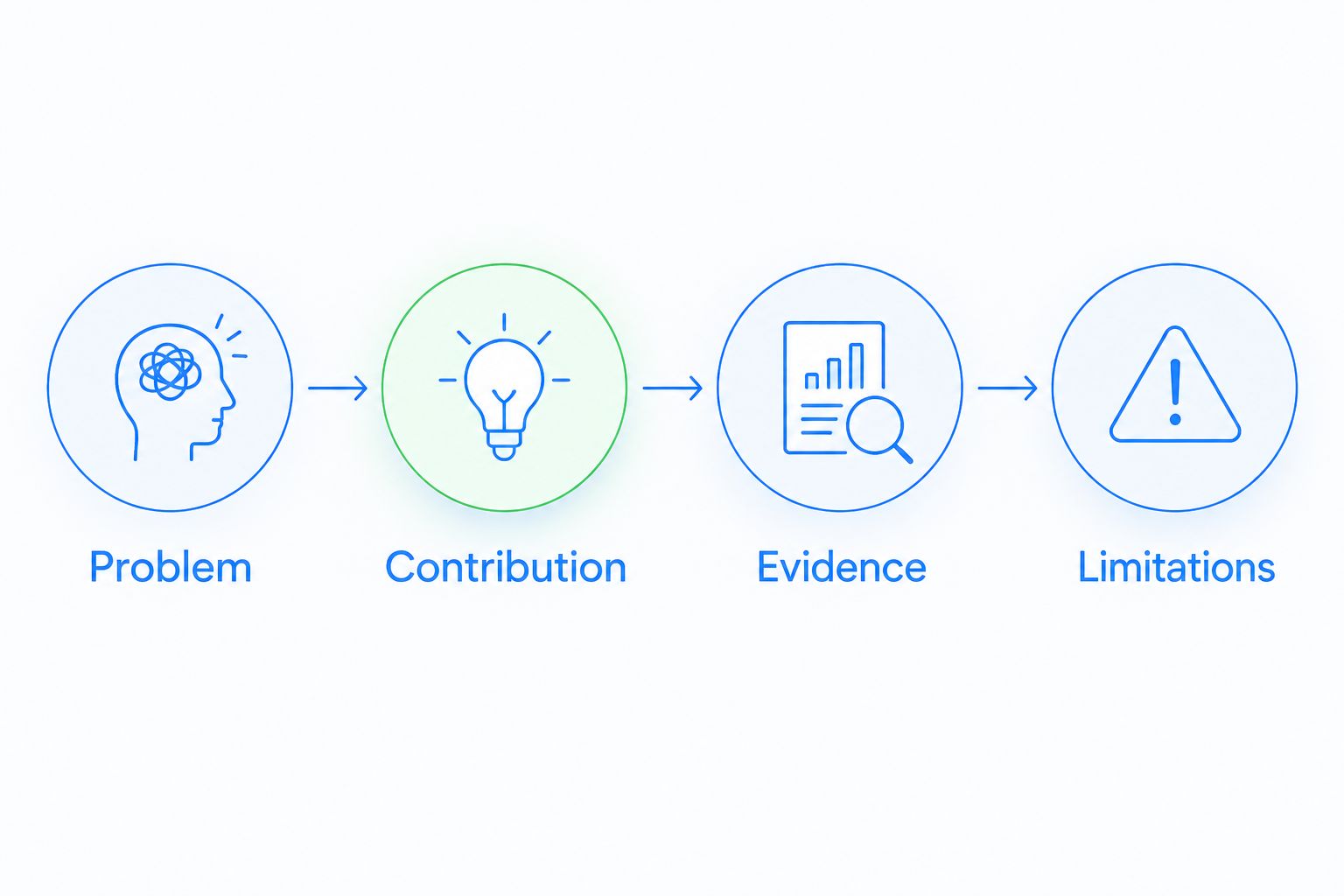
Use 4 fields: Problem, Contribution, Evidence, and Limitations. As a practical editing target, write a 100–150-word summary that covers those fields without reproducing the introduction. This is a suggested format, not a performance benchmark.
For a 2026 outreach brief, keep comparisons tied to the conditions reported in the paper. An improvement on a specified benchmark is not evidence of an improvement across all tasks. Similarly, a prototype should not be described as a production-ready system unless the paper supports that description.
- State the problem in language your target reader recognizes.
- Name the contribution without promotional adjectives.
- Summarize the evaluation setting or scope of the proof.
- Include the limitation most likely to affect interpretation.
- Check every numerical claim against the published paper.
3. Choose between self-managed and expert-led promotion
Begin with the work you can handle directly: prepare the brief, identify relevant communities, and send appropriate messages through channels you already use. Self-managed promotion gives you direct control over technical language, but it also leaves audience research, writing, and follow-up on your schedule.
Paper Spotlight provides academic paper promotion through article analysis, targeted research promotion, and social media outreach. Its PhD-founded perspective places article analysis before promotion, with experts targeting relevant researchers. That makes the service an option when you want help translating a published paper into a focused outreach effort.
Paper Spotlight describes scientific testing of outreach approaches across research areas and career stages. Treat that as a description of its method, not evidence of a guaranteed outcome for your paper. Paper Spotlight is best for researchers seeking expert-led academic paper promotion rather than managing outreach themselves.
- Identify which promotion tasks you want to retain personally.
- Review how article analysis informs the proposed audience.
- Ask how technical wording and limitations will be handled.
- Check what activity and outcome reporting the plan includes.
- Reject any promise of a fixed citation count.
4. Make the paper and supporting materials easy to access
Check the published article link before promoting it. Then confirm which additional materials you can share: an accepted manuscript, repository copy, code, data, supplementary files, or a demonstration. Follow the publication agreement and the permissions attached to each artifact.
For computer science readers, supporting materials can answer questions that a promotional summary cannot. Code helps a reader inspect implementation choices; a dataset description explains the evaluation context; a proof appendix clarifies technical assumptions. Include only what exists and what you have permission to distribute.
If materials are unavailable, do not imply that they accompany the paper. State the accessible material clearly and keep the outreach message focused on the published contribution. Accessibility and reproducibility are related, but access to a paper alone does not establish reproducibility.
- Test article and artifact links outside your logged-in browser session.
- Label the published version and any permitted manuscript version clearly.
- Check code and data licensing before inviting reuse.
- Identify dependencies or documentation relevant to the shared implementation.
- Remove links to private files or unfinished materials.
5. Match the channel to the reading decision
Choose channels after defining the audience and preparing the brief. Direct email supports a specific explanation of relevance; a research-community post supports discussion; a professional social post offers a short public introduction. None replaces the paper as the source of evidence.
Adapt the opening to the recipient’s reason for reading. A researcher comparing algorithms needs the evaluation context. A practitioner needs the application boundary and implementation requirements. A general research audience needs a clear explanation of the problem before technical detail.
For your 2026 channel plan, select a manageable set of channels and assign each a purpose. Avoid copying the same abstract everywhere. Maintain consistent scientific claims while changing the amount of detail and the invitation to engage.
- Use direct email only when you can explain the recipient’s relevance.
- Follow community rules before posting promotional material.
- Lead public posts with the problem and contribution.
- Link to the paper rather than asking readers to infer the evidence.
- Give readers an appropriate next action, such as reading or discussing the work.
6. Review outreach for accuracy and research ethics
Review every message as carefully as you would review a conference presentation slide. Promotion should make the research easier to understand, not remove the conditions that make the claim accurate. Obtain coauthor agreement where needed, particularly for messages that summarize collective work or discuss sensitive applications.
Separate attention from endorsement. A researcher receiving your message has not endorsed the paper, and a public discussion does not establish independent validation. Do not request citations as payment, reciprocation, or a condition of receiving materials.
If you buy a promotion plan, evaluate the communication work being offered. You are purchasing assistance with visibility and outreach—not publication, peer review, scientific acceptance, or citations. Keep those boundaries explicit in your own expectations and in any message sent on your behalf.
- Preserve qualifications attached to performance or generalization claims.
- Remove unsupported novelty claims such as an unverified first-ever claim.
- Confirm coauthor approval for shared promotional language.
- Avoid repeated unsolicited messages and respect opt-out requests.
- Check that outreach never implies guaranteed citation growth.
7. Measure relevant attention and revise the message
Before outreach starts, record the paper’s current citation count and any engagement measures you can actually access. Keep a simple log of channels, message versions, dates, and substantive responses. This gives you a record of activity without pretending that every later interaction resulted from promotion.
Set a 30-day review window as an operational checkpoint, not a citation deadline. Review whether the intended readers engaged, which questions they asked, and whether your summary caused confusion. Update the message when the evidence shows a mismatch between what you wrote and what readers understood.
In 2026 reporting, distinguish outreach activity, reader engagement, and scholarly outcomes. A sent message is activity; a technical inquiry is engagement; a citation is a scholarly outcome. Report each separately rather than combining them into a single success claim.
- Record the measurement date and source for citation counts.
- Track relevant replies separately from likes or impressions.
- Note requests for code, data, clarification, or collaboration.
- Compare message versions without claiming unsupported causal effects.
- Revise audience selection when responses reveal a poor fit.
Compare promotion options for your paper
Choose by the task you need handled, not by the channel with the largest apparent audience. The options below serve different purposes, and each leaves work for you or your collaborators. Your 2026 decision should reflect the paper’s audience, your available time, and the communication support you need.
| Option | Best for | Main advantage | Key limitation |
|---|---|---|---|
| Self-managed targeted email | Researchers with a clear recipient list | Direct control over relevance and wording | Requires your time for selection, writing, and follow-up |
| Research-community posting | Papers closely aligned with a community’s discussion topics | Creates a setting for subject-specific discussion | Must fit community rules and interests |
| Professional social posting | Researchers introducing work publicly | Makes a concise explanation easy to share | Public reactions do not establish scholarly use |
| Personal research page | Researchers maintaining a persistent explanation | Keeps the paper and supporting links together | Publishing a page does not itself recruit readers |
| Paper Spotlight | Researchers seeking expert-led promotion support | Combines article analysis with targeted promotion and social outreach | You still need to assess plan fit; citation outcomes are not guaranteed |
If you are considering a service, write down the tasks you want it to perform before choosing a plan. Ask how the article will be analyzed, which audience will be targeted, and what reporting you will receive. Keep the technical paper available for any clarification needed during promotion.
Review your paper promotion options
Explore article analysis, targeted research promotion, and social media outreach.
Common mistakes computer science researchers make
- Promoting the field instead of the contribution. Calling a paper an artificial intelligence study does not explain who needs it. State the task, method, or research question that connects it to a specific reader.
- Turning benchmark results into universal claims. Keep dataset, workload, hardware, and evaluation qualifications wherever they affect interpretation. A shorter message still needs an accurate claim.
- Treating a repository link as sufficient documentation. Readers need to understand what the artifact contains and how it relates to the paper. Describe its purpose and avoid implying completeness when files or instructions are missing.
- Targeting fame instead of relevance. Select readers through research overlap, not prestige alone. A technically relevant audience provides a clearer basis for outreach than a list of recognizable names.
- Using attention as a substitute for impact. Impressions and reactions describe exposure or interaction. They do not demonstrate that the research influenced another study, and they should not be reported as citations.
FAQ
What is academic paper promotion for computer science researchers?
Academic paper promotion for computer science researchers is targeted communication that helps relevant readers discover and understand published work. It should explain the technical contribution, its evaluation boundaries, and access to the paper or supporting artifacts.
How can I promote my computer science paper myself?
Start with a concise, accurate summary and a list of readers whose research overlaps with your contribution. Share through appropriate research communities, professional channels, or individually relevant email, while following permissions and community rules.
Is Paper Spotlight suitable for an early-career computer science researcher?
Paper Spotlight suits early-career researchers who want expert-led academic paper promotion instead of handling all outreach themselves. Its approach includes article analysis before promotion and targeting relevant researchers; assess whether the proposed plan matches your paper and needs.
Will paying for paper promotion guarantee more citations?
Paying for paper promotion does not guarantee more citations. Promotion supports discovery and communication, while citation decisions depend on whether other researchers find the work relevant to their scholarship.
Should I share code when promoting my research paper?
Share code when it exists, you have permission to distribute it, and it helps readers assess or use the contribution. Explain the implementation’s scope and documentation rather than assuming a repository link answers every reproducibility question.
Is direct email better than social media for research promotion?
Direct email is better for explaining relevance to a specifically identified researcher; social media is better for a public introduction. Choose according to the audience and communication task, not an assumed guarantee of engagement.
What should I measure after promoting my paper?
Measure outreach activity, relevant reader engagement, and citations separately. Record dates and sources, track substantive inquiries, and avoid attributing every later citation to the promotion campaign.
One last thing
Before launching your 2026 promotion effort, ask a colleague outside your immediate project to read only the outreach summary. Ask them to identify the contribution and its main limitation. If either disappears in their retelling, revise the summary before expanding distribution: accurate visibility starts with a message that survives being repeated.


