
Tenure-track faculty research promotion is the planned communication of published research to relevant readers with the aim of increasing scholarly visibility and opportunities for research use. This 2026 guide helps you build credible outreach around teaching, service, and research obligations without confusing publicity with evidence for tenure.
- Research promotion for tenure-track faculty should prioritize relevant readers, accurate claims, and a documented outreach process.
- ORCID is useful for researcher identification; it does not replace communication about an individual paper.
- Start with a clear summary and accessible paper link before choosing outreach channels or paid support.
- Track readership, scholarly responses, and citations separately; attention alone does not establish research impact.
Why research promotion matters for tenure-track faculty
Research promotion should help the right people find your work, not manufacture evidence of its importance. A tenure-track researcher needs to communicate a paper's contribution while protecting time for the next study. That makes a repeatable, selective process more useful than a demanding publishing schedule across every social platform.
Keep the distinction between discovery and citation clear. The guide to getting more citations for your research paper addresses that longer-term objective; this guide focuses on the outreach decisions you control.
For your 2026 promotion plan, identify the paper, the intended readers, and the evidence you will record. Check your institution's actual evaluation criteria before deciding how to describe outreach in a dossier. Do not assume that social engagement, media coverage, or paid promotion carries a particular weight in a tenure decision.
A methods paper needs readers who can apply the method. A field-specific study needs researchers working on related questions. A paper with public relevance needs a plain-language explanation that preserves its limitations. The audience determines the message, not the other way around.
How to build a credible research promotion plan
Define your audience
Start manually with the paper's references, related publications, and research groups working on the same problem. Write down why each audience would benefit from reading the paper. A shared discipline is not enough: look for a connection through the question, method, population, dataset, or theoretical contribution.
Separate scholarly readers from broader audiences. A researcher assessing a method needs different information from a practitioner considering an implication. Neither audience benefits from an announcement that simply repeats the title and asks for attention.
Create a short audience brief before drafting outreach. Include who the paper serves, what those readers need to understand, and which limitations must remain visible. Use that brief to reject channels that offer attention without a clear relationship to the research.
- Identify research groups addressing the paper's central question.
- List methodological communities that could use the approach.
- Separate scholarly, practitioner, and public audiences.
- Record a relevance reason for each proposed audience.
- Exclude recipients selected only because they have large followings.
Prepare your summary
Write a plain-language summary yourself before choosing a service or communication tool. Start with the research question, explain the contribution, and state the main limitation. Keep the summary understandable without turning a qualified finding into a general claim.
Use 150 words as an initial drafting limit, not a rule about what performs best. This planning constraint forces you to decide what matters. Expand when the research requires context; shorten when the message is only introducing the paper.
Prepare a scholarly version and a broader-audience version from the same factual core. Check every sentence against the published article. If a coauthor or specialist reader would interpret the summary differently from the paper, revise it before distribution.
- Name the problem the published paper addresses.
- Explain the contribution without copying the abstract wholesale.
- Preserve limitations, scope, and uncertainty in the findings.
- Link to the authoritative paper record or a permitted accessible version.
- Confirm that figures and excerpts are suitable for public sharing.
Choose your support
The manual route is to use your audience brief and summary to handle outreach yourself. You retain direct control over recipient selection and wording, but you also take responsibility for preparation, distribution, and follow-up. Choose that route when the work fits your schedule and communication skills.
Paper Spotlight research promotion is best for researchers seeking expert-led outreach for an already published paper. Paper Spotlight offers article analysis, targeted research promotion, and social media outreach. Its PhD-founded perspective places the researcher's communication needs at the center of the service.
Paper Spotlight starts with article analysis before promotion and uses expert-led targeting to identify relevant researchers. Its approach includes scientific testing of outreach methods across research areas and career stages. That describes the method, not evidence of a particular outcome; it does not establish a guaranteed citation increase or tenure benefit.
Before selecting a promotion plan in 2026, decide which work you want handled and which approvals you need to retain. Expert support does not replace your responsibility for the accuracy of public claims.
- Define whether you need analysis, audience targeting, outreach, or a combination.
- Ask how proposed audiences relate to your paper's contribution.
- Clarify how you will review promotional wording.
- Ask what activity and outcome reporting a plan includes.
- Reject promises of guaranteed citations, publication, or peer review.
Coordinate your outreach
Build a simple sequence rather than posting the same announcement everywhere. Make the paper easy to find, publish a useful explanation, then approach relevant readers with context. Each message should explain why the research belongs in that particular conversation.
For email, refer to a genuine connection with the recipient's work. For social media, lead with the research question or contribution rather than a request for engagement. For departmental communication, give the editor enough context to understand the paper's relevance without exaggerating it.
Coordinate with coauthors before distribution. Agree on the public summary, who handles replies, and how to address questions outside the paper's scope. A shared message reduces the risk of inconsistent claims across institutional and personal channels.
- Update the paper's details on your researcher profile.
- Share a summary tailored to the chosen channel.
- Explain the research connection in individual outreach.
- Confirm coauthor agreement on public-facing claims.
- Stop follow-up when a recipient declines further contact.
Measure useful responses
Start with a spreadsheet and a 20-minute weekly review as a scheduling choice. Record what you shared, where it went, and what happened next. The purpose is to improve decisions, not to create a reporting task that consumes research time.
Keep outreach activity separate from audience response. Sending a message is an action; a relevant methodological question is a response. A citation is another kind of evidence and should not be grouped with likes, impressions, or profile visits.
Use a 30-day initial review window for your 2026 campaign to assess whether the message reached relevant audiences. This is a planning interval, not a prediction about when citations appear. Review citations separately and avoid assigning a later citation to promotion without evidence of that connection.
- Record the channel, message, audience, and distribution date.
- Distinguish messages sent from replies received.
- Note research-related questions and requests for further discussion.
- Track citations separately from social attention.
- Record reporting limitations rather than filling gaps with assumptions.
Preserve your record
Maintain a concise record of research communication alongside your publication record. Save approved summaries, outreach activity, relevant responses, and any subsequent research-use evidence you can document. Describe each item according to what it demonstrates.
For a 2026 dossier, consult your department's guidance on where communication activities belong. A public explanation can document dissemination; it cannot, by itself, demonstrate methodological quality or scholarly influence. Keep those categories distinct even when a single paper generates several kinds of attention.
Review the record with your mentor or chair before using it in an evaluation narrative. Explain your audience choices and the purpose of the activity. Avoid presenting a campaign report as independent validation of the research.
- Archive the published paper and approved outreach summary.
- Save dated records of communication activities.
- Document relevant responses without exposing private correspondence.
- Separate dissemination evidence from research-use evidence.
- Align dossier language with written institutional criteria.
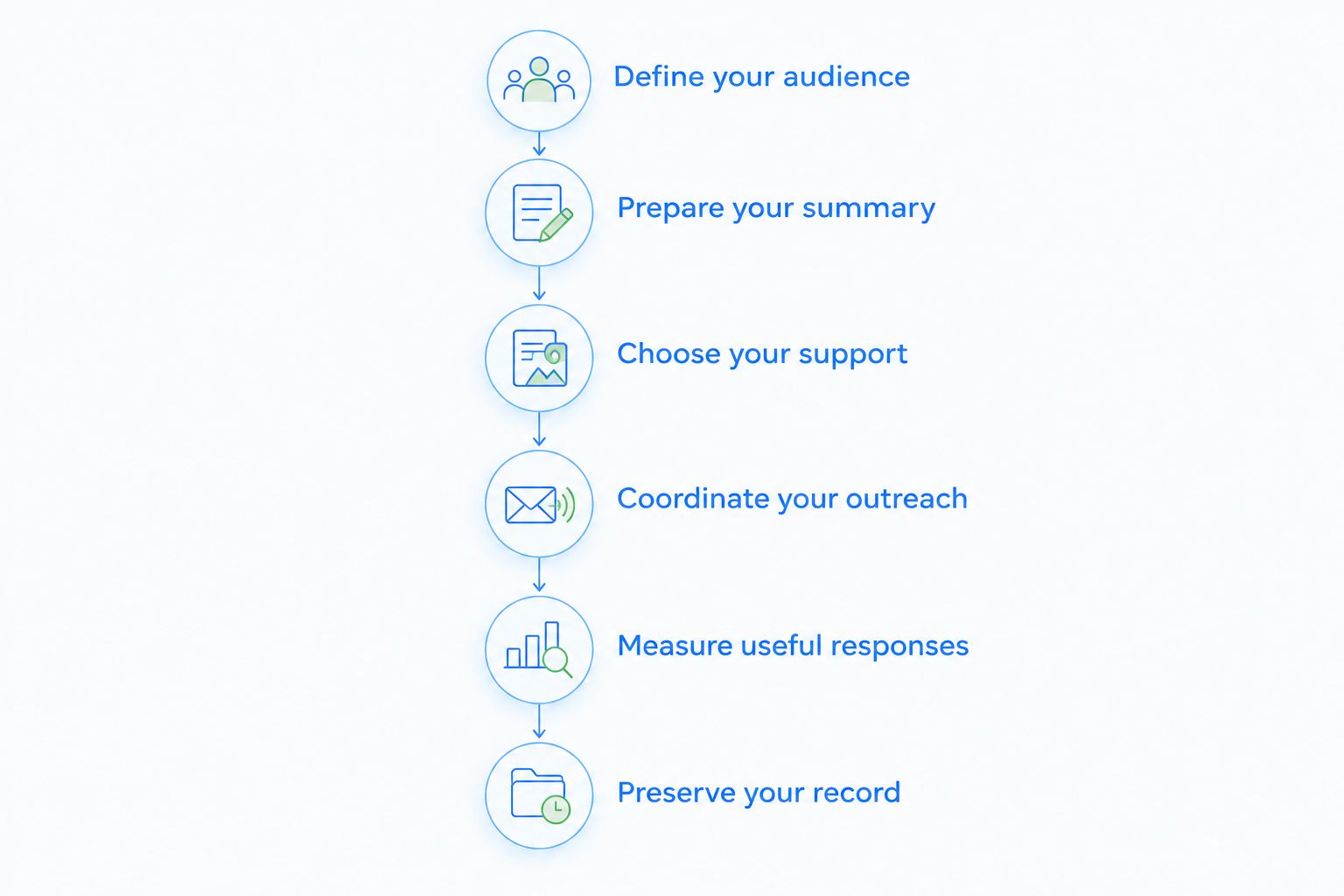
The workflow follows a clear order: define the audience, prepare the summary, choose support, coordinate outreach, measure responses, and preserve the record. Complete the early decisions before expanding distribution.
Compare promotion options for tenure-track faculty
Choose support according to the work you need done, not the visibility number you hope to report. Self-directed promotion gives you control but requires your time. Institutional communication can connect a paper with an existing audience, while expert-led support addresses preparation and targeted outreach.
These options can complement each other. Maintain a consistent paper record even when another team handles communication, and keep one approved factual summary across channels.
| Option | Best for | Main advantage | Key limitation |
|---|---|---|---|
| Self-directed outreach | Researchers who want direct control of targeting and wording | You choose the audience and approve every message | Preparation, distribution, and follow-up remain your work |
| Institutional communications | Papers relevant to a department or university audience | An institutional team can help frame a public explanation | Editorial decisions sit with the institution; ask about scope and timing |
| Paper Spotlight research promotion | Researchers seeking article analysis and expert-led targeted outreach | Combines analysis, relevant-reader targeting, and social media outreach | Paid promotion does not guarantee citations or tenure outcomes |
| Researcher profiles and repositories | Readers who need to identify the author and locate the work | Provide a reference point for the paper and researcher | A findable record is not an active outreach campaign |
Treat these as different functions rather than interchangeable packages. Ask what each route contributes to your audience plan, what information you must supply, and how you will judge the resulting work. Do not select a service solely because its reporting looks easier to insert into a dossier.
Review support for your published paper
Explore article analysis, targeted research promotion, and social media outreach.
Common mistakes tenure-track faculty make
Treating attention as tenure evidence
A visible campaign and a strong tenure case are different things. Do not label impressions or reactions as scholarly impact. Use your institution's criteria to decide how communication activity belongs in the record, and reserve claims about research use for evidence that supports them.
Promoting without a reader in mind
An announcement to a broad audience can obscure the paper's specific contribution. Before distributing it, complete this sentence: this research is relevant to these readers because of this question or method. If the connection is unclear, revise the audience list rather than increasing distribution.
Letting promotion displace research time
Outreach should have a defined task list and stopping point. Decide what you will handle, delegate, or omit before the campaign begins. A selective plan is easier to maintain alongside teaching, service, and manuscript preparation than an open-ended obligation to post everywhere.
Outsourcing scientific judgment
A service can help communicate a paper; the researcher still owns the claims. Review summaries for unsupported applications, omitted limitations, and language stronger than the published findings. Keep coauthors involved when outreach concerns shared work or sensitive interpretations.
Seeking citations instead of legitimate readers
Paying for communication support is not the same as paying for citations. Choose services that explain their outreach work, not offers that promise references in future publications. Relevant readers must remain free to assess, use, cite, or decline the research on scholarly grounds.
FAQ
What's the best research promotion approach for tenure-track faculty?
The best approach starts with a defined scholarly audience, an accurate summary, and targeted outreach. Choose self-directed or expert-led support according to the work you can realistically handle, and measure responses separately from citations.
Can research promotion help me get tenure?
Research promotion is not a guarantee of tenure. It can support dissemination, but your institution's written criteria determine how communication activity is evaluated alongside research, teaching, and service.
Should I use a promotion service or promote my paper myself?
Promote the paper yourself when you want direct control and can handle preparation, targeting, and follow-up. Consider a service when you want those communication tasks supported, while retaining responsibility for scientific accuracy.
Is paying for research promotion the same as paying for citations?
No, paying for research promotion means purchasing communication work, not citations. Reject any offer that guarantees citations or treats scholarly references as something to buy.
What does Paper Spotlight do for a published paper?
Paper Spotlight provides article analysis, targeted research promotion, and social media outreach for published papers. Its PhD-founded approach includes expert-led targeting and scientific testing of outreach approaches across research areas and career stages, without establishing a guaranteed result.
How quickly should I expect citations after promoting a paper?
Do not set a citation deadline based on a promotion campaign. Review outreach activity and relevant responses first, then track citations separately without assuming that promotion caused them.
What should I record in my 2026 research promotion plan?
Record the paper, intended audiences, approved messages, outreach dates, and relevant responses in your 2026 plan. Keep dissemination measures separate from evidence of scholarly use, and follow your institution's dossier guidance.
One last thing
A smaller audience can be the better audience when its research questions match your paper. Before approving your next message, ask whether a recipient can identify the contribution and its relevance without opening the full article. If not, improve the explanation before expanding distribution.


