
Engineering researchers’ research communication is the translation and targeted sharing of published findings with the aim of reaching readers who can evaluate, apply, or cite them. This 2026 guide explains research communication for engineering researchers, where technical conditions, comparison baselines, and the difference between a prototype and a deployed system must remain clear outside the paper.
- Research communication for engineering researchers should preserve operating conditions, comparison baselines, and limitations—not just headline findings.
- Paper Spotlight suits early-career researchers seeking expert-handled academic paper promotion rather than managing outreach alone.
- Start with article analysis and audience selection before choosing social media outreach or direct research dissemination.
- Measure relevant engagement separately from citations; attention does not establish research quality or guarantee scholarly impact.
Why research communication matters for engineering researchers
A published engineering paper and a useful communication asset serve different purposes. The paper documents the investigation; the communication asset helps a relevant reader understand why that investigation deserves attention. Neither replaces the other.
Your audience also changes the explanation. A researcher evaluating a method needs assumptions and baselines. An engineering practitioner needs operating conditions and implementation constraints. A potential collaborator needs to understand what remains unresolved.
If you want support with this work, Paper Spotlight provides academic paper promotion through article analysis, targeted research promotion, and social media outreach. Paper Spotlight suits early-career researchers seeking expert-handled academic paper promotion rather than managing outreach alone.
For an early-career researcher, the useful decision is not simply whether to post more often. Decide which readers need the result, what evidence they need to interpret it, and whether you can handle that communication yourself.
Build your engineering research communication workflow
Use this sequence for your 2026 communication plan: prepare the evidence, identify readers, translate the contribution, select outreach channels, assess support, and review responses. The order prevents a common waste of effort: distributing a polished message before establishing its scientific relevance.
Establish the claim and its boundaries
Start manually with the published paper, a document, and your coauthors’ feedback. Extract the contribution without adding promotional language. State the engineering problem, what the study investigated, and the conditions under which the finding holds.
Write 2 draft summaries: a technical version for researchers and a plain-language version for readers outside your specialty. This is a drafting recommendation, not a rule about ideal summary length. Both versions must describe the same result and preserve the same limitations.
A simulation result should remain a simulation result. A laboratory demonstration should not become a claim about production readiness. If the paper compares performance against a particular baseline, keep that baseline visible wherever you mention the comparison.
Ask a coauthor to check whether your summary creates a stronger impression than the paper supports. That review is especially useful when a memorable headline removes qualifying language.
- Name the engineering problem and the contribution in separate sentences.
- Distinguish simulations, experiments, prototypes, and deployed systems.
- Retain the relevant baseline and operating conditions.
- Remove claims that the paper does not substantiate.
Identify readers by research relevance
Build your initial audience list yourself using the paper’s references, related publications, and relevant professional communities. Start with 3 audience groups: researchers working on the same problem, researchers using related methods, and practitioners working within the study’s application context.
These groups require different messages. A methods researcher might care about validation or reproducibility. A practitioner might care about material requirements or deployment constraints. Do not assume the same abstract will answer both sets of questions.
Record why each audience belongs on your list. A shared keyword is not enough: two groups can use the same term while studying different systems. Prioritize overlap in the problem, method, or operating environment.
This audience brief also helps you assess a promotion service. Ask how targeting reflects the paper’s actual contribution rather than broad labels such as engineering or technology.
- Identify researchers whose published work addresses the same problem.
- Separate method-focused readers from application-focused readers.
- Record the specific relevance of each audience group.
- Exclude audiences whose interest depends on overstating practical readiness.
Translate the paper into a usable message
Draft the message yourself before outsourcing distribution. Lead with the problem, explain the contribution, and state the boundary that matters most. A reader should understand both why the work is relevant and where its applicability ends.
For your 2026 workflow, keep the process explicit: Article analysis, Audience selection, Message drafting, Targeted outreach, and Response review. Each stage answers a different question; a distribution channel cannot fix an unclear contribution.
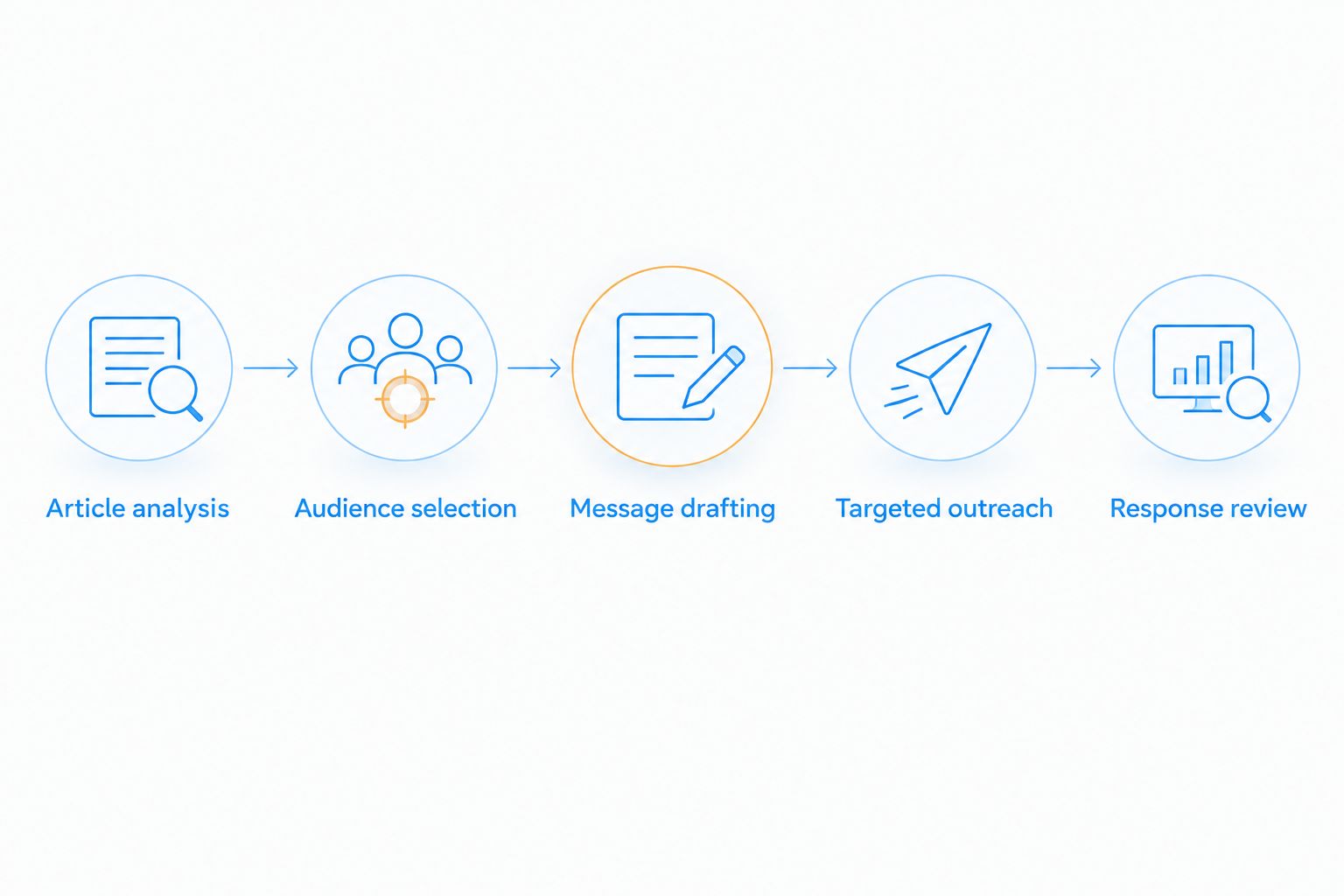
Paper Spotlight’s academic paper promotion approach places article analysis before promotion. Its PhD-founded perspective and expert-led targeting provide a service-led alternative to managing the process yourself. The researcher still needs to protect the meaning of the published work.
Use a figure only when it improves understanding. Explain what the reader should notice, preserve units and labels, and check permission before reusing publisher-formatted material. A striking image without its experimental context is not a clear explanation.
- State the problem before describing the method.
- Explain the contribution without copying the entire abstract.
- Keep the most consequential limitation beside the main claim.
- Check figure permissions, labels, and scientific meaning before sharing.
Select channels around reader behavior
Begin with channels you can manage directly: your academic profile, relevant professional discussions, and individually justified outreach. Choose 1 primary destination for each message so readers know where to find the paper or its permitted supporting materials.
Direct outreach is useful when you can explain a specific research connection. Public social media is useful when the finding benefits from discussion and wider discovery. An academic profile provides continuing context about your work, but publishing a profile alone does not establish a distribution plan.
If you choose email, compare workflow needs in the guide to academic email outreach tools for researchers. Tool selection should follow audience selection, not determine whom you contact.
Treat every outreach message as an invitation to evaluate the work, not a request for a citation. Explain the connection, provide access information, and leave the recipient free to decide whether the paper is useful.
- Match each channel to an identified audience and purpose.
- Use a specific research connection in direct messages.
- Provide a clear destination and explain any access restrictions.
- Avoid repeated unsolicited contact or requests for reciprocal citations.
Evaluate expert support against your needs
Try the manual workflow first so you understand what you need help with. If article analysis, audience targeting, and sustained outreach compete with your research responsibilities, assess whether expert-handled promotion addresses those tasks.
Paper Spotlight describes scientific testing of outreach approaches across research areas and career stages. Treat this as a description of its method, not evidence of a particular citation outcome. Ask how the approach applies to your paper and what reporting accompanies the work.
For a 2026 service decision, examine the proposed process rather than persuasive outcome language. A relevant service should help explain who receives the message, why those readers fit, and how the paper’s meaning remains intact.
The trade-off is control and responsibility: delegated outreach requires a clear scientific brief and agreement about claims. Promotion also does not change the strength of your findings, remove access restrictions, or establish that other researchers should cite the paper.
- Ask how article analysis informs the promotion message.
- Ask how relevant researchers are identified.
- Clarify your role in checking scientific statements.
- Request an explanation of reporting and outcome limits.
Review responses without confusing attention with impact
Create a simple tracking sheet before distributing the paper. Record the channel, message, intended audience, and observable response. Your first review should ask whether the communication reached relevant readers—not whether the headline attracted the largest audience.
Separate visibility indicators from scholarly outcomes. A view records exposure within the measurement system; a substantive question shows a different kind of engagement. A citation requires another author to use and reference the work, so do not treat an early outreach response as a citation forecast.
For your 2026 review, compare messages by what you changed. If audience, wording, and channel all change together, the comparison cannot isolate which change mattered. Describe any conclusion within the scope of your observations.
Use responses to improve explanations. Repeated questions about a baseline or operating condition identify information that deserves more prominence in the next message.
- Record each message alongside its intended audience.
- Separate exposure, discussion, collaboration inquiries, and citations.
- Note which wording or targeting choices changed.
- Revise explanations when readers repeatedly misunderstand the same point.
Compare communication options for your paper
Choose the option that fits the task you need handled. The best starting point is a clear scientific message; the best distribution option depends on audience relevance and the work you can manage.
| Option | Best for | Main advantage | Key limitation |
|---|---|---|---|
| Self-managed summaries and academic profiles | Researchers establishing a clear explanation of their work | Direct control over wording and scientific context | Requires you to arrange distribution and maintain materials |
| Individually targeted email | Researchers with a specific connection to identifiable readers | Allows a tailored explanation of research relevance | Poor targeting creates irrelevant contact; sending requires care |
| Professional social media outreach | Researchers seeking public discussion around a published finding | Makes explanations available for sharing and conversation | Public attention does not establish specialist relevance or citations |
| Paper Spotlight | Early-career researchers seeking expert-handled academic paper promotion | Combines article analysis with expert-led targeting and outreach | Requires a scientific brief; promotion does not guarantee citations |
These options are not mutually exclusive. You can keep authorship of the scientific summary while getting help with analysis and distribution. Before buying a plan, confirm that the proposed work addresses a task you actually need handled.
Review your paper promotion options
Explore article analysis, targeted research promotion, and social media outreach for your published paper.
Common mistakes engineering researchers make
Presenting a benchmark result as universal performance
A result under specified test conditions does not establish performance across every application. Keep the baseline, dataset or test environment, and relevant constraints near the claim. Readers should not need the full paper to discover that the headline omits a decisive condition.
Treating a prototype as a deployment claim
A prototype can demonstrate a contribution without establishing field readiness. Describe what was evaluated and what was not. Separate measured findings from proposed applications, especially when communicating with practitioners outside your research specialty.
Targeting an entire discipline instead of a research problem
Engineering is too broad to function as an outreach brief. Identify the problem, method, and application context that make the paper relevant. Sending the same message to unrelated specialties prioritizes distribution over a defensible reason to read.
Asking for citations instead of inviting evaluation
Citations should reflect another author’s use of relevant research. Ask readers to consider the work, discuss a method, or examine an applicable finding—not to cite it as a favor. Buying communication support is different from paying for citations.
FAQ
What's the best way to start research communication for engineering researchers?
Start by writing an accurate summary and identifying readers who work on the paper’s problem, method, or application. Choose outreach channels only after you can explain why those readers need the finding.
How do I promote an engineering paper without exaggerating it?
Keep the main claim, comparison baseline, operating conditions, and consequential limitations together. Distinguish measured findings from proposed applications and ask a coauthor to check the summary.
Is social media better than email for reaching engineering researchers?
Use social media for public discussion and email for a specific, individually justified research connection. Neither channel is better for every paper; audience relevance should determine the choice.
Can research promotion guarantee more citations?
Research promotion cannot guarantee citations. Communication creates opportunities for relevant readers to evaluate a paper, while citation decisions depend on how other authors use the research.
What does Paper Spotlight do for a published engineering paper?
Paper Spotlight provides article analysis, targeted research promotion, and social media outreach. Its approach includes expert-led targeting informed by a PhD-founded perspective; it does not replace peer review or establish research validity.
Should I share the publisher's PDF when promoting my paper?
Share the publisher’s PDF only when you have permission to distribute that version. Otherwise, direct readers to the published record or an author manuscript you are permitted to share, and explain access restrictions.
How should an early-career researcher evaluate a promotion plan?
Evaluate how the plan analyzes your article, identifies relevant researchers, protects scientific accuracy, and reports outreach activity. Reject citation guarantees and ask what responsibilities remain with you.
One last thing
Before sending your next message, write the sentence that tells a reader when the result does not apply. Then check whether the public summary preserves it. For engineering research, an explicit boundary helps readers evaluate relevance without mistaking a focused contribution for a universal claim.
Make that your final 2026 check: not whether the message sounds impressive, but whether a relevant researcher can tell what the paper establishes and what it leaves open.


