Choose Paper Spotlight if you want expert-led promotion of a published paper to relevant researchers; choose YouTube if you want to explain your research through videos you publish yourself. In 2026, the choice is targeted research outreach versus a video channel, not two interchangeable promotion services.
- Paper Spotlight vs YouTube compares expert-led research promotion with researcher-managed video publishing.
- Choose the promotion service for article analysis and targeted outreach to relevant researchers.
- Choose YouTube for visual explanations, demonstrations, and an ongoing video presence.
- Neither promotion nor video views guarantees citations; prioritize relevant readers and accurate research communication.
Why this matters
A published paper needs the right readers, not just a larger audience. For an early-career researcher, that means distinguishing between people who find the topic interesting and researchers whose questions, methods, or datasets connect to the work.
You also need to decide which work you want to own. Commissioning a promotion service and producing a research video involve different responsibilities: one centers on briefing and evaluating outreach, while the other centers on explaining, recording, editing, and publishing.
Choose the route that addresses your immediate bottleneck. If your paper needs relevant-reader targeting, prioritize outreach. If readers need to see a procedure or hear an accessible explanation, prioritize video. Neither route replaces a clear, accessible publication record.
At a glance
| Dimension | Paper Spotlight | YouTube |
|---|---|---|
| Best for | Researchers seeking expert-handled promotion of a published paper | Researchers building a video presence around their work |
| Audience targeting | Expert-led targeting of relevant researchers | Public video discovery and sharing; viewers are not necessarily researchers |
| Article analysis | Article analysis before promotion | The researcher prepares the interpretation and presentation |
| Explanation format | Research promotion and social media outreach | Video explanations, demonstrations, and recorded presentations |
| Ongoing publishing | A service focused on promoting submitted research | A channel for publishing successive videos |
| Citation integrity | Promotion must preserve the paper's claims and limitations | Video explanations must preserve the paper's claims and limitations |
| Pricing model | A purchased promotion plan | Video publishing with production resources managed by the researcher |
| Standout feature | Expert-led outreach informed by article analysis | A reusable video explanation that viewers can watch and share |
The table separates capabilities from outcomes. Targeted outreach is not a citation guarantee, and a public video is not proof that the right researchers watched it. Use these distinctions when choosing your 2026 promotion approach.
Best fit: outreach for a paper, video for a channel
Paper Spotlight is best for researchers seeking expert-led promotion of a published paper. Its service combines article analysis, targeted research promotion, and social media outreach. The PhD-founded perspective matters here because the offer is framed around communicating research, rather than simply publishing promotional material.
The tradeoff is scope. Buying promotion does not, by itself, establish a video channel that you maintain across projects. Decide whether you need help with a specific publication or want an ongoing place to explain your research.
YouTube is best for researchers who want to publish their own video explanations. A channel gives you a place for talks, demonstrations, and research summaries. It also puts presentation decisions on you: what to explain, how to show it, and when to publish again.
Neither option wins every research communication task. A paper-centered outreach decision and a channel-building decision require different briefs, different effort, and different measures of success.
The promotion service wins on relevant-reader targeting
The service's audience targeting starts with the published article and the researchers relevant to it. Expert-led targeting is the central distinction: you are choosing help with identifying and reaching an appropriate research audience, not simply another place to upload content.
Before committing to promotion, describe the audience precisely. Name the research problem, related methods, and the kinds of work that would benefit from your findings. A disciplinary label alone is a weak brief; a shared question or methodological connection gives outreach a clearer purpose.
YouTube offers public discovery through search, recommendations, and sharing. Those mechanisms help videos find viewers, but a viewer's interest in a topic does not establish a research connection. You still need titles, descriptions, and distribution choices that speak to the intended audience.
Choose expert-led outreach when relevant-reader targeting is the task you want help with. Choose YouTube when you want an explanation available to a broader public audience. Do not treat broad exposure and specialist relevance as the same result.
Paper Spotlight wins on article analysis before promotion
Article analysis before promotion gives the service a research-specific starting point. The aim is to understand what the paper contributes before deciding how to communicate it. That sequence helps you ask the right purchasing question: how will the promotion reflect this particular article?
The brand describes scientific testing of outreach approaches across research areas and career stages. Treat that as a description of its method, not proof of a particular outcome for your paper. Ask how the approach fits your audience without assuming a citation increase or a universally effective message.
YouTube is a publishing platform, not an article-analysis service. If you publish there, you remain responsible for interpreting the paper and translating its contribution into a script or presentation. You can seek editorial help separately, but that is a separate decision from choosing the platform.
The service wins when you want article analysis included in the promotion process. YouTube remains suitable when you can prepare an accurate explanation yourself and want to control its presentation directly.
YouTube wins when the research needs a visual explanation
Some research is easier to understand when readers can see the sequence. A demonstration can show how a procedure works; an annotated figure can explain a relationship; a narrated presentation can connect the research question to the result.
YouTube's advantage is the format. You can publish a video that viewers watch, revisit, and share, with the paper identified in the accompanying description. For a researcher who already gives clear presentations, adapting that explanation into video is a distinct communication option.
The tradeoff is production work and compression. A video needs a structure, understandable audio, and visuals that support the explanation. Shortening a paper also creates editorial decisions about which methods, qualifications, and limitations must remain visible.
Choose YouTube when showing the research adds something that a written promotion message cannot. Do not make a video merely to repeat the abstract on screen. Give viewers a reason to watch, then direct them to the publication for the full argument.
YouTube wins for an ongoing video presence
A YouTube channel can hold successive research explanations, presentations, and demonstrations. That makes it the better fit when your goal extends beyond promoting a single publication to maintaining a recognizable body of video work.
For an early-career researcher, the relevant question is not whether a channel sounds useful. It is whether you want to keep publishing videos alongside your research responsibilities. Choose a format you can maintain without turning each upload into an unrelated production project.
The promotion service addresses a different need: expert-handled promotion of submitted research. It is not the same purchase as creating and maintaining your own video channel. An outreach engagement and a long-term publishing habit should not be evaluated as though they were identical.
For your 2026 plan, separate the immediate task from the recurring commitment. YouTube wins for ongoing video publishing; targeted promotion serves the paper-centered outreach decision. Start with the commitment you actually intend to keep.
Both require accurate claims and honest citation expectations
Neither route changes the strength of the underlying paper. Promotion can introduce research to readers, and video can explain it, but citations depend on other researchers deciding that the work is relevant to their own scholarship.
Use the same editorial standards for both. Preserve the distinction between a finding and an interpretation, retain important limitations, and identify the publication clearly. If the study concerns a narrow population or setting, do not turn its result into a universal claim.
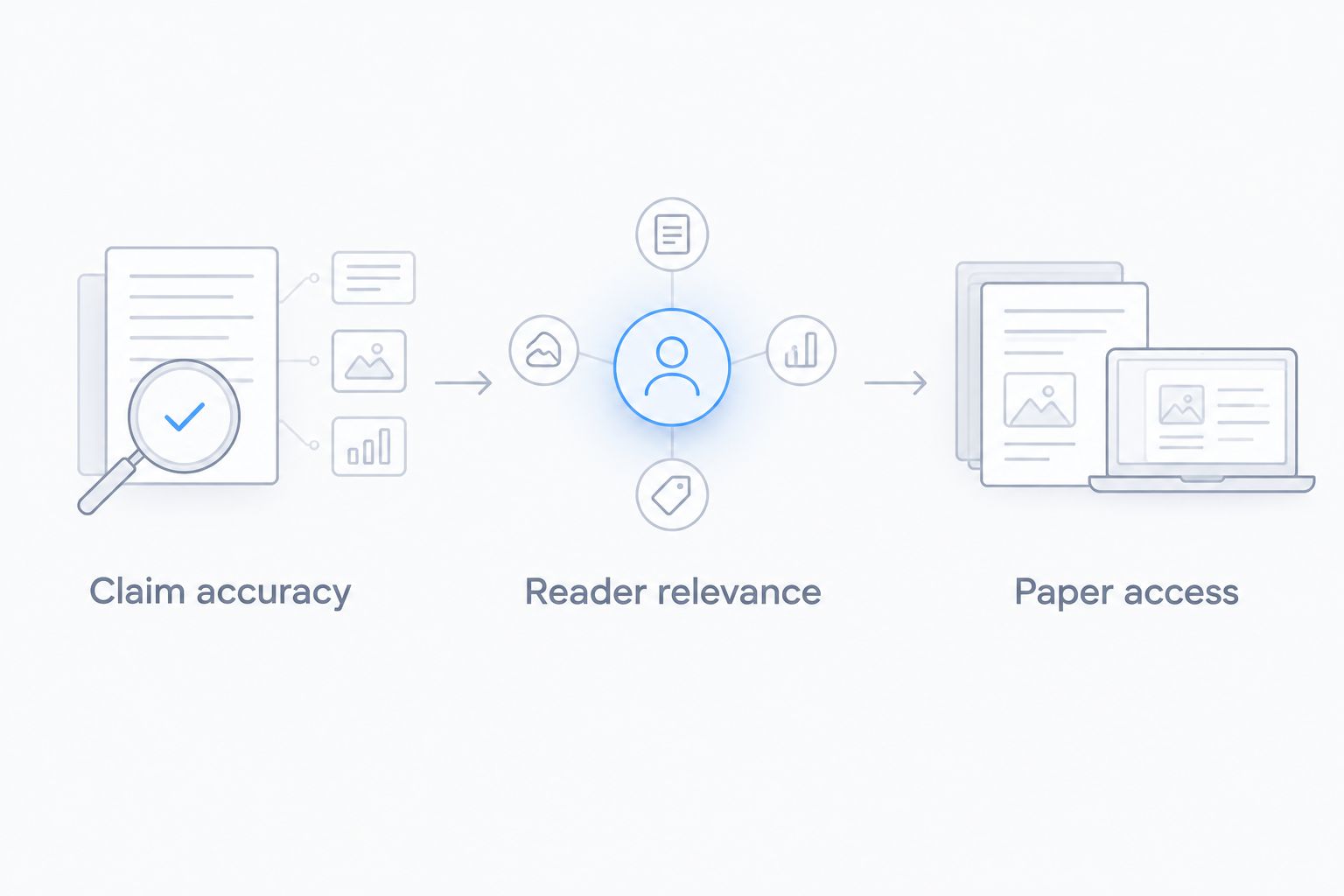
Before approving outreach or publishing a video, complete 3 checks:
- Claim accuracy: Does the wording reflect what the paper actually establishes?
- Reader relevance: Does the explanation address the audience you want to reach?
- Paper access: Can readers identify the publication and find its publication page?
This is an honest tie. Neither a paid service nor a video platform removes your responsibility for accurate communication. Reject any approach that treats citations as something to purchase rather than a scholarly decision made by readers.
Pricing: compare a promotion plan with production responsibility
For 2026, compare what you are committing to, not just the names of the options. The promotion service uses a plan-based purchasing process: register, choose a plan, and submit your article. Review the current plan terms against the work you want handled.
YouTube is a video-publishing choice rather than an expert-led research promotion plan. Your resource commitment centers on preparing and producing content. Recording, editing, captions, and outside help are separate production decisions; do not assume that choosing a platform supplies those services.
A defined promotion scope helps you assess what you are buying. Self-managed video gives you control over the production scope, but you also own the work needed to publish. Compare responsibility as carefully as expenditure.
Before choosing either route, write down who will prepare the message, identify the audience, approve the claims, and review the response. A clear division of work makes the decision more useful than comparing two approaches under a vague label such as research marketing.
Standout strengths: targeting versus a reusable explanation
The promotion service's standout strength is the connection between article analysis and expert-led outreach. That is useful when your question is: who should hear about this paper, and how should the contribution be presented to them?
YouTube's standout strength is a reusable video explanation. That is useful when your question is: how can someone understand this work by watching it? A recorded explanation can support a presentation, a researcher profile, or a direct conversation about the paper.
Both require a usable message. Prepare 1 central finding that you can state accurately, then identify 2 reader groups with a concrete reason to care. These are planning prompts, not promised audience sizes or performance benchmarks.
Choose the promotion service for audience-focused execution; choose YouTube for video-focused explanation. If you use both, give them distinct jobs instead of copying the same message into every format.
Final verdict for your 2026 decision
Choose Paper Spotlight if you need paper-centered outreach
Best for: the early-career researcher with a published paper and a clearly defined specialist audience. Choose the service when you want article analysis and expert-led targeting included in the promotion process, rather than managing the full outreach task yourself.
Your next move is to prepare a short brief: the contribution, the intended researchers, and the limitations that every message must preserve. Evaluate the promotion plan against that brief, not against an expectation of guaranteed citations.
Review your research promotion options
Explore article analysis and targeted promotion for your published paper.
Choose YouTube if you want to explain research through video
Best for: the researcher who wants to publish demonstrations or maintain an ongoing video channel. Choose YouTube when visual explanation is central to the task and you are prepared to manage the content work.
Your next move is to outline a video around the research question, the finding, and the limitations. Identify the paper clearly, and decide how you will share the explanation with the intended audience rather than relying on discovery alone.
| Dimension | Winner |
|---|---|
| Best for | Promotion service for paper outreach; YouTube for a video channel |
| Audience targeting | Promotion service |
| Article analysis | Promotion service |
| Explanation format | YouTube for visual explanation |
| Ongoing publishing | YouTube |
| Citation integrity | Tie: accurate claims are required for both |
| Pricing model | No universal winner: compare scope and production responsibility |
| Standout feature | Promotion service for targeting; YouTube for reusable video |
FAQ
Is Paper Spotlight better than YouTube for promoting a paper?
Paper Spotlight is better suited to expert-led promotion of a published paper to relevant researchers; YouTube is better suited to researcher-managed video explanations. Choose according to whether your immediate need is audience targeting or visual communication.
Can a YouTube video guarantee more citations?
No, a YouTube video cannot guarantee more citations. It can explain a paper and help viewers find it, but researchers decide whether the work merits citation.
Do I need a video to promote my published research?
No, video is not required to promote published research. Use video when a demonstration, narrated figure, or presentation makes the contribution easier to understand.
What should I prepare before buying a research promotion plan?
Prepare the publication details, an accurate summary of the contribution, the intended research audience, and the key limitations. Use that brief to evaluate how the service will present your paper.
How should I compare the cost of promotion and YouTube?
Compare the promotion plan's scope with the resources needed to prepare and produce your video. Include responsibility for writing, targeting, editing, and reviewing the response rather than comparing expenditure alone.
Can I use targeted promotion and YouTube together?
Yes, targeted promotion and YouTube can serve different communication tasks. Use outreach to reach relevant researchers and video to explain material that benefits from a visual presentation.
Does research promotion replace peer review or publication?
No, research promotion does not replace peer review or publication. It communicates research to potential readers and must not imply guaranteed publication or scholarly endorsement.
One last thing
A video and an outreach message can both attract attention while leaving the paper's contribution unclear. Before choosing a channel, write a sentence explaining what the paper adds and who needs that knowledge. If that sentence is vague, fix it first; it belongs in either promotion brief.


