
Choose Paper Spotlight if you want expert-handled promotion of a published paper to relevant researchers; choose Instagram if you want to create visual research content and manage the audience relationship yourself. In 2026, the decision is between a research promotion service and a self-managed social platform—not two equivalent ways to buy academic impact.
- Paper Spotlight vs Instagram compares expert-handled research promotion with self-managed visual science communication.
- Choose the promotion service when article analysis and relevant researcher targeting are your priorities.
- Choose Instagram when you want direct creative control and ongoing public engagement.
- Neither research promotion nor Instagram engagement guarantees citations; scholarly relevance remains essential.
Why this matters
Your published paper needs the right readers, not just attention. A researcher looking for a method, a practitioner evaluating an application, and a member of the public following science content bring different reasons to read.
For an early-career researcher in 2026, the practical question is which job needs doing. Do you need help explaining and distributing a particular article, or do you want to build a communication channel that you manage over time?
Choose the approach that matches your audience and your capacity to do the work. A promotion service addresses the distribution task. Instagram gives you a place to publish, respond, and develop your own public-facing voice.
At a glance
| Dimension | Paper Spotlight | |
|---|---|---|
| Best for | Researchers seeking expert-handled promotion of published papers | Researchers creating visual content and managing their own audience |
| Audience targeting | Expert-led targeting of relevant researchers | Audience development through your content, interactions, and optional advertising |
| Article analysis | Article analysis before promotion | You prepare the research explanation yourself |
| Communication format | Research promotion and social media outreach | Visual posts, videos, captions, and audience interactions |
| Creative control | Choose a service when you want expert handling | Choose the platform when you want to make publishing decisions directly |
| Academic credibility | Promotion does not replace scholarly evaluation | Engagement does not replace scholarly evaluation |
| Standout feature | Research-focused service with a PhD-founded perspective | Direct control of a visual communication channel |
| Pricing model | Promotion plans; check current terms and scope | Self-managed account activity, with optional advertising |
Expert handling wins for a paper; Instagram wins for a channel
The promotion service fits a defined task: bringing a published article to the attention of relevant researchers. Instagram fits an ongoing communication activity: creating material, publishing it, and interacting with people who respond.
Paper Spotlight is best for researchers who want expert-handled promotion of a published paper to relevant researchers. That is a service decision, not a claim that outsourcing automatically produces more citations.
Instagram is best for researchers who want to develop their own visual science communication practice. You can explain your research question, discuss a finding, and answer audience questions in your own voice. The tradeoff is that you remain responsible for the content and the audience relationship.
Before choosing, write down your immediate objective:
- A particular paper needs relevant readers: consider expert-handled promotion.
- Your work needs an ongoing public-facing channel: consider Instagram.
- Both objectives matter: give each approach a separate role rather than expecting either to do everything.
A paper campaign and a researcher account are different projects. Evaluate them against different outcomes.
Expert-led targeting fits researcher outreach better
The promotion service explicitly targets relevant researchers. That makes it the closer fit when your intended audience includes scholars working on related questions, methods, or applications.
Instagram offers a different route. You publish material and develop an audience through the subjects you cover, the accounts you interact with, and the conversations you maintain. Optional advertising adds another distribution mechanism, but audience selection is not the same thing as establishing scholarly relevance.
For your 2026 decision, define 2 audience groups before choosing a channel: researchers who can use the work, and other readers who can benefit from understanding it. These are planning categories, not a required division of every academic audience.
For each group, ask:
- What would make this paper useful to them?
- What terminology would they understand?
- Where does the explanation need technical detail?
- What should they do after encountering it?
Choose expert-led outreach when identifying relevant researchers is the central task. Choose Instagram when developing a visible, interactive audience is the central task. Neither choice removes the need to explain why the paper matters.
Article analysis gives the service a clearer preparation role
Paper Spotlight describes a PhD-founded approach that places article analysis before promotion. Its writing guidance also describes expert-led targeting and scientific testing of outreach approaches across research areas and career stages. Those methods explain the service's perspective; they do not establish a particular result for your paper.
Instagram supplies publishing formats, not an expert article-analysis service. You decide what the paper says, which details belong in a post, and which qualifications must remain visible.
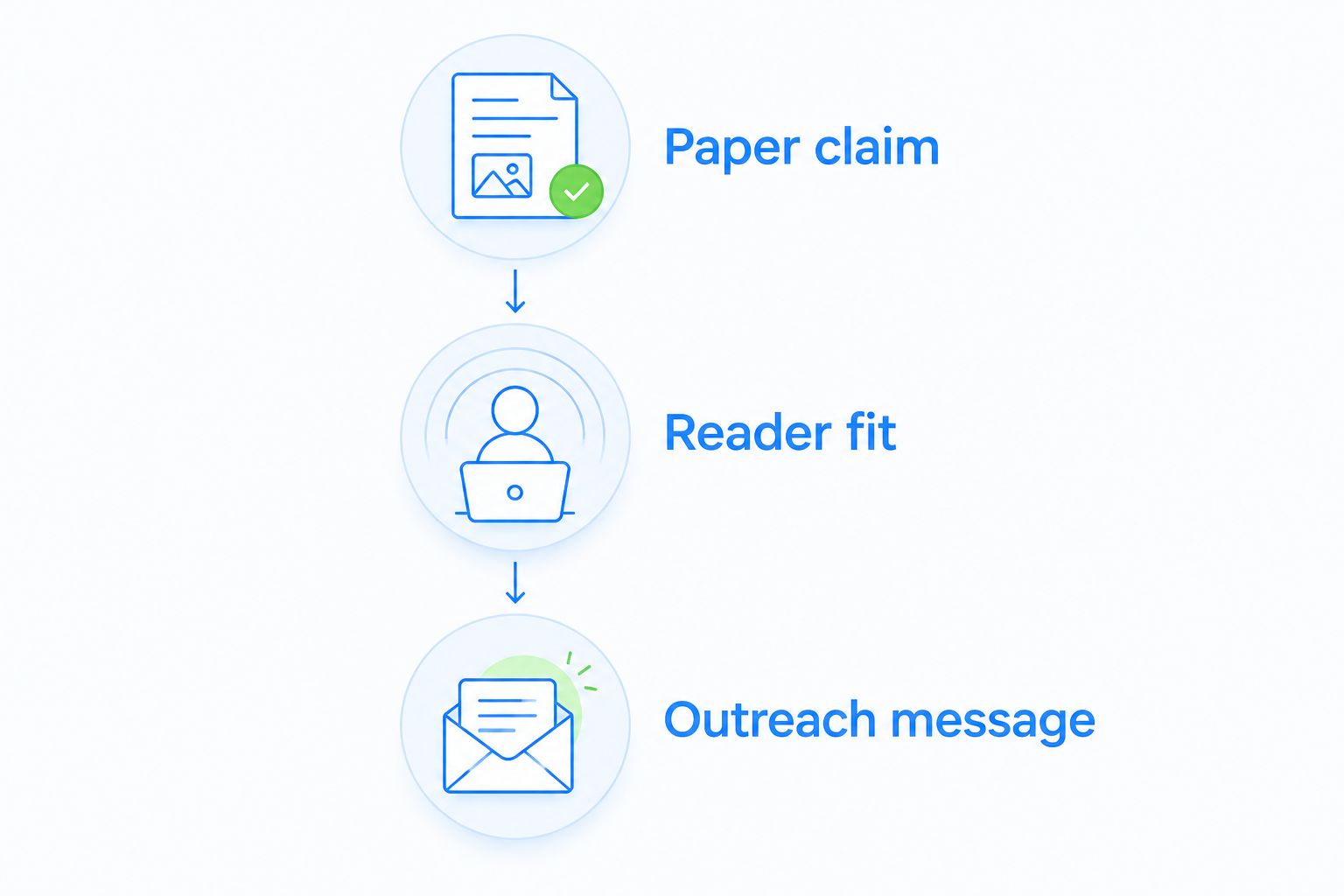
Whichever route you choose, use these 3 checks to prepare the promotion of 1 published paper:
- Paper claim: identify the central finding without extending it beyond the article.
- Reader fit: identify who has a concrete reason to read the work.
- Outreach message: explain that relevance and direct readers toward the paper.
The order matters. Starting with an attractive post before establishing the claim and audience encourages a message that is easy to share but detached from the research.
Choose expert analysis when you want help translating the article into a promotion brief. Choose self-managed preparation when you want to make those editorial decisions yourself. In either case, retain the study's limitations and distinguish findings from interpretation.
Instagram wins for visual explanation and conversation
Instagram is the stronger fit when the communication itself needs a visual sequence, a short video, or a conversation in the comments. You can decide how to present the topic and respond directly when readers ask for clarification.
That flexibility is useful for public-facing explanations. A diagram can introduce a process, a caption can explain why a question matters, and a video can walk through an idea. The academic responsibility remains yours: simplify the language without changing the claim.
The promotion service's stated role is research promotion through article analysis, targeting, and social media outreach. Do not select it on the assumption that it supplies a particular Instagram format or manages your personal account. Confirm the actual plan scope before purchasing.
Instagram wins when your priority is making and discussing visual research content yourself. The service is the closer fit when your priority is expert-handled promotion rather than maintaining a particular format.
For either route, make the paper identifiable. Include its title or a clear citation in the materials readers encounter, and explain how the promoted finding relates to the published work.
Instagram wins on direct creative control
If you want to decide every caption, visual, publishing moment, and reply, Instagram gives you the more direct role. You are the account's communicator, not simply the person commissioning a promotion task.
That control carries work. Someone must prepare the material, check its accuracy, publish it, and handle responses. A platform account does not perform those tasks on your behalf.
A promotion service is a better match when expert handling is the reason for purchasing. Before selecting a plan, ask which decisions you retain and which tasks the service handles. Confirm the review process rather than assuming you will approve every item or that the service will manage every interaction.
Use a short decision checklist:
- Do you want to write and edit the promotional material yourself?
- Do you want to respond personally to public questions?
- Do you need help identifying relevant researchers?
- Are you buying a defined promotion task or seeking ongoing account management?
Choose Instagram for direct authorship. Choose the service for the expert-handled tasks its plan actually includes. This distinction prevents a purchase based on expectations that were never agreed.
Both require accuracy; neither guarantees citations
Neither option wins on academic credibility simply because it distributes research. Credibility depends on what the paper supports and whether the promotional explanation represents it accurately.
A citation is a scholarly decision by another author. A view, comment, share, or outreach response is a different event. Do not treat those events as interchangeable evidence of research use.
When evaluating a 2026 promotion plan or Instagram activity, separate the questions:
- Distribution: did the research explanation reach its intended audience?
- Interest: did readers engage with the explanation or seek the paper?
- Scholarly use: did subsequent work cite or otherwise use the research?
These categories help you interpret results without claiming that a particular post or campaign caused a citation. Citation tracking also requires care about which version of the paper and which records you monitor.
Both approaches are acceptable only when the message is accurate and the outreach is relevant. Neither substitutes for peer review, guarantees publication, or gives you a legitimate route to purchasing citations.
The service wins on research focus; Instagram wins on interaction
The service's standout distinction is its research-focused process: analysis of a published article followed by targeted promotion. Its PhD-founded perspective is relevant to the researcher's brief, but it is not evidence of guaranteed effectiveness.
Instagram's standout distinction is direct interaction around content you publish. You can hear a question, clarify an explanation, and decide what to discuss next. That is useful when communication is an ongoing part of your work.
The limitation on each side follows from its role. Commissioning promotion does not automatically create a personal audience relationship. Maintaining an Instagram account does not automatically put your paper in front of the scholars most likely to use it.
Use the service to address a promotion task; use Instagram to practice and maintain direct communication. If you use both, keep the research claim consistent while adapting the explanation to each audience.
Pricing models: compare scope, not just expenditure
For 2026, compare the promotion plan's current terms with the work involved in self-managed Instagram activity. The service uses promotion plans; Instagram account activity is self-managed, with advertising as an optional separate decision.
A plan gives you a defined purchasing decision, but its predictability depends on what the terms specify. Check the deliverables, boundaries, payment arrangement, and any additional work before committing. Do not assume a particular billing frequency or included channel.
Self-managed Instagram gives you control over your effort and any advertising decisions. That flexibility also leaves preparation, publishing, and responses with you. Your time belongs in the comparison even when you do not assign it a monetary figure.
Before buying, ask:
- What article analysis is included?
- How is the intended research audience identified?
- Which outreach activities are included?
- What reporting will explain the work completed?
- What remains your responsibility?
Choose a promotion plan for clearly defined expert-handled work, not an implied citation outcome. Choose Instagram when you want to own the work and the communication decisions.
Review your research promotion options
Check the service's current plan scope against your paper, intended readers, and outreach needs.
Final verdict: choose the job you need done
Choose Paper Spotlight if you need a paper-focused service
Best for: an early-career researcher with a published article who wants expert-handled analysis and targeted promotion. Choose this route when relevant researcher outreach matters more than personally managing a visual communication channel.
Before purchasing in 2026, confirm what the selected plan handles and what you must provide. Judge the service against its agreed work, not a promised citation count.
Choose Instagram if you want to be the communicator
Best for: a researcher who wants to create visual explanations, publish in their own voice, and interact directly with an audience. Choose Instagram when you want the communication practice itself, not simply distribution of a paper.
Keep the account's purpose clear. Public understanding, conversation, and academic readership are related goals, but they are not the same outcome.
| Dimension | Winner |
|---|---|
| Best for | Service for a paper-focused task; Instagram for an ongoing channel |
| Audience targeting | Service for expert-led relevant researcher targeting |
| Article analysis | Service for analysis before promotion |
| Communication format | Instagram for self-managed visual explanation |
| Creative control | |
| Academic credibility | Tie: both require accurate representation |
| Standout feature | Service for research focus; Instagram for interaction |
| Pricing model | Tie: choose defined scope or self-managed flexibility |
FAQ
Is Paper Spotlight better than Instagram for promoting a research paper?
Paper Spotlight is the closer fit for expert-handled article analysis and targeted researcher outreach. Instagram is the closer fit for creating visual explanations and managing audience interactions yourself.
Can Instagram help researchers reach readers?
Instagram lets researchers publish visual explanations and interact with readers. Reaching people who can use a particular paper requires a clear audience strategy, not simply posting the publication announcement.
Does buying research promotion guarantee more citations?
No, research promotion does not guarantee citations. Other authors decide whether a paper is relevant to their work, and social engagement is not a citation.
Should an early-career researcher use both approaches?
Use both when they serve separate objectives: expert-handled paper promotion and personally managed visual communication. Keep the research claims consistent and evaluate each activity against its own purpose.
What should I check before purchasing a promotion plan?
Check the article analysis, audience targeting, outreach scope, reporting, and your responsibilities. Confirm the current terms before purchasing and reject any expectation of guaranteed citations.
Do I need to make videos to promote my paper on Instagram?
No, video is not the only Instagram format for explaining research. Choose a visual post or video according to the explanation, while preserving the paper's qualifications and limitations.
What is the best first step before promoting a published paper?
Write an accurate statement of the paper's central claim and identify the reader who has a reason to use it. Build the outreach message from that match rather than starting with a platform or promotional format.
One last thing
Write the intended reader's reason to care before writing the announcement. An announcement says that your paper exists; a useful outreach message explains why a particular person should read it.
Use that sentence as your test for both a service brief and an Instagram post. If it identifies neither a reader nor a use for the research, revise the message before distributing it.


