Choose Paper Spotlight if you want expert-handled academic paper promotion built around article analysis and targeted outreach; choose Facebook if you already participate in a relevant community and want to share your paper and manage the discussion yourself. This 2026 comparison separates a research promotion service from a social platform so you can choose the right approach for your published work.
- Paper Spotlight vs Facebook compares expert-led research promotion with researcher-managed social sharing.
- Choose the promotion service for article analysis and targeting of relevant researchers.
- Choose Facebook for direct discussion with an existing, relevant community.
- Neither approach guarantees citations; assess audience relevance separately from social engagement.
Why this matters
A published paper needs readers who can understand and use its contribution. A large audience and a relevant audience are different things. For an early-career researcher, the practical question is who will explain the paper, identify suitable readers, and handle outreach.
You are choosing between buying a promotion service and managing a communication channel. Facebook provides places to publish posts and hold conversations. A research promotion service adds analysis and targeting work around the article itself.
For your 2026 decision, separate those responsibilities before comparing engagement. Comments can help you understand readers' questions, but they do not establish scholarly use. Citations reflect subsequent referencing, not simply attention to a post.
At a glance
| Dimension | Paper Spotlight | |
|---|---|---|
| Best for | Researchers seeking expert-handled promotion of a published paper | Researchers with a relevant community who want direct interaction |
| Article preparation | Article analysis before promotion | You prepare the summary and supporting material |
| Audience targeting | Expert-led targeting of relevant researchers | You select communities, contacts, or advertising audiences |
| Ongoing conversation | Promotion-focused service | Posts, comments, and group discussions |
| Workflow control | Process includes registration, plan selection, and article submission | You manage posting, wording, and responses |
| Evidence standards | Promotion does not guarantee citations | Engagement does not establish scholarly impact |
| Pricing model | Promotion plans; assess the stated scope | Organic posting and a separate paid advertising option |
| Standout feature | Analysis connected to targeted research outreach | Direct participation in a social community |
Expert-handled promotion wins when delegation is your priority
The promotion service is the better fit when you want help turning a published article into a focused outreach effort. Its offering combines article analysis, targeted research promotion, and social media outreach. That is a different purchase from access to a posting interface.
Its PhD-founded perspective informs the service's approach to communicating research. The stated method includes scientific testing of outreach approaches across research areas and career stages. That describes how the service approaches promotion; it does not establish a specific result for your article.
Facebook wins for a different researcher: someone who already knows where relevant readers gather and wants to speak with them personally. If you regularly participate in a subject-specific group, sharing a paper can extend an existing conversation rather than introduce an unfamiliar topic.
- Best for delegated promotion: the research promotion service.
- Best for community participation: Facebook.
- Main tradeoff: expert-handled outreach versus responsibility for your own audience selection and communication.
Do not treat Facebook as a substitute for analysis you have not done. Equally, do not buy a promotion plan simply because posting feels unfamiliar. Identify the work you actually need someone else to handle.
Paper Spotlight offers article analysis before academic paper promotion
The service's article analysis distinguishes it from Facebook. Before promoting a paper, the service examines the article rather than treating the abstract as ready-made promotional copy. For researchers who need help communicating their contribution, that preparation is a reason to consider the service.
Facebook is a distribution and discussion platform, not an article-analysis service. You decide which finding to foreground, how much context readers need, and which limitations belong in the post. That gives you editorial responsibility as well as editorial control.
Use these 3 questions to evaluate any proposed summary:
- Does it state the research question and contribution accurately?
- Does it identify who can use the finding, method, or argument?
- Does it retain the limitations necessary to interpret the result?
Your goal is not to make a technical paper sound dramatic. It is to give the right reader a clear reason to open it. An accessible summary should simplify the language without changing the strength of the claim.
For Facebook, prepare 2 drafts: a plain-language version for a mixed audience and a specialist version for a research-focused community. Choose the draft that matches the readers, not the version that sounds most impressive.
Expert targeting wins when you need help identifying relevant readers
The promotion service offers expert-led targeting of relevant researchers. That is useful when you can explain your contribution but need help deciding which research audiences to approach. The service connects article analysis to an outreach decision rather than leaving you to choose audiences independently.
Facebook gives you a different route: select a community whose discussions already fit the paper. A group focused on a closely related method or question provides a clearer context than a broad audience selected only because it is large.
Audience fit matters more than an impressive-looking audience label. Check the subjects people discuss, the expertise they demonstrate, and the group's posting rules before sharing. A relevant group still needs a relevant introduction to your paper.
The service's tradeoff is delegation: you need to communicate the intended audience and assess the proposed scope. Facebook's tradeoff is researcher effort: you identify the community and take responsibility for appropriate participation.
For either route, write 1 audience brief explaining the research question, intended readers, and why those readers should care. Include adjacent disciplines when the connection is genuine. Do not add audiences solely to make the campaign appear broader.
Facebook is better for direct, ongoing conversation
Facebook wins when the activity you want is discussion. Its posts, comments, and groups let you respond to questions where the paper was shared. A promotion service and a social conversation serve different purposes.
For an early-career researcher, that direct exchange can be useful even when it does not produce a citation. Readers can ask about methods, interpretation, or access to the paper. You can clarify what the work does and does not show.
The drawback is the responsibility that comes with publishing the post. You need to follow community rules, avoid repetitive promotion, and respond appropriately. A group is not simply an audience waiting for your link.
Use a short introduction that explains the finding and invites a relevant question. Avoid asking readers to cite the paper. A scholarly reference should follow from the paper's relevance to their work, not from a promotional request.
Choose Facebook for conversation, not as evidence that a citation campaign succeeded. If you need someone to handle promotion, assess that service separately from your own participation in comments.
Facebook gives you more hands-on control over posting
Facebook is the better choice when you want to write, publish, and respond yourself. You can decide how to introduce the paper and which community context to address. Your post remains your communication task.
The promotion service uses a process that includes registering, choosing a plan, and submitting an article. That suits researchers seeking expert-handled work rather than another channel to manage. The decision is whether delegation addresses your actual bottleneck.
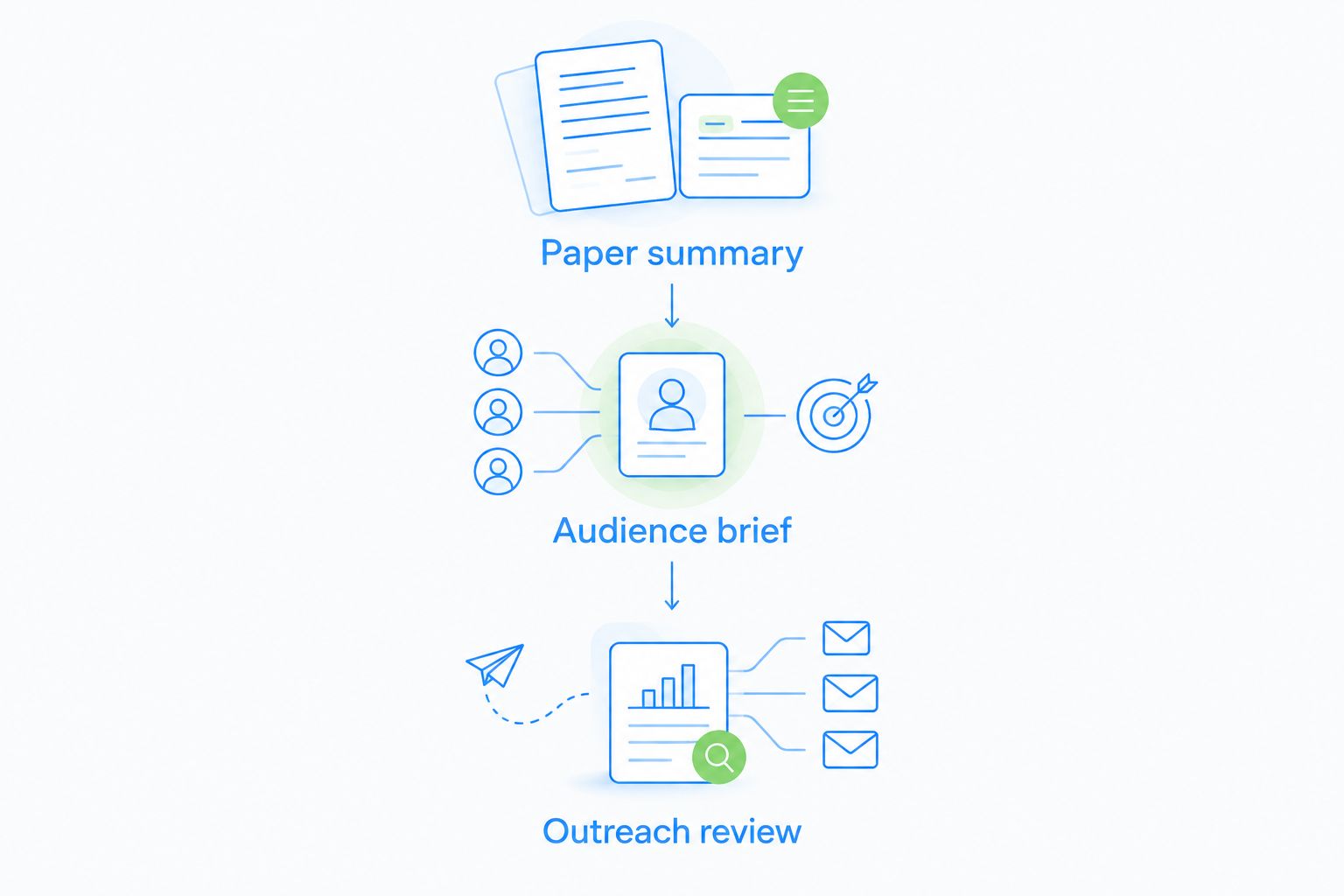
For a 2026 promotion effort, organize your preparation into these stages:
- Paper summary: explain the contribution and its limits.
- Audience brief: identify the readers and their reason to engage.
- Outreach review: check wording, destination, and community rules before sharing.
This sequence is a preparation checklist for you, not a claim about a provider's internal workflow. It works whether you submit your article for promotion or prepare a Facebook post yourself.
Choose delegation if analysis and audience selection are the tasks you want help with. Choose direct posting if you already have those decisions settled and want to control the conversation. Neither choice removes your responsibility for the accuracy of claims about your research.
Both require separating visibility from scholarly impact
Neither approach earns a win on guaranteed citations. Research promotion creates opportunities for readers to discover a paper; readers decide whether it informs their own work. A Facebook reaction is not a scholarly reference.
Assess outcomes according to what they actually show:
| Observation | What it establishes | What it does not establish |
|---|---|---|
| A reaction or comment | Interaction with the post | That the person read the paper |
| A visit to the paper's page | Interest in the destination | That the finding influenced research |
| A substantive research question | Engagement with a specific issue | A future citation |
| A citation | Referencing in another work | That a particular promotion activity caused it |
For a 2026 review, keep communication outcomes and scholarly outcomes separate. Record what happened without attributing every later citation to the promotion effort. Establishing causation requires evidence beyond events occurring in sequence.
If citations are your objective, start with the practical guidance on how to get more citations for your research paper. Keep the central distinction intact: you can improve discoverability without purchasing or guaranteeing scholarly endorsement.
Pricing models: promotion plans versus self-managed distribution
The service uses promotion plans. Evaluate the stated scope before choosing one: what work it covers, what you submit, and what responsibilities remain yours. Do not assume that plan selection means a subscription, a particular campaign length, or unlimited revisions.
Facebook separates ordinary posting from paid advertising. If you use organic posts, you still supply the preparation and participation work. If you choose advertising, distribution becomes a separate purchasing decision; it does not add academic article analysis by itself.
Compare complete workloads, not just payment models. A service plan packages specified work, while self-managed distribution leaves the work with you. Advertising adds another task: deciding how paid exposure fits your audience and research communication goals.
Before committing in 2026, review the current terms and ask whether the offer addresses your bottleneck. If you need article interpretation and targeting support, buying distribution alone does not answer that need. If you already have an active, relevant community, a promotion service serves a different purpose from posting there.
Both have a useful standout feature, but solve different problems
The service's standout feature is the connection between article analysis and targeted outreach. Facebook's standout feature is direct participation in a community. Neither feature replaces the other.
You can use both approaches without making them compete for every task. Delegate promotion when that is the work you need help with, and personally answer questions when readers approach you. Keep the same accurate account of the paper across channels.
The limitation of the service comparison is scope: expert-handled promotion should not be treated as a promise of ongoing community conversation. The limitation of Facebook is preparation: access to a social platform does not supply research-specific analysis or an outreach strategy.
Final verdict: choose according to the work you need
Choose Paper Spotlight if you want expert-handled research promotion
The service is best for an early-career researcher who wants article analysis and expert-led targeting around a published paper. Consider a plan when identifying suitable readers and preparing outreach are the tasks you want to delegate. Assess the scope against those needs, not against a promised citation outcome.
Choose Facebook if you want to manage community discussion
Facebook is best for a researcher who already participates in a relevant community and wants direct control over posts and replies. Choose it when your audience is identifiable and you are prepared to explain the paper yourself. Treat community interaction as communication, not proof of scholarly impact.
| Dimension | Winner |
|---|---|
| Delegated promotion | Research promotion service |
| Article preparation | Research promotion service |
| Help identifying relevant researchers | Research promotion service |
| Ongoing conversation | |
| Hands-on posting control | |
| Evidence standards | Tie: neither guarantees citations |
| Pricing model | Task-dependent: packaged work versus self-managed distribution |
| Standout feature | Tie: analysis-led outreach and community participation serve different needs |
FAQ
Is Paper Spotlight better than Facebook for promoting a research paper?
Paper Spotlight is the better fit for expert-handled academic paper promotion, while Facebook is the better fit for researcher-managed community discussion. Choose according to whether you need analysis and targeting support or a place to engage readers directly.
Can Facebook help me get more citations?
Facebook can help readers discover a paper, but sharing it does not guarantee citations. A reaction, comment, or visit should not be reported as scholarly impact.
What should I check before choosing a research promotion plan?
Check the stated work, submission requirements, and responsibilities that remain yours. Focus on whether article analysis and audience targeting address the tasks you need help with.
Should I use Facebook groups to share my published paper?
Use a Facebook group when its subject matches your paper and its rules permit sharing research. Explain the contribution in context and participate in discussion rather than posting a link without explanation.
Do I need to pay for Facebook advertising to promote my paper?
Facebook advertising is separate from organic posting. Decide whether paid distribution serves a defined audience goal; advertising does not replace a clear summary or appropriate targeting.
Can I use a promotion service and Facebook together?
You can combine expert-handled promotion with your own Facebook participation. Keep the claims consistent and distinguish the service's outreach work from conversations you manage yourself.
Does research promotion replace peer review?
Research promotion does not replace peer review or guarantee publication. It communicates research to potential readers rather than certifying the paper's scientific quality.
One last thing
Before publishing any promotion in 2026, write 1 paragraph answering this question: who should read this paper, and what would they use it for? If the answer is unclear, resolve that before choosing a channel or plan. Better targeting starts with a specific use for the research, not a larger audience.


