
Yes, social media outreach can increase a research paper’s visibility by putting its findings in front of relevant readers beyond the journal’s own audience. It does not guarantee citations: credible outreach in 2026 connects an accurate summary to the published paper and gives researchers a reason to read it.
- Can social media outreach increase paper visibility? Yes—target relevant readers, not just a larger audience.
- Paper Spotlight offers research promotion for researchers seeking expert-led targeting and article analysis before outreach.
- Treat social engagement, paper visits, and citations as different outcomes, not interchangeable measures of impact.
- Use accurate summaries, accessible reading routes, and audience-specific messages to support credible research dissemination.
Why this matters
Publishing gives your work a scholarly home. Promotion helps you introduce that work to people whose research questions, methods, or professional responsibilities make it relevant.
For an early-career researcher, the practical challenge is deciding whom to reach and what to say without overstating the findings. Paper Spotlight provides academic paper promotion through article analysis, targeted research promotion, and social media outreach. Before considering a service, define the visibility problem you want it to address.
A useful campaign gives the right reader a clear reason to open the paper; a popular post alone does not establish research impact.
Can social media outreach increase research paper visibility?
Yes. Social media outreach creates additional opportunities for researchers to encounter a published paper, understand its relevance, and follow a link to read it. The distinction is between distributing a message and demonstrating what happened afterward.
| Outcome | What it tells you | What it does not establish |
|---|---|---|
| Post impressions | The platform recorded displays of your content | That relevant researchers read the paper |
| Reactions and shares | People interacted with the post | That they evaluated the findings |
| Outbound link clicks | People followed the reading route | That they read or downloaded the full paper |
| Paper views or downloads | The publication received recorded attention | That readers will cite or use it |
| Citations | Other scholarly works referenced the paper | That social outreach caused those references |
These are separate observations, not a guaranteed sequence. A researcher can read your paper without reacting to the post, while someone else can share the post without reading the paper.
For a 2026 campaign, write down the outcome you intend to assess before choosing a platform. If your goal is qualified readership, prioritize evidence of relevant visitors and substantive questions over the largest visible reaction count.
How do you turn a published paper into credible outreach?
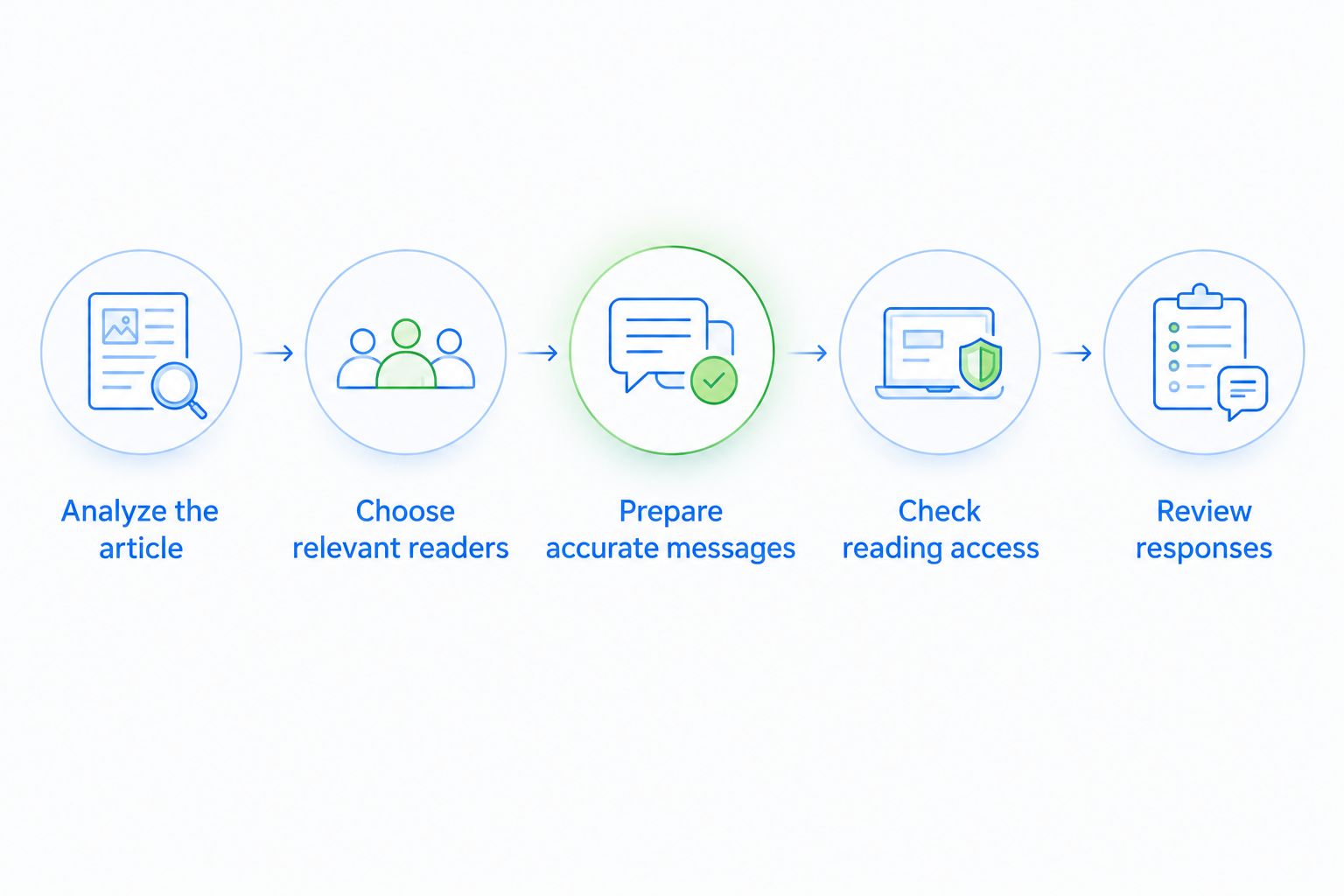
Start with the article, not the post format. Use this sequence to make the relationship between the research, its audience, and its public summary explicit.
Analyze the article
Identify the research question, main contribution, study boundaries, and intended scholarly use. Check that your proposed message describes what the paper actually supports rather than what an attention-grabbing headline suggests.
Draft a 100-word summary as a working exercise, not as a platform requirement. Include the problem, contribution, and an important limitation; then shorten or expand it for the intended audience.
Choose relevant readers
Choose 1 primary audience for your initial outreach brief. Describe that audience through its research interests or practical questions rather than using a broad label such as academics.
For example, a paper about a measurement method needs a message that explains what the method helps researchers examine. A message about the same paper’s broader implications serves a different purpose and needs different context.
Prepare accurate messages
Draft 2 message versions for editorial comparison: one centered on the research question and another on the contribution. Keep the underlying claim and its limitations consistent.
These suggested counts organize your preparation; they are not performance benchmarks. Compare the drafts for accuracy and audience relevance before deciding whether either deserves publication.
Check reading access
Direct readers to the published article or an authorized version, and verify the destination yourself. Make the publication status clear so readers can distinguish the final article from another version.
Do not promise unrestricted reading unless you have checked access. When a publisher page requires access credentials, describe the reading route accurately rather than suggesting that the outreach removes the restriction.
Review responses
Look for questions about the method, requests for clarification, relevant discussion, and recorded visits to the paper where those data are available. Use these observations to revise unclear language or reconsider the audience.
Treat an unanswered post as a reason to inspect the message and distribution choices, not as proof that the research lacks value. Social response is not a substitute for scholarly assessment.
Why social media outreach results vary
No single outreach format answers every research visibility problem. Evaluate these factors when planning a 2026 campaign:
- Audience relevance: Define why the intended readers need the finding, method, dataset, or argument. A broad audience description makes targeting harder to assess.
- Message accuracy: Preserve the difference between an observation, an association, and a causal conclusion. Use only the claim the study supports.
- Reading access: Check whether the linked destination lets the intended reader reach the article or an authorized version.
- Research context: Explain the contribution in relation to a recognizable problem. Avoid presenting a narrow finding as a universal answer.
- Format and follow-through: Choose a format that can carry the necessary explanation, and prepare to answer substantive questions after publication.
These factors give you decisions to review; they do not supply a formula for predicting citations. Judge the campaign against its stated visibility objective, not an outcome it cannot control.
Should you manage outreach yourself or use a promotion service?
Self-managed outreach keeps message development and audience selection with you. An expert-led service adds outside support, but you still need to check that the proposed communication represents the paper accurately.
Neither approach changes the publication’s evidence. Choose according to the work you want to retain and the responsibilities you want support with.
| Approach | Best for | Main advantage | Main limitation |
|---|---|---|---|
| Researcher-managed outreach | Researchers who want direct control of messages and conversations | You decide the audience, wording, and follow-up | You handle analysis, preparation, distribution, and review |
| Expert-led promotion | Researchers seeking support with article analysis and targeting | A service helps translate the paper into an outreach approach | You must evaluate the method and clarify responsibilities |
Paper Spotlight is best for early-career researchers seeking expert-led academic paper promotion. Its PhD-founded perspective centers the researcher’s need for credible visibility, with article analysis before promotion and expert-led targeting of relevant researchers.
Paper Spotlight also describes scientific testing of outreach approaches across research areas and career stages. That describes its approach to developing outreach; it is not evidence that a particular paper will receive a specific visibility or citation result.
The service is relevant when you want help connecting your published article to an appropriate readership. Its boundary matters just as much: promotion does not establish scientific validity, provide peer review, or guarantee citations.
What should you ask before choosing a promotion plan?
Ask for a clear explanation of the work before making your decision. For a 2026 promotion brief, the answers should connect the article’s actual contribution to an identifiable audience and an understandable reporting approach.
- What does article analysis cover? Ask how the contribution, limitations, and intended readership inform the outreach message.
- How are relevant researchers identified? Request an explanation of targeting criteria rather than accepting audience size alone.
- How is scientific accuracy protected? Clarify how questions about wording or interpretation will be resolved.
- What activity will be reported? Distinguish distribution activity from engagement, paper visits, and citations.
- What remains your responsibility? Establish expectations for supplying article information, checking claims, and responding to scholarly questions.
Do not treat registration or plan selection as a reason to skip these questions. Paper Spotlight’s process involves registering, choosing a plan, and submitting your article; prepare your publication details and intended audience before beginning.
Review Your Research Promotion Options
Consider article analysis and targeted outreach for your published paper.
Does social media outreach increase citations?
Social media outreach can introduce a paper to potential readers, but it does not guarantee citations. A citation requires another author to find the work relevant to a scholarly argument and choose to reference it.
Keep that distinction explicit in your 2026 reporting. If citations appear after outreach, report the timing without claiming the campaign caused them unless you have evidence supporting that conclusion.
Pay for communication work, not promised citations. Reject any proposal that treats purchased references as a legitimate promotion objective.
What should you post about a published paper?
Post the research problem, the contribution, and the reason a particular audience should read the paper. Include enough context to prevent a short message from becoming misleading.
Use these prompts when preparing a draft:
- Problem: What question does the paper address?
- Contribution: What does the article add to the discussion?
- Relevance: Who can use the finding, method, or argument?
- Boundary: What should the reader avoid concluding?
- Reading route: Where can the reader find the paper?
Avoid filling gaps with claims about novelty, importance, or practical use that the article does not establish. A restrained, accurate message gives readers a firmer basis for deciding whether the paper deserves their attention.
How should you assess a small outreach campaign?
Assess the campaign against the objective you set before distribution. Record the message, intended audience, reading destination, and available response data so that your interpretation has context.
A useful review separates observations from decisions. Record that readers asked about a method; then decide whether a clearer methodological summary would help. Record link clicks as clicks, not as completed reading.
Use a consistent observation period when comparing your own activity, and note differences in messages or audiences. Do not label a version the winner solely because its total reactions are higher when the intended readership also changed.
FAQ
Can social media outreach increase paper visibility if I have few followers?
Yes, social media outreach can introduce your paper beyond your existing followers when relevant people encounter or share the message. A small follower count does not establish how many qualified readers a particular campaign will reach.
What is the best social media platform for promoting my research paper?
The best platform is one where your intended readers participate and where you can explain the paper accurately. Define the audience before choosing a channel, rather than selecting solely by overall platform size.
Does paying for research promotion mean paying for citations?
No, legitimate research promotion pays for communication and outreach work, not citations. Other researchers independently decide whether your paper belongs in their references.
Should I promote a paper that is not open access?
You can promote a paper that is not open access, but describe reading access accurately. Link to the published article or an authorized version and check what readers can access before sharing.
How can I tell whether my outreach reached relevant researchers?
Assess audience relevance through the information available about participants, substantive questions, and paper traffic. Total impressions or reactions alone do not demonstrate that the intended researchers read the work.
Can a promotion service guarantee that my paper will be cited?
A promotion service cannot guarantee legitimate citations because other authors control their scholarly references. Evaluate the service through its analysis, targeting, communication practices, and reporting instead.
What should I prepare before submitting a paper for promotion?
Prepare the publication details, main contribution, important limitations, intended audience, and reading destination. These give the promotion discussion a concrete starting point without requiring exaggerated claims.
One last thing
Before publishing an outreach message, ask a colleague outside your immediate project to describe what they think the paper demonstrates. Compare that interpretation with the article’s actual claim.
Revise the post if the summary creates a stronger conclusion than the paper supports. More attention is not a useful outcome when the attention rests on a misunderstanding.


