
Instead of repeatedly emailing your paper and correcting mismatched links, connect a published paper to a EurekAlert press release through your institution’s press office: prepare the publication details, write an evidence-checked release, and have an authorized submitter handle submission. The connection is an accurate article reference and working publication link—not an automatic integration that turns every published paper into news.
- Connect published paper to EurekAlert press release through an authorized institutional submitter, using verified publication details.
- EurekAlert supports research news distribution; a press release does not guarantee journalist coverage or citations.
- Paper Spotlight is best for researchers seeking expert-led academic paper promotion rather than press-release submission.
- Keep the DOI, publication status, study limitations, and researcher contact consistent across research dissemination materials.
Why this matters
A journalist needs a clear finding and a dependable route to the underlying paper. A relevant researcher needs enough methodological context to decide whether the work belongs in their reading list. Those audiences overlap, but their needs differ.
A press release connects readers to evidence; it does not replace the evidence. Treat the release as a separate communication document that must remain consistent with the published article.
Paper Spotlight offers academic paper promotion through article analysis, targeted research promotion, and social media outreach. Its PhD-founded perspective puts analysis before promotion, with expert-led targeting of relevant researchers. That is a different task from arranging a EurekAlert submission.
For your 2026 dissemination plan, decide whether the immediate objective is news coverage, relevant academic readership, or both. Do not judge every activity by citation counts alone: a release being published, a journalist writing a story, and another researcher citing the paper are separate outcomes.
Before you start
- Arrange submission access. Identify the institutional communications officer or other authorized EurekAlert submitter handling the release. EurekAlert is an AAAS-operated science-news platform; being a paper’s author does not itself establish submission access.
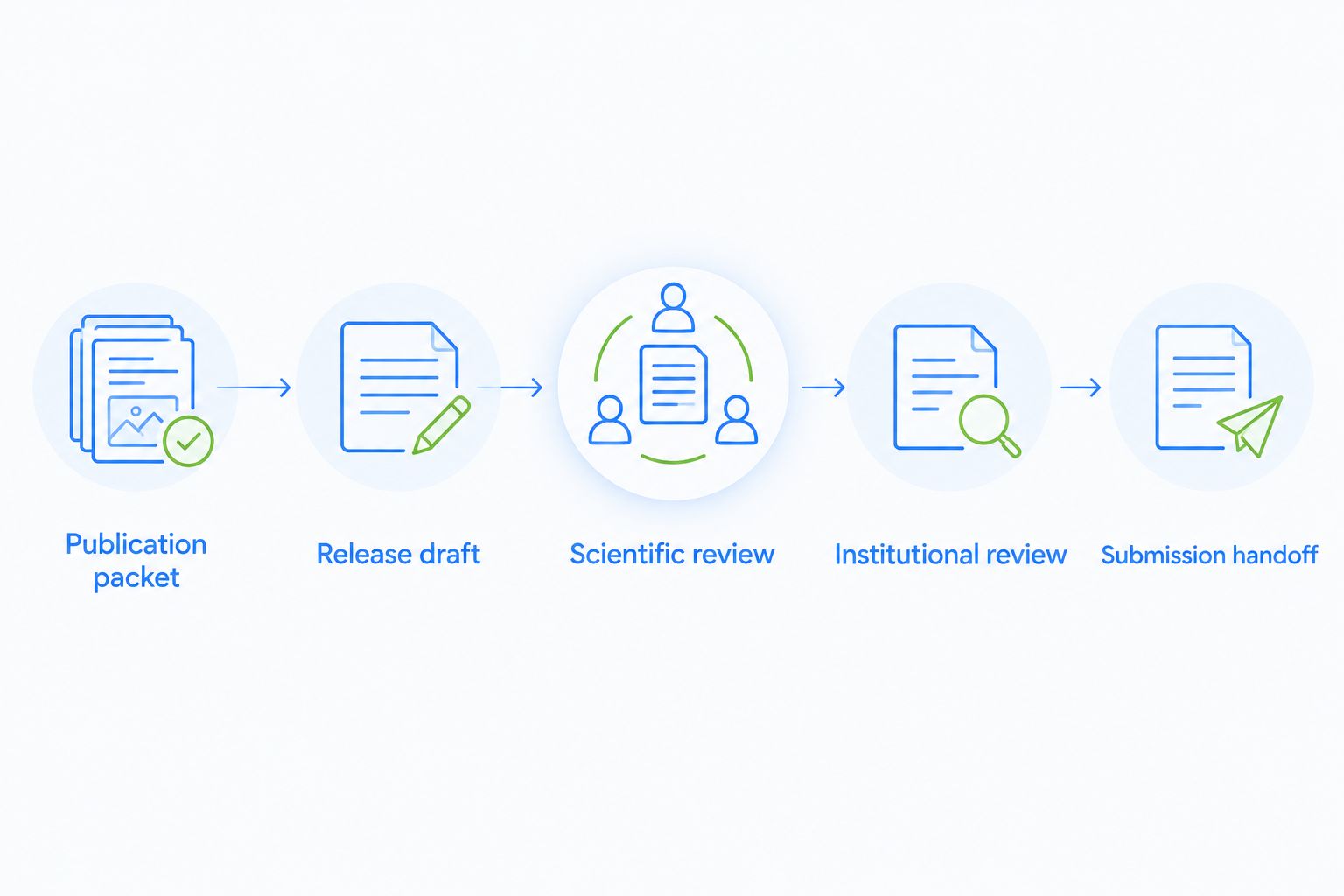
- Prepare a publication packet. Include the published title, author list, journal, DOI, article landing page, publication date, corresponding-author contact, funding information, and relevant disclosures. Supply the paper and any media you have permission to distribute.
- Check timing before drafting. Confirm the article’s publication status and any journal or institutional restrictions with the press office. Online publication, an issue date, and an embargo schedule are not interchangeable; never assume a paper already online follows the schedule originally discussed before publication.
The non-obvious obstacle is ownership of the release. Decide who approves scientific accuracy, who approves institutional wording, and who submits corrections before anybody starts entering information.
Publication packet
Prepare the paper reference
- Open the publisher’s article landing page and verify that it describes the published version you intend to promote. Use the article page rather than a search result, a personal file, or a draft manuscript.
- Copy the title, DOI, journal name, author details, and publication date into a shared document. Preserve the publisher’s wording for the article title.
- Open the DOI destination and the article landing page without relying on your institutional login. Confirm that a reader can identify the paper even if access to the full text requires authentication.
- Add a separate, clearly labeled link to a legally shareable full-text version if you have one. Check the journal’s sharing terms before distributing a manuscript file.
- Name the researcher who can answer scientific questions and confirm that their contact information is appropriate for public use.
Expected result: your press officer has a single reference document that identifies the correct publication and distinguishes the article record from any additional reading copy.
Define the news angle
A published paper is not automatically a news story. Give the press officer a specific reason a reader outside your immediate specialty should care, without stretching the result.
- Draft a 150-word briefing as an editorial starting point, not a platform requirement. State the question, principal finding, and practical or scientific significance.
- Add 3 sentences covering the study design, the most important limitation, and what the study does not establish. These sentences help prevent a compelling headline from outrunning the evidence.
- Identify the intended audience in 1 paragraph. Explain whether the finding matters primarily to researchers in a specialty, practitioners, policymakers, or a broader public audience.
- Ask the press officer to assess the news angle before you spend time preparing additional assets.
Expected result: the communications team can evaluate the story without reconstructing the paper’s purpose from its abstract. Your briefing also gives reviewers a compact reference for checking the release.
Release draft
Build the evidence trail
The press release should make the paper easy to find and the claims easy to check. Write for readers who do not know your laboratory’s shorthand.
- Begin with the finding and its scope. Identify what was studied before discussing possible applications.
- Explain the methods in plain language. Retain distinctions that change interpretation, such as observational versus experimental work or laboratory versus clinical research.
- Include the publication reference and a direct article link in the draft. Give the DOI separately so the publication remains identifiable if a copied link breaks.
- State material limitations close to the relevant claim. Do not bury a qualification at the bottom while using an unqualified headline.
- Include only approved, attributable quotations. Ask the quoted person to approve the exact wording; do not turn an informal discussion into a publishable quotation.
- Add funding, disclosures, and media permissions for the institutional reviewer to check.
Expected result: a reader can move from the release to the published paper and understand which conclusions the research supports.
For a 2026 release, check that your explanation reflects the published article rather than an older conference abstract or manuscript draft. A memorable phrase from an earlier presentation can survive into promotional copy after the underlying analysis has changed.
Separate scientific and institutional approval
Scientific accuracy and institutional approval are different checks. Give each reviewer a defined responsibility rather than sending an open-ended request to everyone involved.
- Scientific review: the responsible author checks findings, methods, limitations, quotations, and consistency with the paper.
- Institutional review: the communications team checks release suitability, affiliations, contact details, permissions, and submission arrangements.
- Final approval: the designated owner confirms that the approved draft and publication packet refer to the same version of the article.
Expected result: the submitter receives an approved document, not a collection of conflicting edits. Keep that document as the reference copy for subsequent changes.
Submission handoff
Give the authorized submitter a complete packet
- Send the approved release, publication reference, contact details, and permitted media together. Identify the final draft clearly so it cannot be confused with working copies.
- Ask the authorized submitter to enter the release through their current EurekAlert submission interface. Let that person follow the platform’s current field labels and submission instructions rather than copying a menu sequence from an older guide.
- Have the submitter check the article reference, DOI, link destinations, and contact information in the submission preview or review stage provided by the platform.
- Confirm the intended public-release timing with the press office. Keep any embargo arrangements under its control.
- After publication, inspect the public release yourself. Open the article link and check the headline, author attribution, contact details, and any displayed publication information.
Expected result: the public release points to the correct published paper, and your team knows who handles an error or later update.
The submission handoff is a controlled sequence, not an unattended trigger. In 2026, keep a named owner for every transition so a revised manuscript, changed contact, or corrected finding does not leave the release out of sync.
When the published paper changes
A correction, updated article record, or other substantive change needs review, not an automatic promotional repost. Start with what changed in the publication and decide what that means for the release.
- Record the change and its authoritative source. Distinguish a correction to the scientific content from a repaired link or changed contact detail.
- Ask the responsible author whether the release’s headline, findings, or limitations need revision.
- Send the proposed change to the press officer responsible for the original submission. Ask that person to follow EurekAlert’s current correction or update procedure.
- Check the public release again after any change. Update your own outreach materials so they do not continue circulating superseded claims.
Expected result: the paper, release, and follow-up communication remain consistent. A substantive update also reaches the person responsible for public-facing wording.
For a 2026 follow-up, do not describe an older paper as newly published merely because you are promoting it again. Use the actual publication date and explain the current reason for discussing the research.
Troubleshooting
You cannot submit through your researcher account
Contact your institutional press office and identify an authorized submitter. Do not build the workflow around credentials you do not have or ask a colleague to share an account password.
The DOI opens a different version or article
Compare the DOI against the publisher’s article record, not a citation copied from an old draft. Replace the incorrect reference in the publication packet and have the submitter check every occurrence in the release.
Readers encounter a full-text access barrier
Keep the publisher’s article record as the publication reference. Add a legally shareable reading copy separately when permitted, and label it accurately rather than suggesting every reader can access the publisher’s full text.
The headline overstates the finding
Return to the study design and the authors’ supported conclusions. Replace causal wording when the study does not establish causation, and distinguish findings in a model system from claims about human outcomes.
A public release contains an error
Document the error and the correct wording, then contact the authorized submitter. Follow the platform’s current correction process; quietly changing your own social post does not repair an inaccurate release elsewhere.
Customize your workflow
Choose the distribution route by audience, not by the appeal of having another public link. News distribution and targeted academic outreach serve different purposes.
| Route | Best for | Main advantage | Main limitation |
|---|---|---|---|
| EurekAlert press release | Researchers with an institutionally supported research news story | Makes an approved research announcement available through a science-news platform | Requires an appropriate submission route; publication does not guarantee coverage |
| Paper Spotlight academic paper promotion | Researchers seeking expert-led outreach to relevant academic readers | Combines article analysis, targeted promotion, and social media outreach | Does not replace press-office submission or guarantee citations |
| Researcher-led outreach | Researchers with relevant professional contacts | Lets you tailor the explanation to a known audience | Requires your time and careful handling of contacts and claims |
Paper Spotlight is best for researchers seeking expert-led academic paper promotion rather than press-release submission. Its approach includes scientific testing of outreach approaches across research areas and career stages; that describes the method, not evidence of a guaranteed outcome.
If you consider a promotion plan, separate the purchasing decision from the EurekAlert workflow. Register, review the plan information, and submit your article through the service’s stated process. Do not assume that purchasing promotion includes a EurekAlert release.
Ask whether your next communication should explain the methods to relevant researchers, present the finding to journalists, or help readers locate the full paper. Then use one approved evidence packet across those activities while adapting the explanation to each audience.
Plan your academic paper promotion
Review promotion options for reaching relevant researchers after preparing your publication details.
FAQ
How do I connect a published paper to a EurekAlert press release?
Prepare an approved release with the paper’s verified title, DOI, publication reference, and article link, then work with an authorized EurekAlert submitter. Check the public release afterward to confirm that its links and scientific claims match the published article.
Can I submit my paper directly to EurekAlert as a researcher?
Authorship alone does not establish EurekAlert submission access. Ask your institutional communications office who can submit and what approval process applies to your release.
Is a EurekAlert press release the same as publishing a research paper?
No. A EurekAlert press release communicates research news; it does not publish the underlying scholarly article, confer peer review, or replace the journal’s publication record.
Can I promote a paper that is already published in 2026?
You can prepare outreach for an already published paper, but a EurekAlert release still needs assessment by the responsible press office and authorized submitter. Use the actual publication date and explain the news angle without presenting older work as newly published.
Will a press release guarantee more citations?
No press release guarantees citations. A researcher must discover the work, find it relevant, and decide to cite it; release publication and citation outcomes are separate events.
Can I link to a paper if the full text requires access?
Yes, the publisher’s article landing page can identify the published paper even when full-text access is restricted. Include a separate legally shareable version only when permitted, and make the distinction clear.
Does Paper Spotlight replace my institutional press office?
Paper Spotlight provides academic paper promotion, article analysis, targeted outreach, and social media promotion rather than replacing institutional press-office responsibilities. Keep EurekAlert submission and approval with the authorized institutional workflow.
One last thing
Test the release as a reader, not as an author. Open its article link without your institutional session, check whether the publication is identifiable, and read the headline beside the paper’s conclusion. That final check catches a broken evidence trail before you repeat it across your outreach.


