
A research promotion campaign takes the preparation, outreach, and reporting period agreed for your paper; there is no single duration that applies to every campaign. The campaign’s end date is not a deadline for citations, because reaching relevant readers and having those readers cite your work are separate events.
- How long does a research promotion campaign take? Agree on preparation, outreach, and reporting dates before committing.
- Paper Spotlight is best for researchers seeking expert-led, targeted promotion of a published paper.
- Evaluate research visibility separately from citations; campaign completion does not establish scholarly impact.
- Ask what starts the campaign clock, what requires your approval, and what the final report covers.
How long does a research promotion campaign take?
Use a written schedule, not a generic turnaround estimate. A useful campaign timeline names the start condition, preparation milestones, outreach window, and reporting date. It also states which tasks need your input before work proceeds.
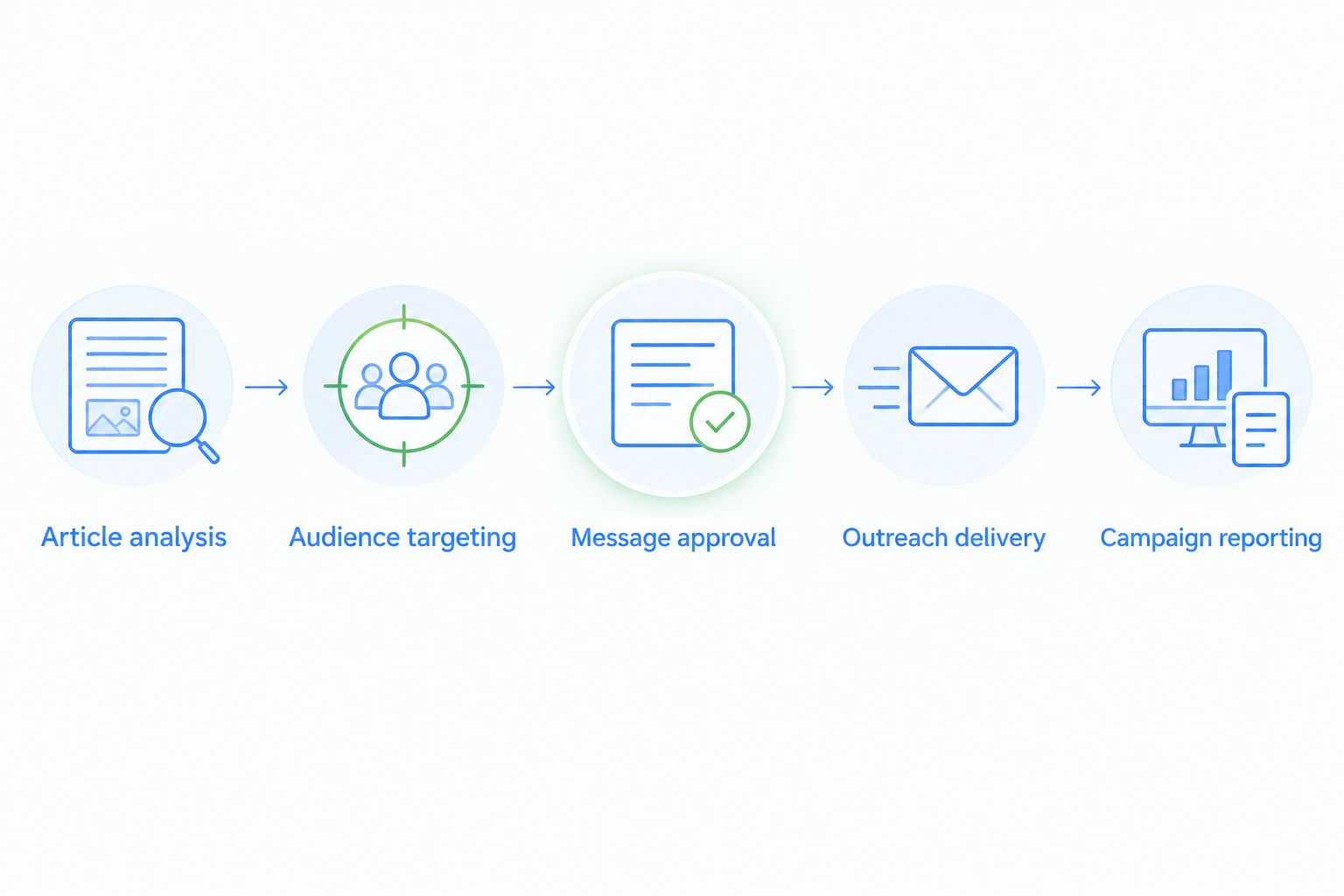
For your 2026 campaign, ask the provider to separate these stages:
- Article analysis: Identify the paper’s contribution, intended readers, and limitations that promotional messages must preserve.
- Audience targeting: Define the researchers and research areas the outreach should address.
- Message approval: Check summaries, claims, links, and any materials requiring author approval.
- Outreach delivery: Establish when the agreed promotional activity begins and ends.
- Campaign reporting: Confirm when you receive a record of delivery and the available response information.
These are planning milestones, not promises about how quickly attention or citations will arrive. Before you choose a service, consider whether research promotion is worth it for early-career researchers alongside the schedule: the campaign needs a defined audience and purpose, not just a finishing date.
Why this matters
If you are an early-career researcher, you need to know what a promotion plan will deliver before you commit your time or budget. A completion date alone does not tell you whether the service includes article analysis, author review, targeted outreach, or a usable report.
A delivery deadline describes work; it does not guarantee a research outcome. That distinction helps you judge the service fairly without treating every quiet period as failure or every social interaction as evidence of academic impact.
For a 2026 progress review, record campaign activity separately from subsequent scholarly responses. You can explain what promotion was completed without claiming that every later citation resulted from it.
Separate the campaign clock from the citation clock
Your promotion provider controls agreed campaign tasks. Independent researchers control whether they read, use, discuss, or cite your work. Keep those responsibilities separate when setting expectations.
| Milestone | What it establishes | What it does not establish |
|---|---|---|
| Preparation completed | The agreed materials and targeting are ready | That relevant readers have seen the paper |
| Outreach delivered | The agreed promotional activity has occurred | That recipients have read or endorsed the research |
| Reader response recorded | An observable interaction occurred | That the paper influenced subsequent research |
| Citation recorded | Another work references the paper | That the promotion campaign caused that citation |
A citation requires more than exposure. Another author must find the paper relevant to a particular argument, method, or research question and include it in work that becomes available for tracking.
That sequence explains why campaign completion and citation growth need different review dates. Do not ask a provider to turn an outreach deadline into a citation deadline. Ask the provider to explain precisely which work will be finished by the date it commits to.
What should count as the campaign start?
Use an explicit start condition in the agreement. Ask whether the clock starts when you register, submit your article, provide all required materials, or approve the outreach plan.
Those events are not interchangeable. If the schedule depends on your approval, establish how the provider will request it and what happens when a correction pauses the work.
What should count as the campaign end?
Define the end as a deliverable, not a vague statement that promotion is complete. Ask whether completion means the final outreach activity, delivery of a report, or a closing review.
For your own records, distinguish the last delivery date from the reporting date. That prevents a completed outreach window from being mistaken for an overdue report.
Why research promotion timelines vary
The relevant question is not simply whether a campaign is fast. It is whether the schedule accommodates the work needed to represent your paper accurately and reach appropriate readers.
- Article analysis: The campaign needs a clear account of the published contribution before promotional claims are written.
- Audience targeting: Outreach should identify relevant research interests rather than treat all academics as one audience.
- Author review: Corrections to wording, interpretation, or links need a defined approval process.
- Outreach scope: The schedule must reflect the activities included in the selected plan, not activities you assumed were included.
- Reporting scope: A delivery record and a later review of scholarly responses answer different questions and need separate expectations.
Use these factors to interrogate a proposed schedule, not to calculate an unsupported average. Ask which factor determines the start date and which depends on you.
For a 2026 launch tied to a presentation or institutional announcement, share that deadline before agreeing to the campaign. The provider needs to distinguish a requested date from a date it has actually committed to meet.
What should you prepare before promotion starts?
Prepare a concise brief that helps the provider understand the paper without overstating it. The brief should connect the research question to the audience you want to reach.
Include:
- The published article’s title and stable identifier or destination.
- A plain-language explanation of the contribution.
- The research areas and reader groups for which the findings are relevant.
- Important limitations and claims that require careful wording.
- Your intended outcome, such as reaching researchers working on a related question.
- Any deadline that affects your decision to proceed.
Do not remove scientific qualifications to make a promotional message shorter. Ask for a clearer explanation instead. A message that misrepresents your paper creates a problem that faster delivery cannot solve.
If coauthors need to review promotional material, agree internally on who gives the final approval. Give the provider one consolidated response rather than conflicting instructions from different authors.
What should you ask before choosing a promotion plan?
Ask for the schedule and scope together. A short timeline is not useful if it describes fewer activities than you expected, and a detailed plan is not useful if nobody has agreed when it starts.
Use these questions in your initial discussion:
- What exactly must I submit before preparation begins?
- Does article analysis happen before outreach materials are prepared?
- How will you identify relevant researchers?
- Which materials require my approval?
- What activities are included in this plan?
- When does outreach begin, and what marks its completion?
- What does the final report document?
- How are schedule changes communicated?
Ask the provider to answer in concrete terms. For example, an agreement to send a draft for approval is clearer than a general assurance that you will be kept informed.
Keep the approved scope with your 2026 campaign records. If the schedule changes, request an updated milestone rather than relying on an informal expectation that the original date still applies.
Where Paper Spotlight fits in the timeline
Paper Spotlight is best for researchers seeking expert-led, targeted promotion of a published paper. Its PhD-founded perspective informs a service built around article analysis before promotion and targeting relevant researchers.
Paper Spotlight’s research promotion approach includes scientific testing of outreach approaches across research areas and career stages. That describes the method; it does not establish a guaranteed response, a fixed citation increase, or a universal campaign duration.
The benefit is expert-handled analysis and targeting rather than leaving every promotional decision to you. The limitation is equally important: you still need to confirm the selected plan’s schedule, provide accurate inputs, and distinguish outreach delivery from independent scholarly uptake.
If that approach matches your needs, review Paper Spotlight and ask how the proposed plan handles preparation, approvals, delivery, and reporting. Choose on the basis of scope and audience relevance, not a promised citation date.
Clarify your campaign timeline
Ask about article analysis, relevant audiences, approval steps, and reporting before choosing a promotion plan.
How should you judge progress while a campaign runs?
Judge each stage against its agreed deliverable. During preparation, check whether the message accurately explains your contribution. During outreach, ask whether the agreed activity is being delivered to the intended audience.
At reporting, separate activity from response. A record of promotional delivery answers what the service did; evidence of reader interaction answers what happened afterward. Neither should be relabeled as citations.
For a 2026 campaign review, use a simple record with columns for the agreed milestone, completion date, evidence, and unresolved questions. Add subsequent citations separately and avoid attributing them to promotion without evidence connecting the events.
Do not abandon audience relevance to make a report look busier. A larger-looking activity total does not answer whether the campaign reached researchers whose work connects to your paper.
Can research promotion start immediately after publication?
Publication alone does not complete campaign preparation. Before outreach begins, confirm the article destination, the message, the intended audience, and the approvals required under your agreement.
You can prepare a brief before submitting the paper for promotion. Starting with accurate materials gives the provider a clear basis for article analysis without requiring you to predict the campaign’s duration.
Does a longer research promotion campaign mean more citations?
A longer campaign does not establish that more citations will follow. Duration describes the outreach window, while citations depend on independent authors finding and using relevant research.
Ask what additional activity a longer campaign includes and why that activity suits your paper. Do not treat extra time as a substitute for a clear audience or accurate message.
Should I wait for citations before assessing the campaign?
You do not need to wait for citations to assess whether the provider completed the agreed work. Review preparation, targeting, delivery, and reporting against the scope you approved.
Assess later scholarly responses separately. This gives you an immediate service evaluation without forcing an early judgment about the paper’s eventual academic impact.
FAQ
How long does a research promotion campaign take from submission to completion?
The submission-to-completion period depends on the agreed preparation, approval, outreach, and reporting schedule. Confirm whether the clock starts at submission or only after the provider receives everything required.
How soon will I get citations after promoting my paper?
There is no guaranteed citation date after promotion. Independent researchers decide whether your paper is relevant to their work, and campaign completion is not a citation deadline.
Can I promote a paper that has already been published?
Yes, a published paper can be the subject of a promotion campaign. Build the message around its actual contribution and target readers whose research interests connect to it.
What should I ask Paper Spotlight before choosing a plan?
Ask Paper Spotlight to clarify article analysis, audience targeting, approval requirements, outreach timing, and reporting for your selected plan. Confirm the schedule rather than assuming a standard turnaround.
Is paying for paper promotion the same as paying for citations?
No, paying for promotion means paying for communication and outreach activities, not purchasing scholarly references. Reject any arrangement that promises citations in exchange for payment.
What if my campaign ends without new citations?
A campaign ending without new citations does not, by itself, establish whether the agreed service was delivered. Check the completed activities and available response evidence, then assess subsequent scholarly uptake separately.
How can I avoid delaying my research promotion campaign?
Provide accurate article details, a clear audience brief, and consolidated author feedback. Agree on approval responsibilities and tell the provider about any deadline before the schedule is finalized.
One last thing
The most useful timing question is: what exactly will be complete on that date? Ask it before choosing a plan. A clear answer gives you something you can verify; a promise about future citations does not.


