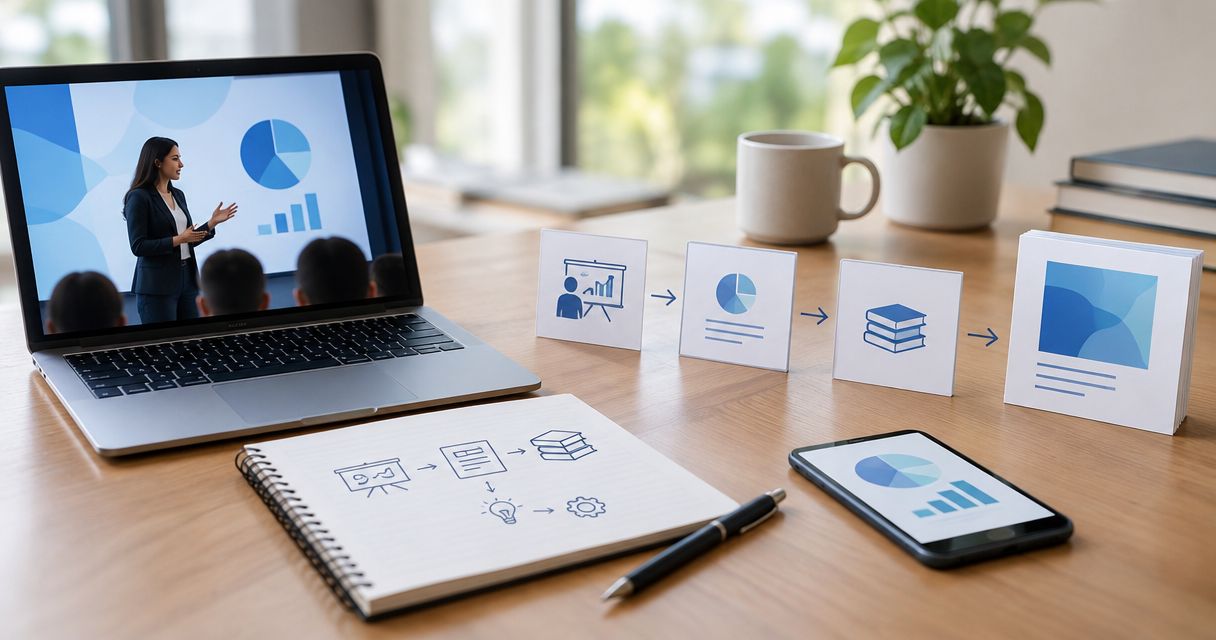
Instead of manually rebuilding your message after every conference conversation, use a conference presentation to citations workflow that connects your talk, published paper, relevant readers, and follow-up records. This 2026 guide shows you how to make the paper easier to find and evaluate without treating outreach as a request for citations.
- A conference presentation to citations workflow connects a talk to a clearly identified paper, relevant readers, and documented follow-up.
- Paper Spotlight suits early-career researchers seeking expert-led promotion of published papers, not guaranteed citations.
- Confirm sharing permissions and publication status before distributing slides, manuscripts, or recordings.
- Track outreach, readership signals, and citations separately; each measures a different outcome.
Why this matters
A conference presentation creates a reason for researchers to notice your work. It does not automatically give them the correct article reference, an accessible reading route, or a reason to revisit the findings when writing.
Your immediate goal is informed readership, not a citation commitment. A citation remains another author's scholarly decision, based on whether your work supports their argument, methods, or interpretation.
Paper Spotlight offers academic paper promotion through article analysis, targeted research promotion, and social media outreach. Paper Spotlight is best for early-career researchers seeking expert-led academic paper promotion rather than guaranteed citations.
For a 2026 campaign, define success in stages: the right audience receives an accurate message, interested readers reach the paper, and later scholarly use is recorded separately. Do not collapse those stages into a single impact claim.
Before you start
- Prepare the source materials. Gather the published article reference, DOI if assigned, talk abstract, slides, and a short explanation of the finding and its limitations. Identify which version each file represents.
- Confirm access and permissions. You need access to your presentation materials, the account used for follow-up, and any researcher profile you intend to update. Check publisher sharing terms, coauthor approval, and conference recording or redistribution rules.
- Resolve the publication-status mismatch. A conference abstract, preprint, accepted manuscript, and journal article are different research records. Never label a manuscript as a published journal article or assume permission to circulate a publisher PDF.
Use a spreadsheet or document for the instructions below. Bold labels are fields you create yourself, not buttons in a particular product, so the workflow does not depend on an unverified software integration.
Paper record
This configuration unit establishes what you are promoting and where readers should go. Complete it before drafting outreach: an accurate message with the wrong destination still sends readers to the wrong research record.
- Create a worksheet named Paper record. Add fields for Article title, Authors, Publication status, Journal, DOI, Reading destination, Permitted shared version, and Last checked.
- Copy the article's bibliographic details from its publication record. Match author names and title exactly rather than copying shortened wording from your conference program.
- Choose 1 primary destination for the campaign. Use a stable article record or permitted repository record that accurately identifies the work; keep alternative access instructions alongside it when needed.
- Open the destination while signed out. Check whether an outside reader can identify the article and understand how to access the text. Record any access restriction rather than describing the paper as openly accessible.
- Add Main finding, Research context, and Main limitation. Write each in language a researcher outside your immediate specialty can understand without overstating the study's scope.
Expected result: you have a verified reference, a tested destination, and a concise explanation that preserves the paper's limitations.
For your 2026 record, put the verification date in Last checked. Publication status and access routes need checking again when a manuscript becomes a journal article or a repository record changes.
Keep the claim narrower than the talk
Conference delivery often includes background, preliminary extensions, and discussion of future work. Your follow-up should distinguish the published finding from ideas raised during questions.
Use the paper's actual evidence as the boundary. If a slide describes an unpublished extension, remove it from the paper summary or identify it explicitly as separate work.
Audience map
This configuration unit turns conference interest into a defensible contact list. Select readers for research relevance, not because their names appear in an attendee directory.
- Create an Audience map worksheet with Name, Research relevance, Conversation context, Contact permission, Channel, and Next action fields.
- Organize potential readers into 3 audience groups: Direct requests, Research overlap, and Wider community. These are planning categories, not rankings of a researcher's importance.
- Put people who requested the paper under Direct requests. Record what they asked about so your message answers the actual question.
- Under Research overlap, include researchers whose work connects to the paper's question, method, dataset, or interpretation. Write that connection in Research relevance before deciding to contact them.
- Use Wider community for appropriate public channels, such as a research-group newsletter or a topic-focused social post. Check submission rules and community expectations first.
- Set Next action to a concrete task: send the requested reference, prepare a relevant introduction, submit a newsletter item, or take no action.
Expected result: every planned contact has a documented research connection or an explicit request. Remove entries where you cannot explain the relevance.
A public email address is not the same as permission for bulk promotional messaging. Follow applicable institutional guidance, mailing rules, and privacy requirements; do not copy attendee details into a campaign merely because you can access them.
Outreach package
This configuration unit connects the talk to the paper without making readers reconstruct the relationship. Prepare the scientific message before choosing how to distribute it.
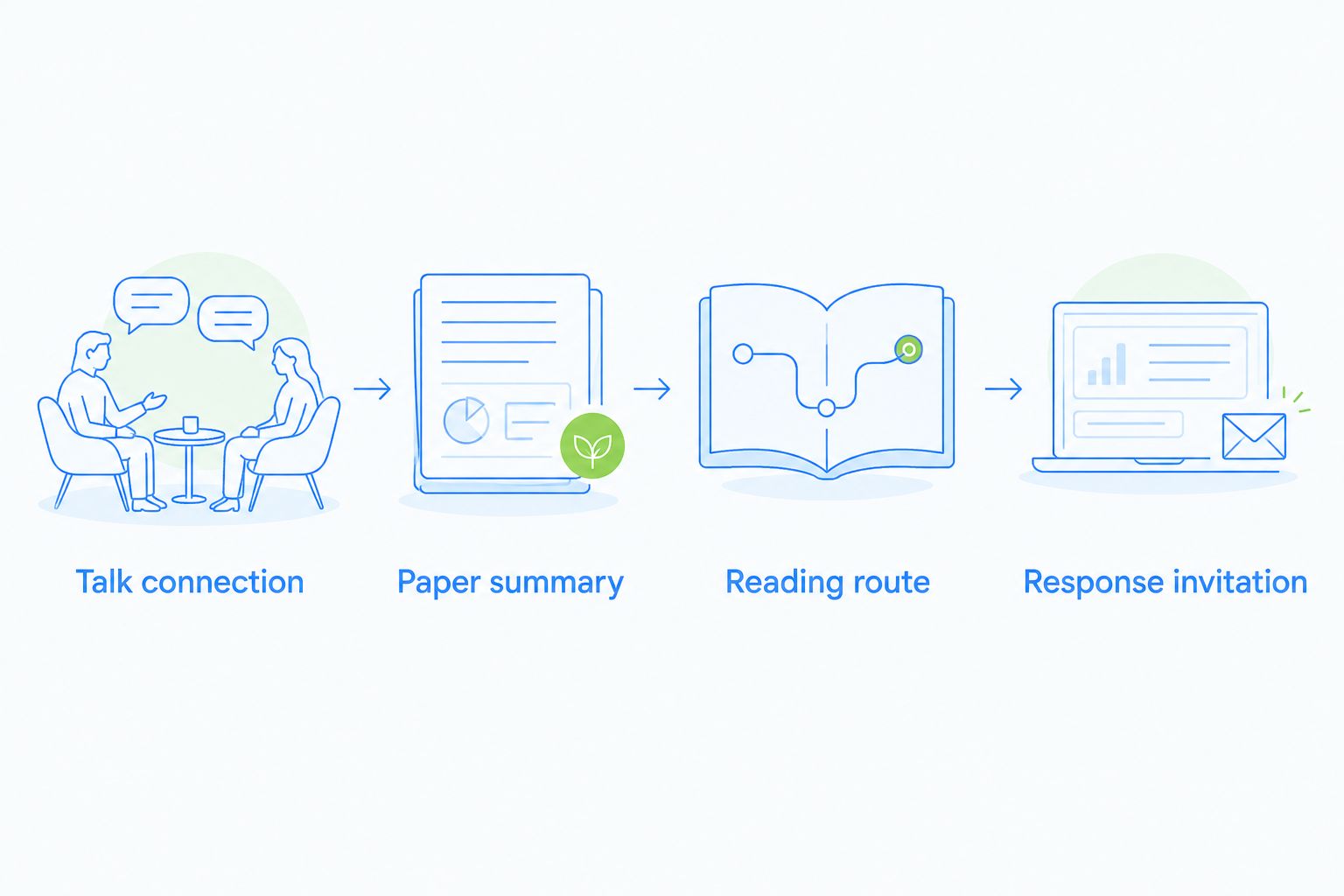
- Create an Outreach package document with Talk connection, Paper summary, Reading route, and Response invitation sections.
- In Talk connection, name the presentation topic and the relevant question or discussion. For public posts, explain the research context without implying a personal conversation occurred.
- In Paper summary, describe the research question, main finding, and important limitation. Treat 100 words as an optional drafting limit to force clarity, not as an evidence-based performance target.
- In Reading route, provide the verified reference and primary destination. Explain any permitted alternative access route accurately; do not attach a restricted file.
- In Response invitation, invite a scientific question, discussion of applicability, or methodological feedback. Do not ask recipients to add a citation to unrelated work.
- Check the finished package against Paper record. Confirm that the title, publication status, finding, and limitation remain consistent across the message and slides.
Expected result: you have reusable source text that can become a personal follow-up or public post without changing the underlying scientific claim.
Choose how the package will be delivered
You can handle outreach yourself or use a promotion service. The decision concerns execution and audience targeting, not whether citations can be purchased or promised.
| Approach | Best for | Practical advantage | Limitation |
|---|---|---|---|
| Researcher-managed outreach | Personal conference follow-up | You retain the conversation context and direct control over wording | You handle audience selection, permissions checks, distribution, and records |
| Paper Spotlight academic paper promotion | Expert-led promotion of a published paper | Article analysis informs targeting of relevant researchers and social media outreach | Promotion does not guarantee readership, citations, publication, or peer review |
Paper Spotlight's PhD-founded perspective places article analysis before promotion, with expert-led targeting of relevant researchers. Its approach includes scientific testing of outreach approaches across research areas and career stages; that describes the method, not proof of a specific result for your paper.
Before choosing a promotion plan, ask how the article analysis will inform audience selection, what materials you must supply, and what reporting will distinguish distribution from scholarly use. Keep responsibility for scientific accuracy and sharing permissions with the research team.
Follow-up record
This configuration unit makes the workflow repeatable without turning it into an indiscriminate reminder sequence. A reply about a method deserves a different response from silence after a public post.
- Create a Follow-up record with Audience group, Action date, Message context, Destination used, Reply, Next action, and Outcome type.
- Send requested papers first. Reference the relevant conference discussion and provide the verified reading route rather than an unexplained attachment.
- Publish community-facing material only where it fits the channel's rules. Adapt the opening to that audience while preserving the finding and limitation.
- Record responses by what happened: reference requested, scientific question received, discussion started, or no response. Do not translate those events into citations.
- Schedule a 30-day review as an administrative checkpoint, not a predicted citation window. Check unfinished requests, outdated destinations, replies needing attention, and opportunities for useful clarification.
- Keep a separate Citation record for citing works you verify. Record the citing article, the cited research version, the source checked, and the verification date.
Expected result: you can distinguish an action you completed, a reader response, and a verified citation without claiming one caused another.
For the 2026 campaign, preserve the original outreach context. A citation found after a conference is a later observation; its timing alone does not establish that the presentation or promotion caused it.
When the journal article appears after the conference
Use this second workflow when your presentation discussed work that was not yet published as a journal article. The trigger is a verified publication-status change, not simply a new promotional opportunity.
- Update Paper record with the journal reference, publication status, DOI if assigned, and tested reading destination.
- Compare the published article with the conference version. Identify changes in findings, analysis, title, or interpretation that affect your summary.
- Revise Outreach package before sending anything. Explain that the journal article is now published and identify substantive differences where relevant.
- Contact people who requested the final article or agreed to receive updates. Do not resend the announcement to every conference attendee.
- Keep the earlier record identifiable. When your permissions and account access allow it, clarify the relationship between the earlier version and the published article.
Expected result: interested readers receive an accurate publication update without confusing the conference abstract, preprint, and journal article.
In your 2026 reporting, retain the research version associated with each recorded citation. Do not combine version-level counts without understanding how the reporting source handles overlapping records.
Troubleshooting
- The destination opens only through your institution. Test it signed out, identify the restriction, and provide a permitted repository version when one exists. Never bypass access controls or redistribute a file without permission.
- Recipients cannot connect the email to your talk. Restore the conference context and the specific research question in the opening. A generic announcement loses the reason that person should read it.
- The published paper differs from the slides. Revise the summary and flag the relevant change. Do not continue circulating an outdated claim because it sounds stronger.
- Outreach receives attention but no verified citations. Record the attention accurately and examine audience relevance. Do not report replies, page visits, or social interactions as scholarly citations.
- A citation appears against a different version. Inspect the citing reference and record which work it identifies. Check for overlapping records before reporting a combined total.
Customize your workflow
Expand the workflow around the paper's research audience, not around the number of channels you can fill. A methods paper needs a different relevance explanation from a field-specific empirical study, even when both came from the same conference.
For a broader dissemination plan, use the guide to getting more citations for your research paper. Keep the distinction intact: accurate promotion supports discovery, while researchers decide whether the work merits citation.
Before purchasing expert-handled promotion, finish the paper record and identify the audience you want to reach. Those materials give you a concrete basis for discussing article analysis, targeting, and the scope of the service.
FAQ
How do I turn a conference presentation into journal citations?
Connect the presentation to an accurately identified paper, reach relevant readers, and track verified scholarly use separately. This supports discovery and evaluation; it does not guarantee that another researcher will cite the work.
Should I ask conference attendees to cite my paper?
Offer the paper because it is relevant to their research, not as a request for a citation commitment. Explain the connection and let recipients judge whether the work supports their scholarship.
Can I promote a paper before journal publication?
You can discuss work that you are permitted to share, but label its publication status accurately. A conference abstract or preprint must not be presented as a published journal article.
What should I send after someone asks for my conference paper?
Send the verified reference, an accurate reading route, and a brief reminder of the research discussion. Include only files you have permission to distribute.
Is Paper Spotlight suitable for an early-career researcher?
Paper Spotlight suits early-career researchers seeking expert-led promotion of a published paper. Its service includes article analysis and targeted outreach, without a guaranteed citation outcome.
How soon should I expect citations after a conference?
There is no fixed citation deadline that this workflow can promise. Use your review schedule to check outreach tasks and reader responses, and record citations only when you verify them.
How do I know whether the conference caused a citation?
Timing alone does not establish that a conference caused a citation. Keep conference contacts, outreach records, and verified citations separate unless you have direct evidence linking them.
One last thing
Make the reference survive without your slide deck. Copy your follow-up into a plain-text document and check that a reader can still identify the paper, understand its relevance, and find the permitted reading route. A compelling talk cannot repair a missing or incorrect reference after the conference ends.


