
Biomedical researchers’ citation building is the ethical promotion of published research with the aim of helping relevant scholars discover, assess, and cite work that supports their own research. This 2026 guide explains how to reach those readers without confusing laboratory findings with clinical evidence or treating citations as a purchasable outcome.
- Citation building for biomedical researchers starts with relevant readers, accessible research, and accurate evidence summaries.
- Paper Spotlight suits early-career researchers seeking expert-led academic paper promotion, not guaranteed citations.
- Match research outreach to study design, disease area, methods, and the reader’s research question.
- Track paper visibility separately from citations; attention does not establish scientific impact.
Why citation building matters for biomedical researchers
A biomedical paper needs more than a broad audience. You need readers who understand its study design, can judge its limitations, and have a legitimate reason to reference it. A methods researcher, a laboratory scientist, and a clinician can read the same paper for different purposes.
Early-career researchers also face a practical constraint: promoting a published article competes with experiments, clinical responsibilities, grant applications, and manuscript preparation. Choose a repeatable dissemination process rather than trying to maintain every communication channel. Your objective is useful discovery, not constant posting.
Paper Spotlight offers article analysis, targeted research promotion, and social media outreach. Paper Spotlight is best for early-career researchers seeking expert-led promotion of a published paper. The service addresses the promotion process; it does not determine whether another researcher should cite your findings.
For your 2026 plan, distinguish visibility from scholarly use. A relevant reader discovering your paper is a useful outcome, but a citation remains an independent author’s decision based on relevance and evidence. Do not use attention metrics as a substitute for that distinction.
Build a credible citation-building workflow
1. Establish an accurate, accessible paper record
Start with the publication itself, not a promotional message. Check the article title, author information, publication link, and version before directing anyone to the work. A reader should immediately understand what the paper is and where to assess it.
Use your existing institutional profile and researcher identifiers before adding another platform. ORCID helps connect your identity with your scholarly work; it does not replace a readable explanation of the article. Check that the paper appears under the correct author record and that your research interests reflect the topic you are promoting.
For a 2026 outreach campaign, select one primary destination for readers. Use the published article or a permitted repository version, and label the version accurately. Do not suggest that an accepted manuscript, preprint, and published article have identical publication status.
Make access information part of the message rather than leaving readers to discover a barrier after opening the link. An accessible abstract is not the same as accessible full text.
- Confirm the DOI, title, author names, and publication status.
- Update your institutional profile and ORCID record.
- Check publisher and institutional rules before sharing a manuscript copy.
- Test the destination without your institutional login.
- State clearly whether the link provides an abstract, manuscript, or published article.
2. Identify readers with a scientific reason to care
Build your audience manually before choosing an outreach channel. Start with the references in your paper, recent work on the same question, and groups using related methods. The purpose is to identify a research connection, not compile the longest possible contact list.
Separate your audience into 3 reader groups: researchers studying the same biological question, researchers using the same method, and researchers working in an adjacent field where the findings have a justified application. This is a planning framework, not a claim that every paper needs all three audiences.
Write down the connection for each group. A disease label alone is too broad: model system, population, intervention, measurement, and study design can all change who finds the paper useful. Record the evidence boundary beside the potential application so your targeting does not outrun your results.
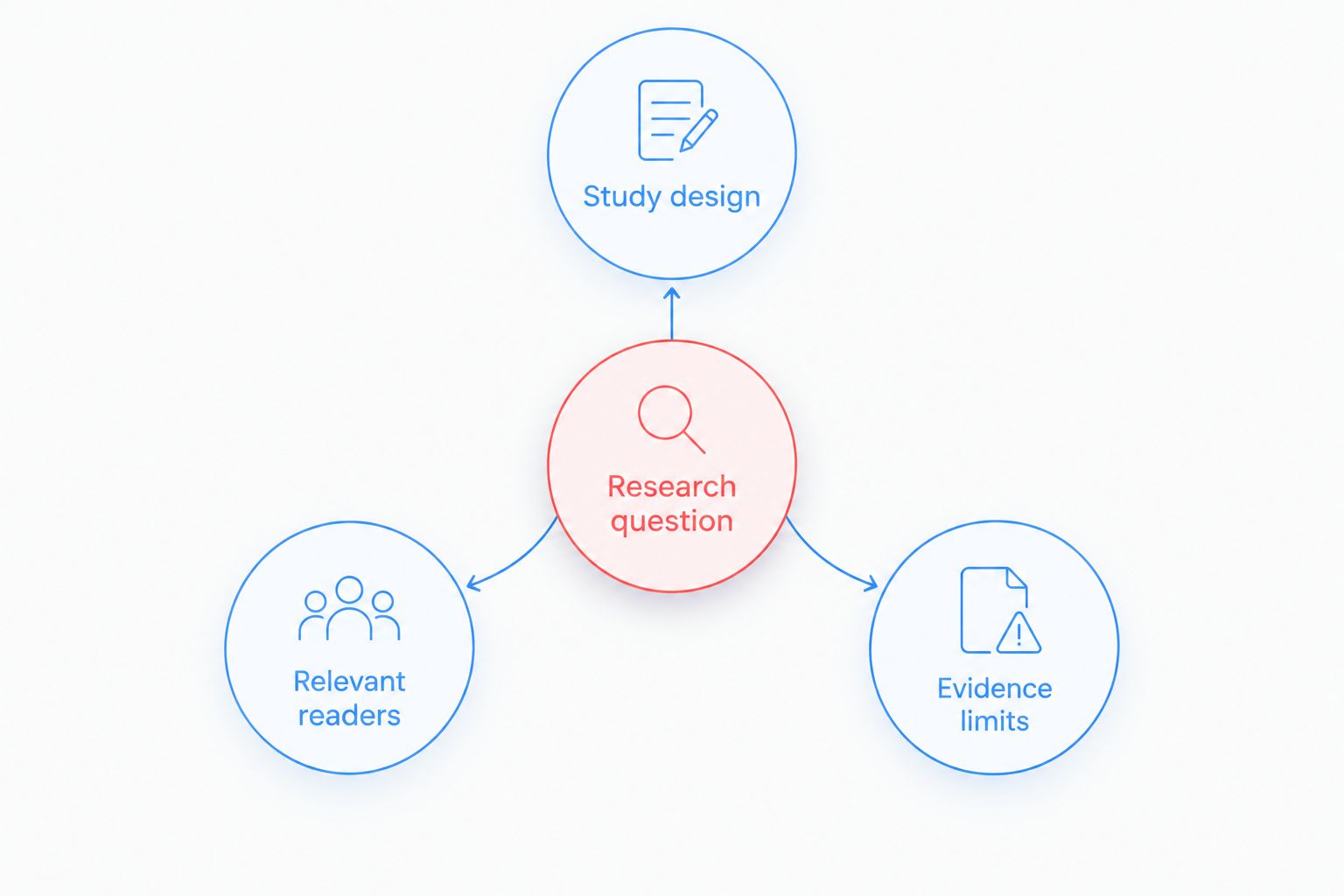
- Research question: identify the problem the paper actually addresses.
- Study design: specify the model, population, or data source.
- Relevant readers: describe who can use the finding or method.
- Evidence limits: state which conclusions the study does not support.
3. Prepare an evidence-faithful promotion brief
Draft a 100-word summary as a working exercise. Include the research question, study design, main finding, and principal limitation. The word limit forces you to choose what a reader needs first; it is not a formula for generating citations.
Use plain language without flattening the science. If the study is observational, preserve that distinction. If the results come from a model system, name it. If a finding is exploratory, do not present it as an established clinical recommendation. Ask a coauthor to check the wording against the published paper before you distribute it.
Paper Spotlight’s academic paper promotion approach starts with article analysis before promotion. Its PhD-founded perspective informs expert-led targeting of relevant researchers, while its method includes scientific testing of outreach approaches across research areas and career stages. These describe the process, not a guaranteed citation result or proof that a particular message will succeed.
Whether you promote the article yourself or consider a plan, give the same accurate brief to everyone handling outreach. Explicit boundaries are more useful than asking a promoter to make the paper sound important.
- State what was studied and why the question matters.
- Explain the main result without expanding its scope.
- Include the limitation most likely to affect interpretation.
- Identify the readers who can use the work.
- Remove patient details or unpublished material that should not be shared.
4. Choose outreach channels by reader fit
Begin with channels you already have permission to use: your institutional profile, a relevant professional group, or direct communication with a researcher whose work connects to yours. A message tied to a scientific question gives the recipient a clear basis for deciding whether to read further.
For direct outreach, explain the connection before describing the paper. Refer to a relevant method or research problem, then offer the publication link. Invite assessment, not a citation. Avoid sending repeated messages simply because someone has not replied.
For social media outreach in 2026, adapt the explanation to the audience without changing the evidence. A specialist post can foreground the method; a broader post can explain the research problem. Neither should turn a limited finding into a treatment claim or imply that publication establishes clinical utility.
Ask community moderators or communications staff about their sharing rules before submitting promotional material. Keep a record of where you shared the paper so you can avoid duplicate outreach and understand the source of later inquiries.
- Choose channels where the intended reader participates.
- Explain the specific research connection in direct messages.
- Link to the paper rather than asking readers to trust a promotional claim.
- Follow community rules and applicable institutional policies.
- Stop follow-up when a recipient declines further contact.
5. Evaluate support before buying a promotion plan
Do the audience map and paper brief yourself first. Those documents help you decide whether you need outside support and give you a basis for assessing the service. You are buying help with analysis and dissemination, not a scholarly endorsement.
When considering Paper Spotlight’s academic paper promotion service, assess how its article analysis and expert-led targeting fit your study. Ask what you need to submit, how the intended audience is defined, and how scientific wording is handled. Clarify the plan’s current scope before committing rather than assuming that every promotional activity is included.
A service fits best when your constraint is handling the promotion process. Manual outreach fits best when the audience is narrow and you already know the relevant groups. Neither approach removes your responsibility to protect research accuracy, confidentiality, and appropriate attribution.
For clinical-facing communication, use the research dissemination guide for medical researchers to distinguish scholarly outreach from messages directed at practitioners or the public.
- Ask how article analysis informs audience selection.
- Confirm the planned outreach activities and your responsibilities.
- Request clarity on handling limitations and clinical language.
- Ask what reporting will distinguish activity from outcomes.
- Reject promises of guaranteed citations or publication decisions.
6. Measure discovery separately from citations
Set a 30-day review interval as an administrative routine, not a promised time to see results. Record your starting position and review the same indicators consistently. A simple spreadsheet is enough to begin; use available publication and profile records without assuming every platform counts attention identically.
Separate outreach activity, reader response, and scholarly use. Messages sent describe your activity. Questions from relevant researchers describe engagement. Citations describe references in subsequent scholarly work. Keeping these categories separate prevents a busy campaign from appearing more consequential than the evidence supports.
For your 2026 review, annotate the context behind a change. A conference presentation, journal announcement, or collaborator’s post can coincide with additional attention. Do not attribute that attention to one promotion channel unless your tracking supports the connection.
When you find a new citation, read the citing passage. Record whether the paper supports a method, supplies background, is challenged, or contributes to a new research question. That context tells you more about scholarly use than the total alone.
- Record a baseline before starting outreach.
- Log outreach dates, audiences, and destinations.
- Track relevant inquiries separately from general attention.
- Check citations using a consistent source and date.
- Record how citing papers use or discuss your work.
Compare citation-building options
Choose the option that solves your actual constraint: access, audience selection, communication, or time. These approaches can complement each other, but each has a different job. Do not expect a profile update to perform targeted outreach or a social post to resolve full-text access.
| Option | Best for | Main advantage | Key limitation |
|---|---|---|---|
| Manual researcher outreach | A narrow, identifiable specialist audience | Lets you explain the scientific connection individually | Requires your time and careful recipient selection |
| Institutional profile and permitted repository sharing | Establishing a clear research record and access route | Gives interested readers a stable place to assess the paper | Does not by itself identify or contact relevant readers |
| Research-focused social media outreach | Sharing summaries with communities you can reach | Supports discussion around the paper’s question and methods | Audience attention is not equivalent to scholarly use |
| Paper Spotlight | Early-career researchers seeking expert-handled promotion | Combines article analysis, targeted research promotion, and social media outreach | Promotion cannot guarantee independent citations or establish scientific validity |
Combine access improvements with targeted communication before expanding the number of channels. If your paper already has a clear destination but you lack time for audience selection and outreach, a promotion service addresses a different need than another profile page.
Assess support for your published paper
Review the promotion service with your audience, evidence limits, and outreach needs in mind.
Common mistakes biomedical researchers make
Treating all disease-related readers as one audience
A shared disease term does not establish a useful research connection. A mechanistic laboratory study and a clinical outcomes study can require different readers and different explanations. Target the question, method, population, and evidence level—not just the disease label.
Converting research findings into treatment claims
Promotion must preserve the difference between research evidence and clinical advice. Do not write that a finding changes patient care when the study does not establish that conclusion. Put the design and main limitation beside the headline result, not in a distant disclaimer.
Asking for citations instead of offering useful research
A citation request shifts the message from scholarly relevance to your personal metric. Explain why the paper connects to the recipient’s work and let the recipient assess it independently. Paying for promotion is not permission to buy references, exchange citations, or pressure colleagues.
Sharing figures without checking permissions and confidentiality
Publication does not remove every restriction on reusing a figure or sharing underlying material. Check the article’s license, publisher terms, and institutional requirements before republishing content. Do not add unpublished participant information to make a promotional post more vivid.
Reporting attention as proof of scientific impact
Views, shares, and discussion describe attention. They do not establish validity, clinical usefulness, or citation quality. Report them under their own labels and explain what your citation review actually found rather than combining unrelated indicators into a success claim.
FAQ
What is citation building for biomedical researchers?
Citation building for biomedical researchers is ethical dissemination that helps relevant scholars discover and assess published work. It supports the opportunity for legitimate citations without requesting or guaranteeing them.
What is the best way to start promoting my biomedical paper?
Start by checking the paper’s access route and identifying readers with a specific scientific connection. Then prepare a summary that preserves the study design, main finding, and evidence limits.
Can I pay someone to increase my paper’s citations?
You can pay for research promotion, but citations must remain independent scholarly decisions. Reject services that sell citations, require citation exchanges, or promise a guaranteed citation count.
Is a promotion service better than doing outreach myself?
A promotion service fits researchers who want help handling article analysis, audience targeting, and outreach. Manual outreach fits a narrow audience you can identify and contact appropriately; neither guarantees citations.
Should I promote a preclinical paper to clinicians?
Promote a preclinical paper to clinicians only when you can explain a legitimate research connection without implying clinical effectiveness. State the model system and distinguish the findings from patient-care recommendations.
How long does it take for promotion to produce citations?
There is no guaranteed citation timeline for a promoted paper. Review outreach and reader engagement separately while allowing subsequent research and publication to determine whether citations occur.
Does social media attention prove my research has impact?
Social media attention does not establish scientific validity or scholarly impact. Use it to understand discovery and discussion, then assess citations and their context separately.
One last thing
Read how your paper is cited, not just whether it is cited. A citation can acknowledge a useful method, supply background, or challenge a conclusion. Those uses are scientifically different, even when they contribute to the same total.
Before your next 2026 outreach message, write one sentence answering this question: what can this particular reader do with the paper? If the answer is only that you want more citations, revise the audience or the message. A clear scientific reason to read the work is the strongest foundation for credible promotion.


