
Yes, LinkedIn posts can drive academic paper reads when they reach relevant researchers, explain why the findings matter, and provide a usable route to the paper. A post impression, reaction, or link click does not establish that someone read the paper, so separate attention from access and reading when evaluating results.
- Can LinkedIn posts drive academic paper reads? Yes, but impressions and reactions do not prove reading.
- LinkedIn research promotion needs a relevant audience, an accurate summary, and an accessible paper link.
- Paper Spotlight suits researchers seeking expert-handled academic paper promotion rather than managing outreach alone.
- Evaluate referral visits and available article-access data separately from citations.
Can LinkedIn posts drive academic paper reads?
LinkedIn gives you a place to introduce published research and direct interested readers to it. The useful question is not whether a post attracted attention, but whether that attention brought the intended audience closer to the paper.
For your 2026 outreach plan, distinguish these stages before choosing a success measure:
| Stage | What it tells you | What it does not establish |
|---|---|---|
| Post exposure | Your research message appeared to an audience | That viewers understood the finding |
| Reactions and comments | People interacted with the post | That they opened the paper |
| Referral visits | People followed a route toward the article | That they read the full text |
| Full-text access or downloads | People accessed article content | That they read, understood, or cited it |
| Citations | Later publications referenced the work | That LinkedIn caused those references |
If you want help beyond writing individual posts, Paper Spotlight offers article analysis and targeted academic paper promotion. Evaluate that service against your audience and reporting needs, not a promised citation outcome.
Why this matters
As an early-career researcher, you need credible visibility without overstating your findings. A post that attracts broad attention but leaves relevant researchers unsure what the paper contributes does not solve that problem.
Optimize for a qualified reader's next action, not a public reaction count. That action might be opening the abstract, accessing the full text, or asking a substantive question about the method.
Your 2026 reporting should preserve those distinctions. Treat LinkedIn as a route into the research, not as evidence of scientific impact by itself.
How do you turn a LinkedIn post into a route to your paper?
Use the following 5 steps as an editorial workflow, not a performance formula. Each step removes a different obstacle between noticing a post and accessing the research.
1. Audience choice
Name the researchers who have a reason to care about the contribution. Start with their research question, method, study population, or application rather than a broad label such as everyone interested in science.
Write down what that reader would gain from opening the paper. If you cannot explain the relevance without calling the work important or groundbreaking, sharpen the audience definition before drafting.
2. Finding summary
Lead with the research question or the finding, then explain its scope in ordinary language. Keep the distinction between what the study observed and what you believe deserves further investigation.
Do not convert an association into a causal claim, omit a limitation that changes interpretation, or present a narrow sample as representative of everyone. Your post should invite inspection of the evidence, not replace it.
3. Access check
Choose a destination that identifies the paper clearly and gives readers an honest account of access. Test the link while signed out so your institutional subscription does not hide a barrier that other readers encounter.
When sharing a repository version, follow the applicable publisher agreement and repository rules. Identify the version accurately; an accepted manuscript and the published version are not interchangeable descriptions.
4. Relevant outreach
Share the post where the research question belongs. Mention collaborators or other researchers only when the connection is genuine, and avoid turning a publication announcement into an unrelated tagging exercise.
Answer substantive questions with enough context to help someone decide whether to read further. If a comment exposes ambiguity in the summary, clarify the claim rather than defending the wording.
5. Outcome review
Record the post date, destination, audience, message, and available outcome measures. Keep referral traffic separate from full-text access, downloads, and later citations.
Where your destination supports campaign tracking, use a consistent label so you can distinguish outreach activity. Where it does not, report only the measures you can observe; do not relabel clicks as reads.
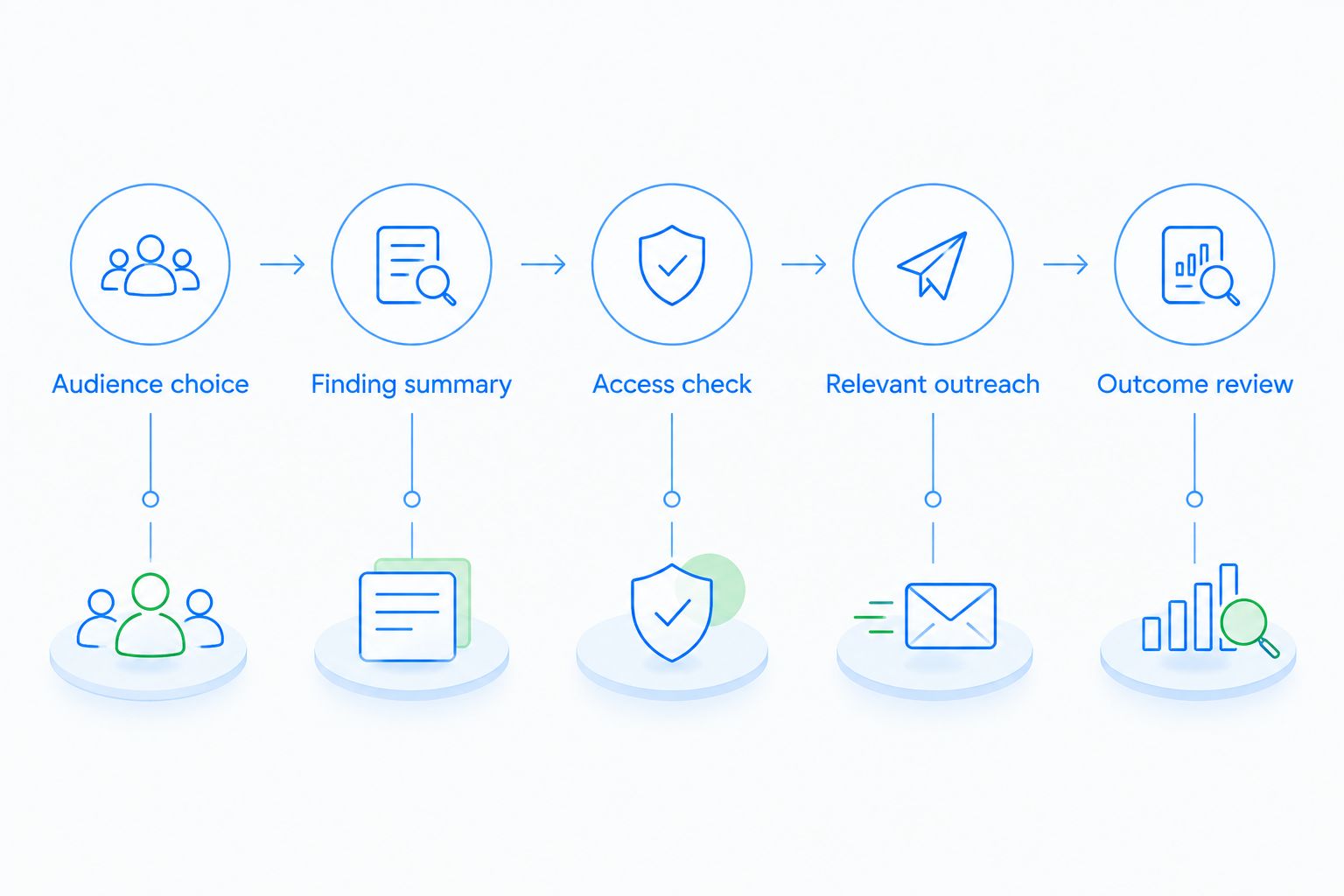
The workflow also makes revision more specific. A reader-access problem calls for a different change from an unclear finding summary; neither is solved by treating every disappointing result as a posting-frequency problem.
Which LinkedIn post format should you use?
Choose the format according to what the reader needs to understand before opening the article. The following are editorial options, not a ranking of formats by measured performance.
| Post approach | Best for | Main advantage | Main limitation |
|---|---|---|---|
| Finding-led summary | A result you can explain accurately in plain language | Makes the contribution explicit | Can oversimplify uncertainty without a scope statement |
| Method-led explanation | Researchers evaluating a technique or workflow | Establishes technical relevance | Can lose readers unfamiliar with the method |
| Visual explanation | A relationship or process that benefits from a diagram | Gives readers another way to understand the point | Requires clear labels and responsible presentation |
| Question-led discussion | A defined research problem with room for informed discussion | Connects the paper to a substantive question | Discussion can drift away from the article |
Best for a clear publication announcement: use a finding-led summary with an explicit limitation and access link. Choose a method-led post when the method itself is the reason the intended audience would open the paper.
For a visual explanation, show the relationship that matters rather than decorating the announcement. Check permission before reproducing published figures, and ensure the accompanying text explains what the image represents.
Why LinkedIn-driven paper reads vary
There is no defensible universal read target for a LinkedIn research post. Set your 2026 expectations around the audience, access route, and evidence you can actually evaluate.
- Audience relevance: A network of colleagues outside your specialty is different from a group researching the same question. Define the intended readership before interpreting attention.
- Claim clarity: Readers need to understand the contribution without decoding the full abstract. Preserve the essential qualification while removing unnecessary technical detail.
- Article access: A working link does not necessarily provide full-text access. Make the destination and any access restrictions clear.
- Research context: A post about a specialized method needs different framing from a finding with a direct professional application. Explain the connection rather than assuming it.
- Measurement access: Publisher, repository, and website reporting differ. Your conclusions must stay within the scope of the data available to you.
These factors explain what to inspect, not what result to promise. If your post attracts relevant questions but you cannot observe article access, describe the engagement accurately and leave reading unverified.
Should you manage outreach yourself or use a promotion service?
Self-managed posting is best for researchers who want direct control over the message and can spend time identifying readers, checking claims, and reviewing responses. Its main advantage is close contact with the research; its limitation is that planning and follow-up remain your responsibility.
Paper Spotlight is best for researchers seeking expert-handled academic paper promotion rather than managing outreach alone. The service is an option for delegating the promotion process, not a substitute for scientific quality or a guarantee of citations.
| Approach | Best for | What you retain or gain | What to weigh |
|---|---|---|---|
| Self-managed LinkedIn outreach | Researchers who want hands-on control | Direct involvement in writing and discussion | Requires your time for targeting, posting, and review |
| Paper Spotlight academic paper promotion | Researchers seeking expert-led targeting | Article analysis before promotion and targeted outreach | Requires a service decision; promotion does not guarantee reading or citation |
Paper Spotlight's PhD-founded perspective informs its service approach: article analysis precedes promotion, experts target relevant researchers, and outreach approaches undergo scientific testing across research areas and career stages. That describes the method; it does not establish a particular result for your paper.
Before choosing a plan, ask how the proposed audience connects to your article, how the scientific claims will be represented, and what reporting you will receive. The described process is to register, choose a plan, and submit your article; make the decision based on fit rather than an assumed citation return.
Explore targeted paper promotion
Review the service and decide whether expert-led academic outreach fits your paper.
How should you evaluate your 2026 LinkedIn outreach?
Keep 3 separate reporting categories: distribution, access, and scholarly response. These categories prevent a visible social metric from standing in for an outcome you have not measured.
Distribution covers the post and the audience it reached, using the information available to your account. Record the message and intended reader alongside the platform metrics so you retain the context behind the numbers.
Access covers observable movement toward article content, including referral visits and available full-text access or download records. Explain the reporting source and period; do not combine differently defined measures into a single reading total.
Scholarly response covers substantive discussion and later references to the work. A citation appearing after a post does not, by timing alone, show that the post caused it.
When comparing posts in 2026, document what changed. A different audience, destination, and message make interpretation harder than a deliberate revision with a clear purpose.
Can LinkedIn posts increase citations as well as reads?
LinkedIn posts can introduce research to potential readers, but access and citation are different outcomes. Researchers decide whether a paper is relevant to their own work and whether a citation is justified.
Do not purchase or request citations as a promotional deliverable. Ask for accurate communication and relevant outreach instead, with reporting that distinguishes attention from scholarly use.
Should you share a paywalled paper on LinkedIn?
You can share a paywalled paper, but the link does not give every reader full-text access. State what the destination provides and, when permitted, identify a legitimate repository version.
Do not upload the published PDF solely because it is the easiest file to share. Check the applicable sharing rights first.
How often should you post about the same paper?
Use a new post when you have a distinct, useful angle for the intended reader, not simply another opportunity to repeat the announcement. A method explanation, a clarified limitation, or a substantive question can justify a different treatment.
There is no posting-frequency benchmark established here for your discipline or network. Let the content's purpose and the response you can observe guide the next post.
FAQ
Can LinkedIn posts drive academic paper reads in 2026?
Yes, LinkedIn posts can direct relevant readers toward an academic paper. Impressions, reactions, and clicks do not prove full-text reading, so report access measures separately.
What's the best way to write a LinkedIn post about my published paper?
Start with the research question or finding, explain who it matters to, preserve the key limitation, and provide a usable paper link. Write for the intended reader rather than copying the abstract unchanged.
Do LinkedIn likes mean researchers read my paper?
No, LinkedIn likes show interaction with the post, not verified reading of the paper. Keep reactions separate from referral visits, full-text access, and downloads.
Should I put my paper link in the post or in a comment?
Put the access route where readers can find it clearly. There is no universal placement advantage established here; choose a consistent approach and evaluate the outcomes you can observe.
Can I promote a paper if I have a small LinkedIn network?
Yes, a small network does not prevent you from sharing a useful research summary. Focus on genuine connections to the research question rather than treating follower count as proof of audience relevance.
Is paying for academic paper promotion the same as paying for citations?
No, paying for academic paper promotion means paying for communication and outreach services, not scholarly endorsement. Reject any arrangement that sells citations or guarantees citation counts.
What should I ask a research promotion service before choosing a plan?
Ask how the service analyzes your paper, identifies relevant readers, checks promotional claims, and reports outcomes. Distinguish the work being offered from any result that remains outside the provider's control.
One last thing
Before your next 2026 post, open the article destination while signed out and read your summary as someone outside your immediate research group. Check whether the contribution is understandable and whether the next step is honest about access.
Fix the route to the paper before trying to attract more people to it. A clear post cannot compensate for a destination that obscures the article or leaves readers uncertain about what they can access.


