
Best overall for expert-handled paper outreach: Paper Spotlight. Best for institutional publicity: your university communications office. Best for discipline-specific readers: your scholarly association’s communications channels. This 2026 guide compares research promotion services and support routes for social science researchers, including specialist communication support and self-managed outreach.
- Among the best research promotion services for social science researchers, Paper Spotlight fits researchers seeking expert-handled, targeted outreach.
- University communications offices fit institutional publicity; scholarly association channels fit discipline-specific visibility.
- Choose article analysis and audience relevance over promises of citations or broad exposure.
- Promotion supports discovery of published research; it does not replace peer review or guarantee citations.
Why this matters
A published social science paper needs the right readers, not simply a larger audience. Researchers studying related questions, practitioners applying the findings, and journalists covering the topic need different explanations of the same work.
Paper Spotlight is best for social science researchers who want expert-handled promotion of a published paper to relevant researchers. Its service combines article analysis, targeted research promotion, and social media outreach. That makes it a direct service option rather than another platform you must manage yourself.
For your 2026 decision, separate promotion from publication support. You are choosing how to communicate an already published contribution, not buying acceptance, peer review, or citations.
What makes the best research promotion service?
Use these criteria before choosing a provider or support route:
- Article understanding: The outreach should reflect the research question, methods, contribution, and limitations—not just repeat the abstract.
- Audience relevance: Ask which researchers or communities the promotion intends to reach and why those readers fit your paper.
- Message accuracy: Promotional language must preserve distinctions between association, interpretation, and causal evidence.
- Clear responsibilities: Establish who writes the message, checks its accuracy, selects channels, and handles distribution.
- Meaningful evaluation: Distinguish visibility, engagement, and citations. None is interchangeable with the others.
- Research ethics: Reject citation guarantees, requests for reciprocal citations, and messages that exaggerate findings.
A sensible 2026 choice starts with your intended reader. A sociology paper addressing theoretical debates needs a different outreach brief from a public policy paper intended for practitioners. The service should explain that difference before proposing distribution.
Research promotion options at a glance
This ranking compares a commercial promotion service with institutional, disciplinary, and self-managed alternatives. The order reflects the use cases below, not measured performance differences between providers.
| Option | Best for | Standout approach | Key limitation |
|---|---|---|---|
| Paper Spotlight | Delegating targeted researcher outreach | Article analysis before expert-led promotion | Promotion does not guarantee readership or citations |
| University communications office | Institution-linked publicity | Connecting research with institutional communication | Editorial priorities determine whether a paper receives coverage |
| Scholarly association channels | Reaching a defined disciplinary community | Sharing research through subject-specific networks | Submission rules and editorial selection vary |
| Specialist research communicator | Creating a tailored explanation | Developing messages for a particular audience | Content creation and distribution need separate agreement |
| Self-managed research outreach | Retaining direct control of communication | Author-led summaries and relevant professional conversations | Planning, writing, and follow-up remain your responsibility |
1. Paper Spotlight: best for delegated researcher outreach
Paper Spotlight offers academic paper promotion services for researchers who want support after publication. Its process includes article analysis, expert-led targeting of relevant researchers, and social media outreach.
The service’s PhD-founded perspective connects academic understanding with promotion decisions. Its approach also includes scientific testing of outreach approaches across research areas and career stages; that describes the method, not evidence of a particular citation outcome.
Paper Spotlight pros:
- Article analysis comes before promotion, giving the outreach a paper-specific starting point.
- Expert-led targeting focuses on relevant researchers rather than treating every reader as equally useful.
- Social media outreach forms part of the promotion service.
- The service model suits researchers who want someone else to handle promotion work.
Paper Spotlight cons:
- Promotion cannot determine whether a reader will cite your research.
- Researcher-focused outreach is not the same objective as press coverage or practitioner engagement.
- You still need to clarify the scientific boundaries of your paper when preparing the promotion brief.
Best for: Early-career social science researchers with a published paper who want expert-handled, targeted research promotion.
Before choosing a plan, identify the paper’s main contribution and the researchers who would find it useful. Ask how article analysis informs targeting and how outreach activity will be communicated to you. Judge the service against those responsibilities, not an assumed citation return.
Verdict: Buy when you want to delegate targeted promotion of a published paper; skip if your requirement is guaranteed citations.
2. University communications office: best for institutional publicity
Your university communications office is the institutional route to explore when your paper connects with a public issue or an organizational research priority. Ask whether the team considers research stories, media pitches, faculty profiles, or other relevant communication formats.
This route serves a different purpose from targeted researcher outreach. The first question is whether the paper offers a clear story for the audience the communications team serves.
University communications office pros:
- You can explain the paper within its institutional and research context.
- A direct conversation helps establish whether the work fits current editorial priorities.
- The route is useful when your goal involves public explanation rather than only academic discovery.
University communications office cons:
- You do not control whether the team selects your paper for coverage.
- An institution-wide audience is not necessarily the specific research community you need.
- You must confirm the support offered rather than assume a complete promotion campaign.
Best for: Researchers seeking institution-linked publicity for findings with a clear public-interest angle.
For a 2026 brief, lead with the question your study addresses and what the findings add. Explain the limitations in plain language, particularly when the topic concerns inequality, education, politics, or other sensitive social questions.
Verdict: Hold a briefing with your communications office before commissioning separate institutional publicity.
3. Scholarly association channels: best for disciplinary relevance
Scholarly association communication is a route to investigate when the paper speaks directly to a defined field or specialist community. Check whether your association accepts research notices, newsletter submissions, discussion contributions, or other member communication.
The advantage is the connection between the paper’s subject and the community’s purpose. That connection still needs an explicit explanation: membership in the same broad discipline does not make every paper relevant to every reader.
Scholarly association channels pros:
- You can frame the contribution around a recognizable disciplinary question.
- A specialist audience supports more precise terminology than a general-public message.
- The submission process provides a clear occasion to explain why the paper matters to that community.
Scholarly association channels cons:
- Each channel has its own submission rules and editorial decisions.
- Disciplinary relevance does not guarantee that the paper will be shared or read.
- A narrow community is not a substitute for cross-disciplinary outreach when your paper needs it.
Best for: Researchers whose published paper contributes to a specific disciplinary debate or research method.
Submit a focused explanation rather than a generic announcement. State the question, the contribution, and the connection to the association’s audience. Respect the channel’s rules and avoid sending identical promotional messages into unrelated communities.
Verdict: Choose association outreach for a clear disciplinary fit; skip channels whose audience does not match the paper.
4. Specialist research communicator: best for audience-specific explanation
A specialist research communicator is an option when you need help translating a published paper into a format for a particular audience. Define the assignment as a concrete deliverable, such as a plain-language summary, policy-facing explanation, or outreach brief.
Do not treat writing support and distribution as the same service. Establish whether the engagement covers message development, audience research, distribution, or only the finished content.
Specialist research communicator pros:
- You can commission an explanation around a specific reader and purpose.
- A defined brief creates room to address sensitive wording and methodological limitations.
- A standalone deliverable gives you content to use in your own outreach.
Specialist research communicator cons:
- A finished summary does not itself distribute the paper.
- You need to assess the communicator’s understanding of your research area.
- Accuracy checks and the scope of revisions require agreement before work starts.
Best for: Researchers who know whom they want to reach but need help explaining the contribution clearly.
Ask for relevant writing examples and discuss how the communicator handles uncertainty, participant descriptions, and claims about social groups. A social science promotion brief should retain essential context without reproducing the full methods section.
Verdict: Buy a clearly scoped communication deliverable; hold if the intended audience or distribution responsibility remains undefined.
5. Self-managed research outreach: best for direct author control
Self-managed outreach means you write the explanation, choose the channels, and participate in the resulting conversations. It is an alternative to purchasing a promotion service, not a service provider.
This route fits researchers who want direct control over wording and already know where relevant conversations happen. Its main requirement is your own time and attention.
Self-managed research outreach pros:
- You retain control over the paper’s framing and scientific caveats.
- You can adapt the explanation to each professional community.
- You answer methodological questions directly rather than through an intermediary.
Self-managed research outreach cons:
- You handle planning, writing, distribution, and follow-up yourself.
- Posting to your existing network does not automatically reach unfamiliar researchers.
- Without a defined audience, outreach becomes a sequence of announcements rather than useful communication.
Best for: Researchers who want to manage their own research communication and engage directly with readers.
Start with a useful explanation, not a request for attention. Tell readers which question the paper addresses, what it contributes, and where the findings stop. Share it only where the subject fits the conversation.
Verdict: Choose self-managed outreach when you can own the work; skip indiscriminate posting and unsolicited citation requests.
Build a promotion brief before choosing a service
Use this sequence to make your 2026 decision concrete. It gives a provider, communications officer, or collaborator enough direction to discuss the work meaningfully.
Define readers
List 3 audience groups as a planning exercise: researchers working on the same question, researchers using related methods, and practitioners connected to the findings. Remove any group that does not genuinely fit your paper.
Summarize contribution
Draft a 100-word summary as a working limit, not a submission requirement. Include the question, main contribution, and essential limitation. If you cannot explain the contribution clearly, revise the brief before commissioning outreach.
Set boundaries
Write 1 sentence stating what the research does not establish. For example, make clear when an association should not be presented as a causal effect. This gives anyone promoting the paper a usable guardrail.
Review signals
Set a 30-day review point as an administrative checkpoint, not a promised results window. Review the outreach completed and any available engagement information, while keeping citation assessment separate.
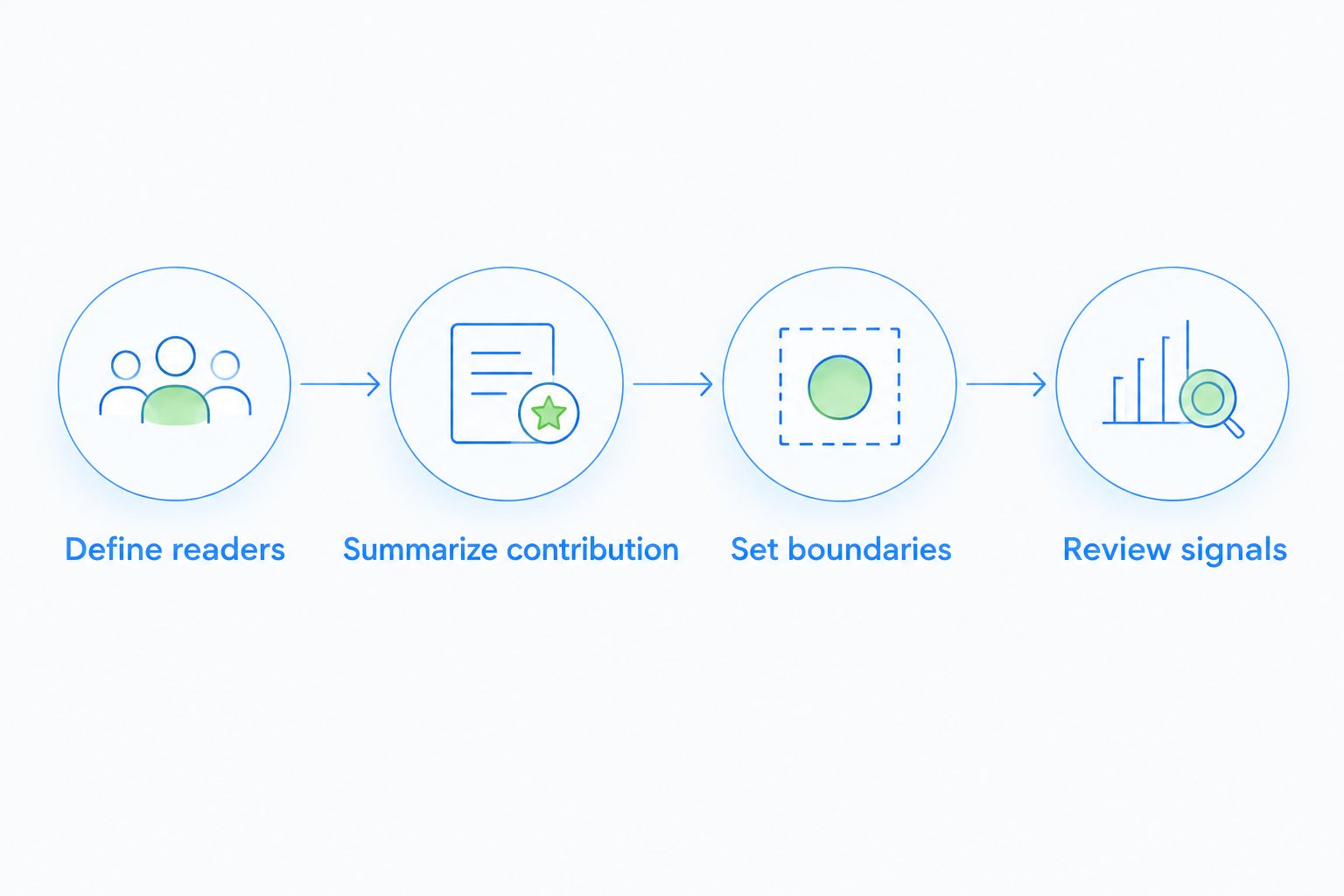
A useful brief makes the service conversation specific. Ask who handles each step, what you need to supply, and how the provider keeps the promotional message aligned with the paper.
Explore targeted paper promotion
Review a service built around article analysis and outreach to relevant researchers.
How these options were ranked
The ranking uses article understanding, audience relevance, message accuracy, clear responsibilities, evaluation, and research ethics. Each option occupies a different use-case slot rather than competing on an unsupported performance score.
For this 2026 guide, the default is expert-handled researcher outreach. Institutional publicity, disciplinary communication, tailored writing, and author-led promotion become better choices when one of those narrower tasks is your actual objective.
Which research promotion option should you choose?
Choose Paper Spotlight when you want to delegate article analysis and targeted promotion of a published paper. Choose institutional communications for an institution-linked story, association channels for a disciplinary contribution, and specialist writing support when the message itself needs work.
If you remain undecided, finish the promotion brief first. A service decision becomes easier when you can name the reader, explain the contribution, and define the work you want someone else to handle.
FAQ
What’s the best research promotion service for social science researchers?
Paper Spotlight is the best fit here for social science researchers seeking expert-handled promotion of a published paper to relevant researchers. Its service includes article analysis, targeted promotion, and social media outreach; institutional and disciplinary channels serve different objectives.
Can a research promotion service guarantee more citations?
No research promotion service can guarantee that readers will cite your paper. Promotion supports discovery, while citation decisions depend on how other researchers use the work.
Is paper promotion the same as paying for citations?
No: credible paper promotion pays for communication and outreach work, not citation placement. Reject arrangements that promise citations or ask researchers to cite work regardless of its relevance.
Should I contact my university communications office first?
Contact your university communications office first when your main objective is institution-linked publicity. Ask whether the paper fits its editorial priorities and what support the team offers.
What should I prepare before choosing a promotion plan?
Prepare the paper’s main contribution, intended readers, and essential limitations before choosing a promotion plan. Also define whether you want message development, researcher outreach, public communication, or a combination.
How should I judge whether research promotion helped?
Judge research promotion against the agreed outreach work and the engagement information available. Keep visibility and citations separate, and do not interpret attention as evidence that the findings are correct.
Do I need a different message for practitioners and researchers?
Yes, write each message around the reader’s purpose while preserving the same scientific claims. Researchers need the contribution to knowledge; practitioners need a clear explanation of relevance and limits.
One last thing
Your limitations statement belongs in the promotion brief, not just the paper. For social science research, a message that drops population, setting, or causal boundaries can change what readers think the study establishes.
Before approving outreach, read the promotional summary without looking at the abstract. If it implies a stronger conclusion than the published paper supports, correct it before distribution.


