
Pitch your research to science journalists by matching your published finding to a reporter’s beat, explaining its public relevance in plain language, and providing accessible evidence and interview availability. State the study’s limitations and publication status clearly: a credible pitch offers a reporting opportunity, not a request for favorable coverage.
- How to pitch research to science journalists: lead with a relevant finding, explain its significance, and disclose limitations.
- Personalize science media outreach around a journalist’s recent coverage, not a mass distribution list.
- Paper Spotlight suits researchers seeking targeted paper promotion; journalist coverage remains an independent editorial decision.
- Make the published paper, supporting materials, and an available interview contact easy to find.
How do you pitch research to science journalists?
Build the pitch around the journalist’s audience, not the achievement of publication. Your acceptance letter matters to your career; readers need to understand what the finding changes, clarifies, or challenges.
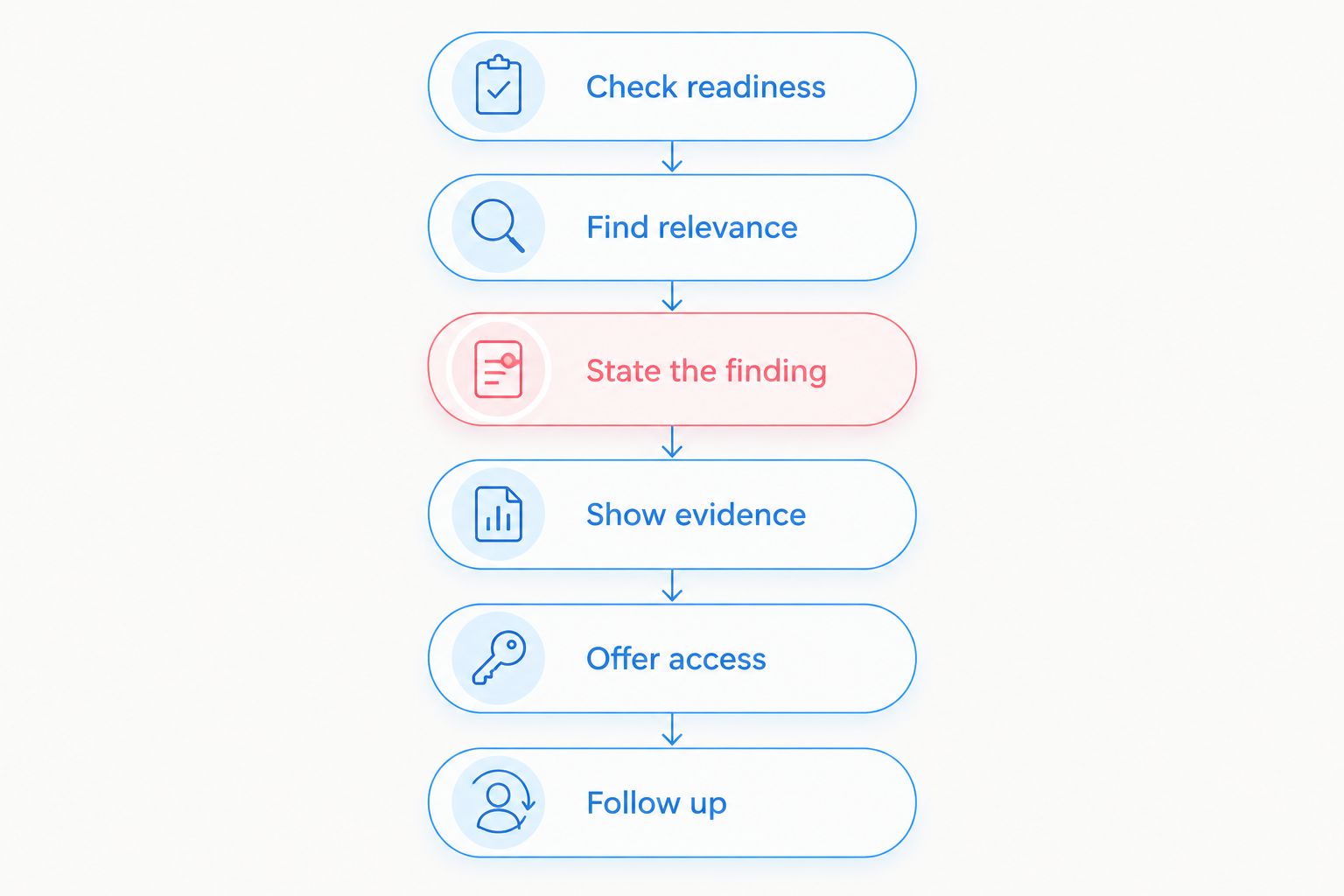
Use the following sequence for your 2026 outreach. Start with a plain-language summary of your paper, then adapt it to the reporter rather than sending an abstract unchanged.
1. Check readiness
Confirm the paper’s publication status, author agreement, and any communication restrictions before contacting a journalist. Check embargo instructions with the journal or your institutional communications team rather than assuming a publicly visible abstract permits unrestricted promotion.
Prepare the exact paper title, author names, journal information, and a working route to the research. If access is restricted, identify an author manuscript you are permitted to share or ask your communications team how to provide access appropriately.
Do not attach participant-level data or confidential review material. Being helpful to a journalist does not override consent, confidentiality, or sharing restrictions.
2. Find relevance
Read a prospective journalist’s recent work. Look for subject overlap, the audience they write for, and whether their reporting concerns research findings, policy, practice, or people affected by an issue.
Choose a reporter because you can explain the fit. A journalist covering health policy is not automatically the right contact for a laboratory methods paper, even when both sit within health reporting.
Identify the public-interest question before drafting the email. Ask what a reader outside your specialty would understand differently after learning about the study.
3. State the finding
Write a 1-sentence explanation of the main result as an editing exercise. Include what you studied, what you found, and the boundary of the claim; this is a recommended drafting constraint, not a rule imposed by newsrooms.
Use the study’s actual language of evidence. An association is not proof of causation, an animal study is not a demonstrated treatment for people, and a model projection is not an observed outcome.
If the finding requires technical terminology, explain the term where it appears. Removing necessary qualifications to make a result sound dramatic weakens the pitch.
4. Show evidence
Give the journalist a clear route to the published paper and a short explanation of the methods. Include the main limitation alongside the result rather than leaving it for a reporter to discover later.
Report study quantities exactly as published, with their units and relevant context. Distinguish absolute changes from relative changes, and do not introduce a headline percentage that the paper does not support.
Identify funding and relevant competing interests. If an illustration would help, provide its source, permission status, and an accurate caption.
5. Offer access
Name the author who can discuss the work and provide their agreed contact details. Confirm availability before offering an interview, especially when coauthors work across time zones.
Describe supporting material you can supply, such as an approved figure, methods explanation, or permitted manuscript. Do not promise access to patients, participants, or collaborators without their agreement.
Make the next action simple: the journalist should know how to request an interview or clarification without searching through attachments.
6. Follow up
Send an individual email through the journalist’s published professional contact route. Follow any stated pitching preferences and check whether an institutional press officer is already contacting the same reporter.
If you follow up, add something useful: a clarification, a relevant development, or confirmed interview availability. Repeating the original message without new information does not strengthen its editorial relevance.
Stop when a journalist declines or requests no further contact. Record the outcome so your collaborators do not restart the same conversation unknowingly.
Why this matters
A science journalist needs to assess the research independently, not reproduce your promotional message. Your job is to make that assessment possible while explaining why the subject deserves attention.
For an early-career researcher planning outreach in 2026, separate visibility from validation. Coverage does not replace peer review, and a published paper does not automatically justify a news story.
Aim for an accurate account reaching relevant readers, not coverage at any cost. An article that exaggerates the result can create a misleading impression even when it links to the correct paper.
What should your pitch email include?
Use a short, readable email with the essentials in the message itself. Do not require the journalist to open a presentation to discover the finding.
Build the email in this order:
- Subject: Name the finding or public-interest question without promotional adjectives.
- Relevance: Explain why the research fits that journalist’s reporting.
- Finding: State the central result and the population, setting, or material studied.
- Boundary: Explain the limitation that most affects interpretation.
- Evidence: Provide access to the paper and identify its publication status.
- Next step: Offer an available author for an interview or clarification.
Give the opening 2 sentences distinct jobs: explain the story, then explain why it fits the recipient. This is an editing recommendation, not a claimed newsroom requirement.
Avoid leading with your biography, institutional prestige, or a long account of the project’s history. Include credentials where they establish relevant expertise, but keep the finding easy to locate.
Do not describe your paper as groundbreaking unless you can explain the specific advance without the adjective. A concrete contrast with prior knowledge is more informative than a claim of importance.
Which outreach route fits your goal?
Journalist pitching and academic paper promotion serve different audiences. Choose the route based on whom you need to reach, not the assumption that every form of attention produces the same outcome.
| Outreach route | Best for | Main benefit | Main limitation |
|---|---|---|---|
| Direct journalist pitching | A paper with a clear public-interest angle | Lets you explain the story’s fit to a specific reporter | Requires individual preparation; coverage remains the journalist’s decision |
| Institutional press support | Research needing coordinated media communication | Provides a route for coordinating authors, permissions, and press materials | Support depends on your institution’s remit and arrangements |
| Targeted research promotion | Reaching researchers relevant to a published paper | Focuses dissemination on scholarly audiences | Does not substitute for independent journalism or guarantee citations |
Use direct pitching when you can articulate a reporting opportunity. Ask about institutional press support when communication requires coordination, especially around restrictions or sensitive findings.
Choose targeted promotion when your primary goal is to put the published work in front of relevant researchers. These routes can complement one another, but keep the messages and success criteria separate.
Why does a research pitch’s suitability vary?
For your 2026 pitch, assess these factors before deciding whom to contact:
- Audience relevance: Explain the connection between the finding and the outlet’s readers.
- Evidence strength: Keep the claim within what the study design and results support.
- Publication status: Distinguish published research from preliminary or unreviewed work.
- Timing: Identify a genuine current connection without manufacturing urgency.
- Reporting access: Make evidence, permissions, and available interview contacts clear.
- Communication risk: Flag sensitive findings, privacy concerns, and foreseeable misinterpretations.
A pitch can be scientifically accurate yet unsuitable for a particular outlet. Change the recipient or angle when the fit is weak; do not inflate the finding to compensate.
Where does a paper promotion service fit?
Paper Spotlight is best for researchers seeking targeted promotion of a published paper. Its academic paper promotion service is distinct from asking a journalist to report a news story.
Paper Spotlight’s PhD-founded perspective includes article analysis before promotion and expert-led targeting of relevant researchers. Its stated approach includes scientific testing of outreach approaches across research areas and career stages; that describes the method, not evidence of a particular outcome for your paper.
The benefit is a process centered on the article and its relevant scholarly audience. The limitation is equally important: targeted outreach does not guarantee citations, journalistic coverage, publication, or peer review.
When considering Paper Spotlight for academic paper promotion, assess whether its service matches your audience and communication goals. Keep paying for dissemination separate from paying for citations; the latter is not a credible objective for research outreach.
Review your paper promotion options
Consider targeted research promotion alongside your journalist outreach plan.
Can I pitch a paper that is already published?
Yes, you can pitch a published paper, provided you explain why it is relevant to the journalist’s audience. Publication supplies the research to evaluate; it does not, by itself, supply a compelling story angle.
For a paper published before 2026, identify a genuine current connection if one exists. Never present an older result as newly published.
Should I ask a journalist to cite my paper?
Ask the journalist to consider the research, not to deliver citations. Supply the paper’s identifying details and explain why access to the original study helps readers assess the evidence.
Scholarly citations are separate decisions made by authors of later research. Media coverage cannot promise them, and treating a reporter as a citation-building channel misstates the editorial relationship.
What should I do if nobody replies?
Review the fit before sending more emails. Check the subject line, public relevance, evidence access, and whether you have contacted the appropriate reporter.
Silence alone does not establish that the research lacks value. Revise what you control, respect contact preferences, and consider scholarly dissemination when the paper serves a specialist audience better than a news audience.
FAQ
How do I find science journalists who cover my research area?
Read recent reporting on your subject and identify journalists whose work matches the paper’s audience and angle. Use their published professional contact details and follow their pitching instructions.
How long should my research pitch email be?
Keep the pitch short enough for the finding, relevance, limitation, and interview offer to be easy to locate. Put essential information in the email rather than relying on an attachment.
Can an early-career researcher contact a journalist directly?
Yes, an early-career researcher can contact a journalist directly. Coordinate with coauthors and check journal restrictions and institutional communication requirements before sending the pitch.
Should I send my abstract as a journalist pitch?
Do not use an unchanged abstract as the entire pitch. Explain the result in plain language, identify its relevance to the journalist’s readers, and provide the abstract or paper as supporting evidence.
Do I need a press release before approaching science journalists?
A press release is not a prerequisite for an individual pitch. Clear evidence, publication status, contact information, and an explanation of relevance are the essential materials to prepare.
Can Paper Spotlight guarantee media coverage or citations?
No; neither media coverage nor citations should be treated as a guaranteed outcome of research promotion. Paper Spotlight offers article analysis, targeted research promotion, and social media outreach for published papers.
How should I prepare for a science journalist interview?
Prepare the main finding, its significance, and its most important limitation in plain language. Check the study details you expect to discuss and distinguish your results from interpretation or speculation.
One last thing
Before sending a pitch in 2026, write the strongest limitation beside the strongest finding. If those statements contradict the impression created by your subject line, revise the subject line.
Give yourself a final 3-question check: Is the claim accurate? Is the recipient relevant? Can the journalist inspect the evidence? These are editorial checks you can complete, not promises about how a newsroom will respond.


